

In August 1990, days after Iraq invaded and conquered Kuwait, British Prime Minister Margaret Thatcher pressed President George H. W. Bush on taking decisive military action. Bush agreed, but when he at first deferred to the United Nations for support, Thatcher challenged him, and famously said, “This is no time to go wobbly, George." Less than six months later, the United States and allies launched the Gulf War, and within a few weeks, Kuwait was liberated, Saddam’s forces were routed, and the Iraqi threat was, for a time, neutralized.
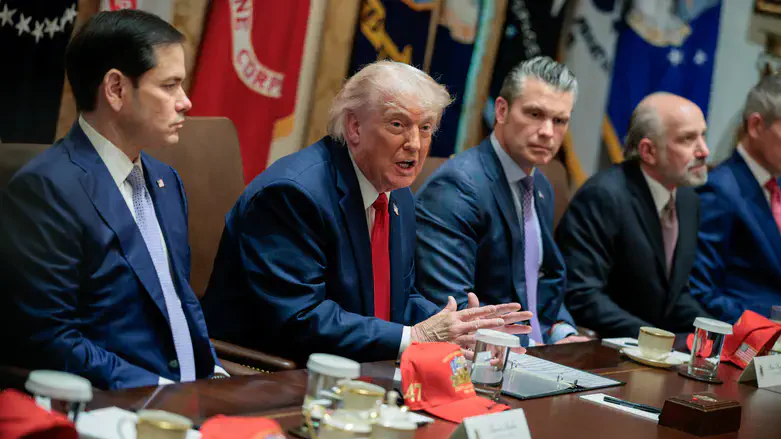
Donald Trump has gone wobbly. Lacking another world leader with the fortitude of Mrs. Thatcher, Mr. Trump lacks any counterforce and thus is torn between several of his more engaged advisors - some of whom are obviously pained and troubled by the deal with Iran - and his more isolationist advisors, who want to cut US losses and run, not to mention the advisors who see the buisnes opportunities. Across the world, Britain’s Prime Minister Keir Starmer is the anti-Thatcher, Europe’s leaders are docile and primed for appeasement, Russia and China can sense American impotence, and the Gulf States fear Iran more than they respect the United States.
The only world leader who still wants to defeat the menace of radical Islam is Binyamin Netanyahu, who has now been set up by Trump as the scapegoat if the agreement with Iran fails, no matter the reason. It can fail because Israel will still not accept an Iran with extensive ballistic missile capabilities (something that Trump has now accepted), because Israel will not withdraw from the land it has freed from Hezbollah domination in southern Lebanon, because Israel cannot accept the remilitarization of Iran’s terrorist proxies, or because Israel is unconvinced of Iran’s sincerity in abandoning its nuclear weapons program.
Indeed, to anyone who does believe that Iran will voluntarily disavow its nuclear program, I would gladly sell them a bridge in Brooklyn that can be renamed the Trump Bridge.
Trump’s concessions are quite flabbergasting. He has already conceded that the 60-day deadline is not final. The Iranian negotiators, masters of procrastination and obfuscation, are playing Trump and will simply delay as long as necessary, knowing the resumption of war is unlikely and especially having received sanctions relief that will enable them to feed their fighters and spread their terror.
More stunning are two admissions that Trump made during his press conference on Wednesday: that the United States never thought that Iran would close the Straits of Hormuz or launch attacks on the oil infrastructure of its Gulf neighbors.
It is hard to underestimate the level of unpreparedness this reflects. Was a US attack on Iran never war-gamed? The essence of war gaming is anticipating the possible responses of the enemy, who, after all, also has a say in how the war is conducted. Was this not done - or, worse, was it done, but Trump simply ignored it because he admittedly prefers to rely on his own instincts?
This fiasco was compounded by two great failures of the US military.
The first was the inability to reopen the Straits of Hormuz to international shipping, dubbed Operation Project Freedom, which was aborted before it began. Ultimately it does not matter whether the Straits remained closed because of the United States’ lack of capability or lack of willpower to reopen them, willpower being an essential element in the conduct of warfare.
This failure emboldened Iran, which now knows that it can open and close the Straits at will, thus disrupting the global economy. Israel may soon be facing Iranian demands such as withdraw from Lebanon and Gaza, divide Jerusalem, or establish a Palestinian Arab state - or Iran will close the Straits of Hormuz to world shipping. If that occurs, that will be a Donald Trump legacy.
The second failure - just as staggering - was the United States’ inability to protect its Gulf allies from Iranian attacks that caused extensive damage to land and infrastructure. It is incomprehensible that these Gulf kingdoms - purchasers of hundreds of billions of dollars in American weapons over the decades - could not protect their own territory. Even more egregious was the reluctance to respond in kind to Iran’s infrastructure, now rendered sacrosanct and off limits to attack, purportedly to allow the Iranian people a greater chance at prosperity once the regime collapsed. There is little chance of that happening now.
Trump going wobbly - when Iran was weakened as never before - has succeeded only in empowering and enriching Iran, heartening the enemies of America and Israel, and intimidating the Gulf states in casting their destiny with Iran and not with the West. And all to save a dollar a gallon in the price of oil or seriously plan on fighting history’s first casualty-free war or chase the chimera of retaining Republican control over Congress this autumn.
A sagacious Israel should realize the limits of American support and prioritize its own interests, as all countries do. This includes not only the judicious use of the word “no," when the demand is made that we withdraw again from Lebanon but also our demand that the American military base outside Gaza be shuttered forthwith. There is absolutely no good that will come to Israel by having American forces on its soil. If anything, they will limit our freedom of action to fight terror.
That being said, the attack on Iran was still useful. It halted Iran’s march to the bomb and greatly weakened Iran’s proxies. Israel is far better situated now than before the war. But Iran saw and sees through Trump’s blustery threats, including the vacuities about resuming the bombing in sixty days. Bombing is a tactic, not a strategy; it would be helpful if Trump could articulate a strategy. Today Iran mocks him as it once did Obama.
Trump was so desperate for an agreement that had Iran asked the US to pay for 444 days of room and board for the American hostages it held in the late 1970’s, Trump would have paid, plus interest.
Donald Trump has a penchant for being liked, sometimes by the most unsavory people. Without a Thatcher to goad him into not going wobbly, he has gone wobbly, and bigly. He would be wise to learn from another saying of Margaret Thatcher: “If you set out to be liked, you would be prepared to compromise on anything at any time, and you would achieve nothing."
That, for now, is Donald Trump’s Iran legacy. A lot of bombs bursting in the hot air of empty threats, curses, and braggadocio. Indeed, it wasn’t the “crazy lunatics" who surrendered, but the self-proclaimed “high IQ genius," outwitted by a gang of murderous thugs, a surrender that has shamed the United States and strengthened the enemies of freedom.
What he does not realize is that the “Guardian of Israel neither slumbers nor sleeps" (Tehillim 121:4). The rest is in our hands, to live as G-d intended, as our existence is more secure than that of Donald Trump, or JD Vance.
Rabbi Steven Pruzansky, Esq. serves as the Senior Research Associate for the Jerusalem Center for Applied Policy (JCAP.ngo), and the Israel Region Vice-President of the Coalition for Jewish Values.