
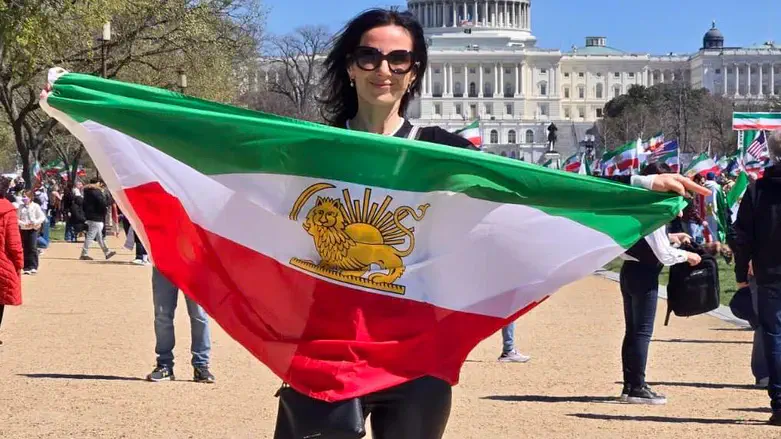
Negar Karamati is a journalist and former Persian language news editor, and an anchor who works in the legal field. She writes on Iran‘s political and social issues, including women's rights and Iran's religious minorities, particularly the Baha’i.
With the 2026 FIFA World Cup now underway, football has once again become far more than a sporting event for Iranians. What unfolded during Iran’s recent match against New Zealand in the United States was not simply a game. It became a public display of identity, memory, and political dissent.
For decades, the Islamic Republic has attempted to use international sporting events as instruments of legitimacy and national representation. Yet many Iranians, particularly those living abroad, increasingly reject the notion that the national team represents the nation itself. For them, the distinction between Iran and the ruling regime has become impossible to ignore.
The atmosphere surrounding the match reflected that reality. Thousands of Iranian-Americans and members of the Iranian diaspora arrived carrying the historic Lion and Sun flag, a symbol many associate with Iran’s long national history and cultural identity. Although FIFA regulations reportedly restricted the display of certain political symbols inside the stadium, many attendees found creative ways to bring the flags with them. What appeared outside the gates as an ordinary sporting crowd soon transformed into a sea of Lion and Sun banners inside the venue.
Videos and photographs rapidly spread across social media, revealing thousands of flags and shirts bearing the historic emblem. For many attendees, the display represented more than nostalgia. It was a statement that Iran’s identity extends beyond the ideology of the Islamic Republic.
The controversy intensified when FIFA officials reportedly moved through sections of the stadium removing some flags and banners (as they did with Israeli flags, but not PA flags). Many Iranian spectators viewed these actions as politically motivated and inconsistent with the principles of free expression they associate with democratic societies. Critics argued that FIFA’s approach demonstrated a troubling misunderstanding of the historical and cultural significance of the Lion and Sun symbol, which long predates the establishment of the Islamic Republic.
The most dramatic moment came during the playing of the Islamic Republic’s national anthem. Large sections of the crowd responded with boos and chants, while others displayed images of Iranians killed during recent anti-government protests. The stadium became a platform for political expression as much as athletic competition.
Many participants also carried photographs and banners commemorating victims of Iran’s latest wave of unrest. For them, the match provided a rare international stage to remind the world that their political struggle continues despite diplomatic developments, shifting international priorities - in short, President Donald Trump's abandonment of the Iranian people.
While President Trump has presented renewed engagement with Tehran as a diplomatic achievement, many regime opponents view such efforts very differently. Among segments of the Iranian diaspora, there is a growing sense of disappointment and betrayal. They believe that Washington is once again prioritizing negotiations and stability over accountability for a government they hold responsible for decades of repression.
Whether that perception is entirely fair is almost beside the point. What matters politically is that it exists. Many Iranian-Americans increasingly feel that Western governments continue to negotiate with the very authorities who have brutally suppressed democratic aspirations inside Iran.
That frustration was visible throughout the match. Chants, flags, banners, and social media campaigns reflected a growing patriotic movement centered not on the Islamic Republic but on the idea of Iran itself. The message from many attendees was unmistakable: support for the nation does not mean support for the regime.
Ironically, the event may have produced the opposite outcome from what Tehran intended. Sporting events have often been used by authoritarian governments to project unity and legitimacy. Yet the images emerging from the stadium told a different story. Rather than showcasing national solidarity behind the Islamic Republic, the match highlighted the deep divide between the regime and many Iranians at home and abroad.
Football remains one of the few arenas where politics, identity, and emotion collide before a global audience. In this case, the crowd transformed a sporting contest into something much larger. The match became a referendum on national identity, a demonstration of political dissent, and a reminder that millions of Iranians continue to separate their love of country from the government that claims to represent it.
For one evening in America, the most powerful symbol in the stadium was not the scoreboard. It was the reappearance of the Lion and Sun-and the message carried by thousands who raised it.
The Iran-New Zealand match in the United States became far more than a football game; it evolved into a public display of national identity and political dissent among Iranians.
What was expected to be a sporting event quickly transformed into a platform for patriotic expression and political protest.
The atmosphere also reflected the frustration and disappointment felt by many opponents of the Islamic Republic toward President Trump’s renewed engagement with Tehran. As a result, the match became not only a demonstration of support for Iran as a nation, but also a visible expression of the growing divide between the Iranian people and the ruling regime.
Ultimately, what Tehran may have hoped would serve as a propaganda opportunity through football and the national team produced the opposite effect.
Rather than showcasing national unity behind the Islamic Republic, the event highlighted a resurgence of Iranian patriotism and opposition sentiment, turning a football match into a powerful political statement before a global audience.