
Recent diplomatic developments have once again placed before us an age-old Torah question. President Donald Trump recently declared that without the United States-and without his own actions-Israel would not exist. He further stated that without his intervention Israel "wouldn't be around for two hours." Whatever one's political views, such remarks compel us to ask:
Upon whom does the Jewish people ultimately rely?
At the same time, reports of the fourteen-point Islamabad Memorandum of Understanding concerning Iran, including proposals for a ceasefire, a period to address Iran's nuclear programme, and extensive reconstruction funding, have raised serious concerns. Whether or not every detail is ultimately implemented, such initiatives reflect a familiar pattern in international diplomacy-the hope that concessions can moderate those who openly seek Israel's destruction.
History has repeatedly shown how dangerous such hopes can be.
The Torah does not teach us to reject diplomacy, nor does it deny the value of loyal friends among the nations. On the contrary, the Torah demands gratitude, Hakarat HaTov. We acknowledge every act of kindness shown to the Jewish people, and we express sincere gratitude to those who stand with Israel in times of danger.
But gratitude is not dependence, and appreciation must never replace trust in Hashem.
This is not a new challenge. Throughout Tanach the prophets warned against placing ultimate confidence in military alliances rather than in the Almighty. The prophet Yeshayahu rebuked those who looked to Egypt for security instead of turning to Hashem:
"Woe to those who go down to Egypt for help, who rely upon horses, who trust in chariots because they are many, and in horsemen because they are very strong, but do not look to the Holy One of Israel, nor seek Hashem." (Yeshayahu 31:1)
Jewish history has reinforced that lesson time and again. Before the Six-Day War, France was Israel's principal supplier of military aircraft and strategic equipment. Successive governments believed that this alliance provided a dependable safeguard. Yet, on the eve of war, President Charles de Gaulle imposed an arms embargo, leaving Israel to confront an existential threat with far less support than it had expected.
The lesson has never changed. Nations have interests. Interests change. Governments change. Leaders change. Only the Ribbono Shel Olam does not change.
David HaMelech expressed this truth in words that have echoed throughout Jewish history:
"Some trust in chariots and some in horses, but we call upon the Name of Hashem our God." (Tehillim 20:8)
And again he warns:
"Do not put your trust in princes, nor in mortal man, in whom there is no salvation." (Tehillim 146:3)
These verses are not a call to passivity. The Torah requires responsible hishtadlut. We are commanded to protect life, prepare wisely, strengthen our defences, and confront those who seek to harm us. David HaMelech himself took five stones, placed one in his sling, and went out to face Goliath. He prepared exactly as he was obligated to prepare, yet he proclaimed with complete confidence:
"For the battle belongs to Hashem." (I Shmuel 17:47)
This is the Torah's model: we do everything within our power, while recognising that victory comes only from the Almighty.
The Ramban teaches at the conclusion of Parashat Bo that the revealed miracles recorded in the Torah are meant to open our eyes to the hidden miracles that accompany us every day. Behind political developments, military achievements, diplomatic initiatives and unexpected turns of history stands the guiding hand of Hashem. Human beings are His messengers; they are never the source of our salvation.
This understanding also shapes the way we view efforts to negotiate with regimes that openly proclaim their desire to destroy Israel. The Jewish people know from bitter experience that lasting peace cannot be built upon illusions. Peace is sustained by moral clarity, by strength used responsibly, and by the unwavering determination to defend innocent life. Appeasement has too often promised security while inviting greater danger.
Israel must therefore preserve both the right and the ability to defend itself whenever necessary. Friends should be valued, alliances should be respected, and kindness should always be acknowledged. But no foreign government can become the foundation of Israel's security.
We owe genuine Hakarat HaTov to every nation and every leader who has stood with Israel in difficult times. That gratitude is both proper and required by the Torah. Yet no Jew believes that the eternity of Israel depends upon any president, parliament or superpower. These are the means through which Hashem may choose to act; they are never the Source.
For more than three thousand years, mighty empires have risen and fallen. Egypt, Assyria, Babylon, Persia, Greece and Rome all believed themselves invincible. They have become chapters in history, while Am Yisrael continues to live. That alone should remind us of where our confidence truly belongs.
Every Jew recites the words of David HaMelech:
"Behold, the Guardian of Israel neither slumbers nor sleeps." (Tehillim 121:4)
Those words have accompanied our people through exile, persecution, and war. They are no less true today.
Israel must continue to strengthen its defences, exercise wisdom and courage, and preserve its ability to protect its citizens. At the same time, we should strengthen our commitment to Torah and mitzvot, deepen our tefillah, and reinforce the unity of our people.
As the prophet Zechariah declared, "Not by might, nor by power, but by My Spirit, says Hashem of Hosts."
That is the foundation of Jewish survival. We are grateful for every friend, but our trust belongs to Hashem alone. He guided our fathers, He sustains us today, and He will continue to watch over His people, for the true Guardian of Israel neither slumbers nor sleeps.
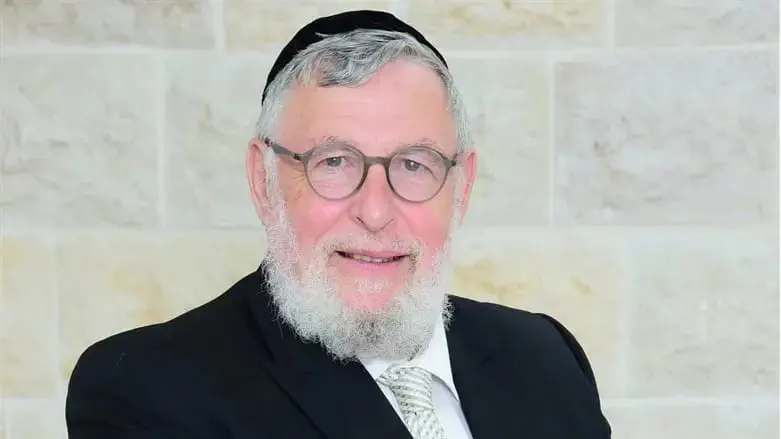
Rabbi Eliezer Simcha Weisz is a member of Israel's Chief Rabbinate Council.