
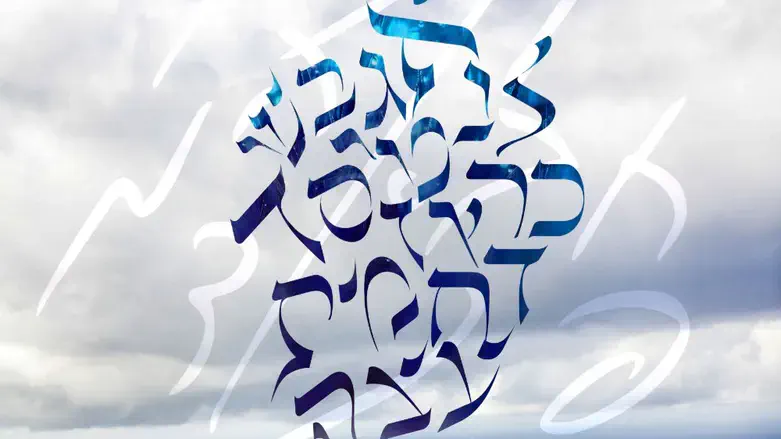
An upcoming summer seminar in the Golan Heights invites participants to discover their letter in the Torah and to connect to its meaning in an active holistic manner. The retreat for English-speaking religious couples led by Rabbi David Samson (RabbiSamson@gmail.com) will explore the inner world of the Hebrew letters through Rabbi Kook’s treatise “Rosh Millin."
Rabbi Samson’s wife, Adi, will be joining the team of professionals directing the in-depth workshop. Through text study, meditation, reflection, conversation, and couples’ interaction, each participant will hopefully encounter the unique letter each individual soul carries from the Torah, discovering the deeper purpose and voice revealed through it.
The seminar will take place July 12-14, 2026 (27-29 Tamuz, 5786) at the Hispin Hotel, Golan Heights.
To learn more about the seminar and the mystery of Hebrew letters, I asked Rabbi Samson some questions:
What is the book “Rosh Millin?"
“Rosh Millin" is one of Rabbi Kook's most profound and esoteric works. On one level, it is a meditation on the Hebrew letters and words themselves. But at a deeper level, Rabbi Kook is exploring how language serves as a bridge between the inner world of the soul and the outer world of action. The Hebrew letters are not merely symbols used to communicate ideas. They are vessels through which Divine Creativity enters the world. Rabbi Kook invites us to pay attention not only to what we think, but to the spiritual roots of thought itself.
For me, “Rosh Millin" is ultimately about learning to listen more deeply - to language, to Torah, to the unique voice of one's own soul and to the soul of one’s spouse.
What does it mean that every person has his or her own letter?
Our tradition teaches that every Jew has a unique letter in the Torah. I do not understand this merely as a poetic image. Each person carries a unique spiritual mission, a distinct perspective, and a particular contribution that no one else can make in exactly the same way. Just as a Torah scroll is invalid if even one letter is missing, the Jewish people are incomplete when individuals fail to bring their unique gifts into the world. Many people spend years trying to become someone else. Rabbi Kook's teachings encourage us to discover who we actually are.
How can an understanding of one's letter bring greater happiness and a better marriage?
A great deal of unhappiness comes from living according to expectations that are not truly our own. When people become more aware of their own "letter," they gain greater clarity about their strengths, limitations, values, and purpose. This has the power to transform relationships. Many marital conflicts arise when spouses unconsciously expect each other to think, feel, and respond in the same way. Recognizing that each person embodies a different "letter" creates greater respect and curiosity. Instead of asking, "Why aren't you more like me?" we begin asking, "What is the unique gift that you bring?" That shift alone can have a profound effect on a marriage.
What role do the meditation sessions play in the workshop?
The meditation sessions are not an escape from Torah learning. They are a way of helping participants internalize what they learn. We live in an age of constant distraction. People are exposed to an enormous amount of information but often have little opportunity to absorb it deeply.
Meditation creates space for reflection, self-awareness, and listening. It helps participants move from understanding an idea intellectually to experiencing it personally. The goal of Jewish meditation is not to empty the mind, but to create enough inner quiet to hear dimensions of Torah and of oneself that are often drowned out by the noise of everyday life.
You held a seminar last summer on the theme of T'shuva. What reactions did you receive from participants?
A reaction that stood out was how relieved participants felt to encounter Rabbi Kook's understanding of T'shuva. Many people associate repentance with guilt, self-criticism, or feelings of failure. Rabbi Kook presents a much larger vision. T'shuva is the soul's movement toward wholeness. It is the process of becoming more fully who we are meant to be.
Participants often reported leaving with greater hope, greater self-acceptance, and a renewed sense of purpose. Rather than feeling judged, they felt that a door had opened into a process of growth.
Rabbi Kook wrote about the importance of learning the deeper dimensions of Torah in our era of Redemption. Is this something for everyone?
I believe Rabbi Kook would answer yes, but not necessarily in the same way for everyone. The deeper dimensions of Torah are not reserved for a spiritual elite. They address questions that every person faces: Who am I? Why am I here? What is the meaning of Jewish life? How do I encounter God in the modern world?
Of course, people differ in temperament, background, and readiness. Some connect to God through study, others through prayer, meditation, creativity, or acts of kindness. The goal is not that everyone become a mystic. The goal is that every person discover the inner dimension of Torah that can illuminate their own life.
One of the remarkable features of our generation is that many teachings that were once hidden are now widely accessible. The challenge is no longer access to wisdom. The challenge is learning how to integrate that wisdom into daily life.