
“We need to come on Aliyah so I can take part in this every month," one of the more than 100 women of all ages said to me smilingly at the OU Rosh Chodesh Tammuz Seminar yesterday (Tuesday). The two of us were enjoying a bagel and salads buffet as well as Jerusalem’s pleasant spring sunshine during a break in the morning’s seminar schedule at the Rechavia neighborhood’s Hanassi Shul.
Of course, the vast majority of those attending had already made their homes in Israel, and the quality of the morning’s program is one of the many reasons women living in Eretz Yisrael, the Holy Land, find so much meaning in daily life. In fact, Rosh Chodesh seminars are just one of many events women can choose from throughout each month.
Rosh Chodesh is traditionally a women’s holiday, a reward for women not taking part in the Sin of the Golden Calf following the Giving of the Torah at Mount Sinai. Many women refrain from certain household tasks on Rosh Chodesh and most Ulpenot (religious Israeli girls’ high schools) have only a half day of classes. What more natural than the OU making it a special day of study for women Anglos, planned to enrich their lives - and I quote - from a "halakhic, hashkafic, Tanach, and personal" perspective?
And what topic could be more fitting at this difficult time than “Ahavat Chinam (unconditional love): Breaking the Walls that Divide Us" - not the walls of Jerusalem that were breached on the 17th of Tammuz nor the walls we erect to protect our loved ones and the mesora we pass down to them, but the walls between different sectors - walls that crumbled on October 7th, the walls we must make every effort not to rebuild, as Aliza Back, OU Israel Jerusalem Women’s Division Education coordinator said in her erudite introduction. Setting the atmosphere of warm camaraderie mixed with intellectual curiosity, Zemira Ozarowski, Director of the OU Woman’s Division, then spoke enthusiastically about the Rosh Chodesh women’s event in Tsfat from which she had just returned. Helping things run smoothly were young National Service volunteer Evey Birenbaum and logistics coordinator Zimra Garfinkel.
The program began with a musical Hallel led by Avigail Scheinfeld, whose melodious rendition of the entire tefillah accompanied by Malka Leah Weiss on the organ, was enhanced by the audience’s singing (and the adorable clapping of Avigail’s toddler - who seems as musical as her mom!).
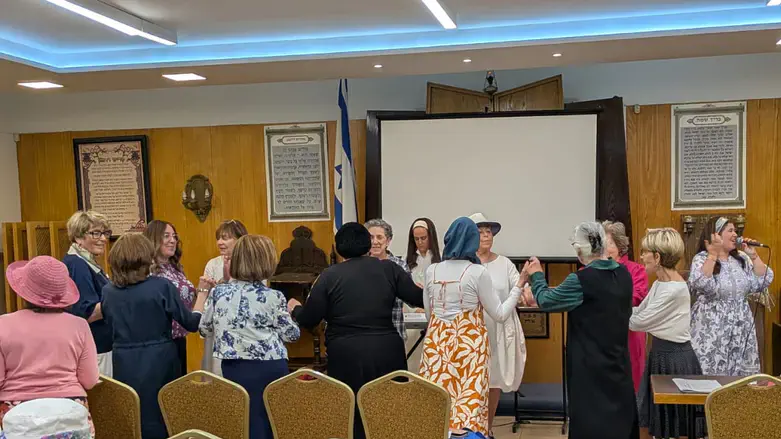
One could not help thinking of the Prophetess Miriam leading the women in song and dance at The Red Sea, the more so because the emotional tefillah acted as an infectious catalyst for the spontaneous dancing to well-known songs that followed it, ending with the one made famous during this war - “Od yoter tov - it will get even better!"
When the dancers returned to their seats, they were treated to an enlightening shiur on the Core of Chessed by popular lecturer Rabbanit Shira Smiles, a talk filled with her usual wisdom and gentle humor and accompanied by an impressive list of sources. (Here is just one gem: One of the nice things about Israel is how perfect strangers greet you with “Shabbat Shalom" when you cross paths on Shabbat, but beyond that - do you listen to the answer when you ask someone “How are you?" Rabbanit Smiles told of a friend who made it a practice to answer “bananas" when asked how she was and how no one ever noticed! ...So those bananas are food for thought…)
Rabbanit Miriam Tannenbaum’s thought-provoking shiur "Ahavat Chinam, Problems and Possibilities" led to a lively discussion on dealing with the difficult dilemma of hating evil but not the evil doer, and how that distinction can be applied and taught to one’s children.
Introducing the last speaker, Aliza began with the story of how at the start of the war, her son was sent home from school for acting up - a situation sadly familiar to all the mothers and grandmothers present - and how she took him bowling to release some of his tension. The two of them and another father and young son doing the same were the only ones bowling that morning. It was only later, when she saw the pictures of the hostage families, that she realized that the father was Dr. Tzvika Mor, who had found the strength to take his young son out to relax although his older son Eitan was being held in the Gaza Strip - this while not yet knowing if Eitan, who returned home after 738 days of barbaric imprisonment, was alive or dead.
“From Personal Pain to Jewish Strength" was the apt title of the riveting power point lecture from this inspiring man who founded the Tikva Forum, a man who overcame his personal pain in order to fight to persuade the government to gain freedom for the hostages without giving in to Hamas threats and demands.
And it was also the perfect way to round off an inspiring and interesting start to the month of Tammuz.
May we overcome the obstacles on the way to Redemption and merit fulfilling the Prophet Zecharia’s words: “The fasts of the fourth, fifth, seventh and tenth months will become joyful and glad occasions and happy festivals for Judah. Therefore, love truth and peace."