

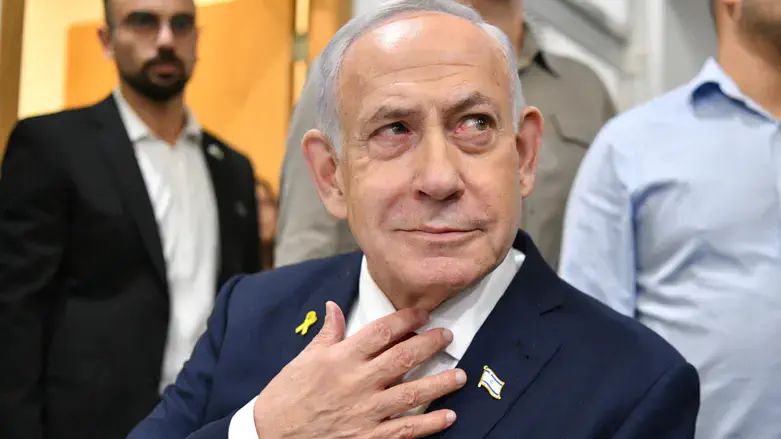
Prime Minister Benjamin Netanyahu's cross-examination concluded on Tuesday after months of testimony in his ongoing trial.
The final hearing focused largely on Case 2000 and was marked by a tense atmosphere, including several heated exchanges between Netanyahu and members of the prosecution team.
At the outset of the session, Netanyahu challenged the basis of the charges related to his contacts with Yedioth Ahronoth publisher Arnon (Noni) Mozes.
“Raz Nizri, then deputy attorney general, said at the time that he did not think a crime had been committed, so how was I supposed to know there was an offense here? Even Reuven Rivlin was shocked by that claim. Who ever thought that interactions between a politician and the media constituted a criminal offense? This is something you invented. You are trying to create a retroactive offense," Netanyahu said.
Later, Netanyahu was questioned about what he described as pressure exerted by Mozes. According to the Prime Minister, “Giving you front-page stories or threatening you is the practice of all journalists. I wanted to record the fact that he was interfering in this matter."
Netanyahu argued that his dealings with Mozes were part of a broader struggle surrounding efforts to advance legislation affecting the Israel Hayom newspaper.
The prosecution sought to highlight what it described as inconsistencies between Netanyahu’s current testimony and statements he gave to police investigators. Attorney Yoni Tadmor asked whether coverage he received in Yedioth Ahronoth concerned him at the time.
“No," Netanyahu replied.
When asked again whether media coverage did not concern him even during election periods, he answered: “I did not pay attention to the coverage at all. What interested me was how to save the newspaper and how to reach a softened version of the law."
The prosecution then presented excerpts from Netanyahu’s police interrogations in which he described his interactions with Mozes differently. Asked about those statements, Netanyahu said he was attempting to prevent harm to himself and his family.
When Tadmor suggested that this amounted to an effort to influence media coverage, Netanyahu responded angrily: “This is not coverage; these are smears. As Raviv Drucker said-and Raviv Drucker again-it goes beyond every limit."
The sharpest confrontation came when prosecutors argued that recordings of Netanyahu’s conversations with Mozes reflected a bribery proposal that was never rejected. Netanyahu firmly denied the allegation and launched a blistering attack on the prosecution.
“You collect targets. You will spend your entire lives in court. There has never been anything like what you did to me. It is disgraceful. What you did to me, you did not do to any other public official. You brought everyone into a network of intimidation and terror. Everyone I speak to asks me, ‘What are you, a police state? The Stasi?’ What you did here was try to bring down Netanyahu. You found nothing. What we have here is political persecution like in a police state," he said.
He later added: “You can speak innocently all you want-you found nothing. This is a gross injustice. You criminalized every connection. I could not have thought this was bribery. What we see is Mozes acting in his own interest, not in the public interest."
In the final portion of the hearing, prosecutor Yehudit Tirosh pursued a line of questioning aimed at linking issues raised in Case 2000 to allegations in Case 4000. Tirosh argued that in both instances Netanyahu acted in response to matters related to media coverage.
Netanyahu rejected the comparison.
“I did not hear from Elovitch. Mozes came with all of his political power, took away my coalition, and it was clear I had to deal with him. If I told him, ‘I’m not talking to you,’ he would do whatever he wanted. I entered into a struggle with him. Not as part of negotiations. He was trying to shut down Israel Hayom, this means of expression, and I fought him," he said.
With the conclusion of Tuesday’s hearing, Netanyahu’s cross-examination has officially ended. The next stage is expected to include questioning by attorneys representing Arnon Mozes and Shaul Elovitch, followed by redirect examination by Netanyahu’s defense team.
If proceedings continue as scheduled, the Prime Minister’s testimony is expected to conclude in the coming weeks.