
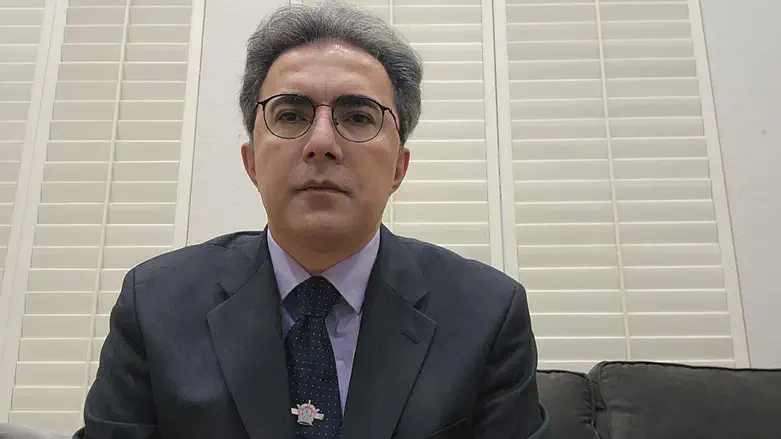
Erfan Fard is a counterterrorism analyst and Middle East studies researcher based in Washington, with a particular focus on Iran, Islamic Terrorism, and ethnic conflicts in the region. His father, mother, and two brothers live in Iran. His latest book is The Black Shabbat , published in the US. You can follow him at erfanfard.com and on X @EQFARD or www.ErfanFard.com.
On the eve of his 80th birthday, President Donald Trump announced a new agreement with the Islamic Republic of Iran and presented it as a diplomatic achievement that demonstrated the effectiveness of pressure, deterrence, and negotiation. Supporters of the agreement will undoubtedly portray it as evidence that American resolve succeeded where previous administrations failed.
Yet beneath the celebrations and political messaging lies a more important question: what fundamental reality has actually changed?
For nearly half a century, successive American administrations have identified the Islamic Republic as one of the principal sources of instability in the Middle East. Republican and Democratic presidents alike cited Tehran's nuclear ambitions, sponsorship of terrorism, hostage-taking, proxy warfare, regional subversion, and ideological hostility toward the United States and its allies as major threats to international security. President Trump himself repeatedly argued during the first months of 2026 that Iran's nuclear program had to be stopped, that the regime's destabilizing activities could no longer be tolerated, and that the status quo was unsustainable.
Yet after months of confrontation, military escalation, economic pressure, and political tension, the central characteristics that produced the crisis remain largely intact.
-Iran's nuclear ambitions have not disappeared (and won't).
-The Islamic Revolutionary Guard Corps remains the dominant force within the state.
-The network of proxy organizations stretching across the Middle East continues to exist.
-The institutions responsible for repression at home and destabilization abroad remain firmly in control.
If the same regime survives with the same ideology, pursuing the same long-term objectives, it is reasonable to ask whether the agreement solved a problem or merely postponed it.
The answer matters because the Islamic Republic measures success very differently from its Western adversaries. American policymakers define success in terms of agreements reached, crises managed, and tensions reduced. Tehran defines success more simply: survival.
Since 1979, every major challenge confronting the regime has been interpreted through a single strategic principle-remain in power at all costs. Economic hardship, diplomatic isolation, military pressure, sanctions, and domestic unrest are all considered manageable so long as the system itself survives. In that sense, the Islamic Republic does not need to defeat the United States militarily in order to claim victory. It merely needs to endure.
That distinction has repeatedly been misunderstood in Washington.
While American officials often focus on immediate outcomes, the rulers of Tehran think in terms of decades. They understand that administrations change, political priorities shift, and international attention inevitably moves elsewhere. Time has frequently been one of the regime's most valuable strategic assets.
For that reason alone, Tehran's propaganda apparatus will portray this agreement as a victory. The message will be straightforward. The Islamic Republic faced enormous military, economic, and political pressure from the world's most powerful nation and yet remained standing. Whether that interpretation accurately reflects reality is less important than the fact that millions across the Middle East will hear it.
In a region where perceptions often shape political outcomes as much as military realities, the symbolism of survival carries enormous weight. The regime has spent decades transforming endurance into legitimacy and portraying every crisis it survives as proof of its historical resilience. This agreement will likely be incorporated into that narrative.
Another recurring problem in Western policy toward Iran is the assumption that changes in personalities somehow represent changes in the nature of the regime itself. For decades, outside observers have searched for moderates, pragmatists, reformers, or technocrats who might alter the behavior of the Islamic Republic. New faces emerge, factions compete for influence, and analysts rush to identify signs of transformation. Yet the underlying architecture of power remains remarkably constant.
The names may change, but the institutions endure. The rhetoric may evolve, but the ideology remains. The regime has repeatedly demonstrated an ability to adapt tactically without changing strategically. It modifies methods without abandoning objectives. It adjusts language without reconsidering its worldview. It negotiates when necessary, escalates when advantageous, and retreats when survival requires flexibility.
To interpret such adaptation as genuine moderation is to misunderstand the political logic that has sustained the Islamic Republic for nearly five decades.
This reality is particularly important for Israel. Supporters of the agreement may argue that it reduces tensions and lowers the immediate risk of conflict. That may well be true. Yet from Israel's perspective, the underlying strategic challenge remains unchanged. The regime that has financed, armed, trained, and encouraged forces hostile to the Jewish state remains firmly in power. The ideology that has fueled decades of hostility toward Israel remains intact. The institutions responsible for advancing Tehran's regional ambitions continue to function.
The immediate crisis may have been managed, but the source of the threat remains. Israeli policymakers have learned through experience that unresolved threats rarely disappear because negotiations temporarily reduce tensions. More often, they reappear later under different circumstances and at a higher strategic cost.
The implications extend beyond Israel. Arab governments throughout the Persian Gulf may welcome the reduction of tensions and the continuation of regional trade and investment. Stability offers obvious economic benefits. Yet many regional leaders are also likely to draw broader conclusions from the agreement. They will inevitably ask whether Washington remains committed to addressing long-term strategic threats or whether it increasingly prefers temporary arrangements that defer difficult decisions.
Such questions are not merely academic. American credibility remains one of the most important components of the regional security architecture. Allies watch carefully not only what the United States says, but what it ultimately chooses to prioritize.
Perhaps nowhere, however, will the consequences of this agreement be felt more deeply than among the millions of Iranians who oppose clerical rule. During the dramatic events of late 2025 and early 2026, many believed the regime was confronting one of the most difficult periods in its history. Economic pressure intensified, public dissatisfaction remained widespread, and unprecedented challenges confronted the ruling establishment.
Many opponents of the Islamic Republic concluded that meaningful political change was becoming increasingly possible. They listened to American rhetoric about pressure and accountability. They heard repeated declarations that Tehran's behavior was unacceptable. They watched events unfold and believed that the international environment might finally be shifting in a direction more favorable to their aspirations.
Instead, Iran's citizens witnessed negotiations resume with the same regime they hold responsible for repression, corruption, executions, economic decline, and decades of national suffering.
Whether that perception is entirely fair is ultimately less important than the fact that it exists. Many Iranians will interpret this agreement as further evidence that foreign governments continue to prefer stability over transformation and crisis management over fundamental political change. They will conclude that the international community remains willing to accommodate the survival of the regime so long as broader regional tensions can be contained. Such perceptions matter because they shape how future generations of Iranians view the outside world and its stated commitment to democracy, liberty, and human rights.
Supporters of the agreement will argue that avoiding a wider regional war is itself a significant accomplishment. There is merit to that argument. Military conflicts carry enormous human, political, and economic costs. Responsible leaders should always seek to avoid unnecessary wars.
Yet preventing conflict and resolving the problem that made conflict possible are not the same thing. The agreement may reduce tensions today, but it does not eliminate the strategic realities that produced those tensions in the first place. The central issues remain unresolved. The confrontation has been managed, postponed rather than settled.
There is also a broader historical lesson worth considering. The Islamic Republic did not enter negotiations because it abandoned its ambitions or fundamentally reconsidered its place in the region. It entered because negotiation offered advantages. Tehran understood that preserving the regime remained more important than confrontation. It recognized an opportunity to secure breathing room without sacrificing its core strategic objectives.
This agreement provides something the regime has repeatedly sought throughout its long confrontation with the United States: time.
Time to regroup.
Time to consolidate authority.
Time to adapt to changing circumstances.
Time to wait for political developments elsewhere.
For nearly half a century, the Islamic Republic has often succeeded not because it was stronger than its adversaries, but because it proved more patient.
Ultimately, the future of Iran will not be decided in Washington, Brussels, Moscow, Beijing, or Jerusalem. It will be determined by the Iranian people themselves. No foreign government can permanently deliver freedom to Iran, and no foreign government can permanently prevent it. The central struggle remains what it has always been: a struggle between a society seeking political self-determination and a ruling system determined to preserve itself at almost any cost.
President Trump may celebrate a diplomatic achievement, and Tehran may celebrate its survival. History, however, tends to judge such moments by a harsher standard. It asks a simple question: did anything fundamental actually change? Judging from the realities visible today, the answer appears to be no. The regime survived, the conflict was deferred, and the underlying challenge remains.
That is not a strategic resolution. It is merely another chapter in a confrontation that is far from over.