

Two 1,700-year-old marble statues depicting historical figures from the Greco-Roman world have been discovered inside a wine collection pit of a Roman-Byzantine winepress near Binyamina.
The excavation is being conducted by the Israel Antiquities Authority as part of a project to expand the Coastal Railway, led by the Ministry of Transport and Israel Railways.
One of the statues bears a Greek inscription with the name "Lycurgus." According to researchers, it may refer either to Lycurgus, the founder of Sparta, or Lycurgus of Athens, a statesman and orator from the fourth century BCE, though research is still in its early stages.
"The statues date to the Roman period, and interestingly, they were not found in their original location," excavation directors Eliran Oren and Avishag Reiss said. "They were discovered carefully placed face down inside a wine collection pit belonging to a Roman-Byzantine winepress." They added that it remains unclear why the statues were buried there, though they may have been hidden for safekeeping.
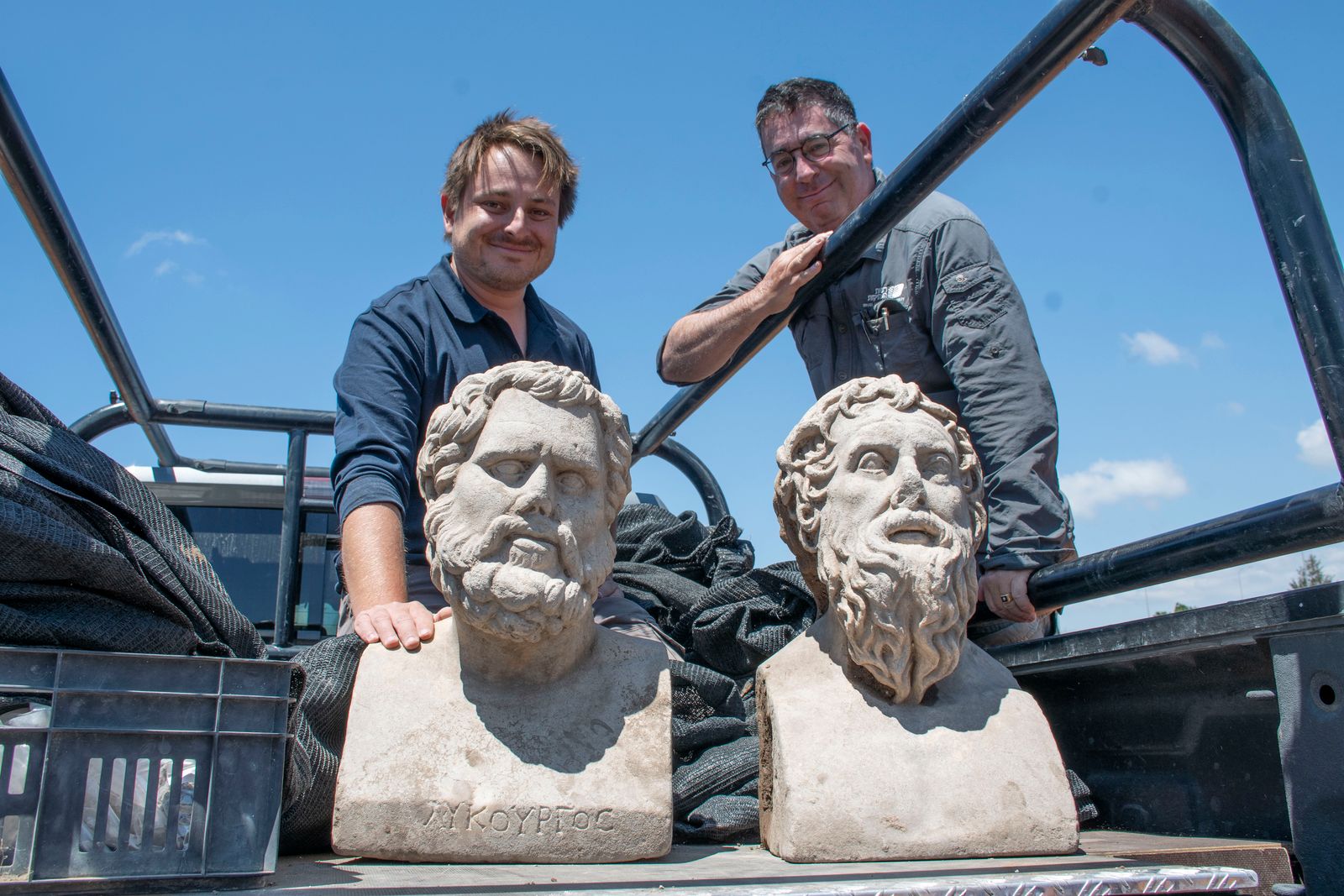
Michael Sorotzkin, an archaeologist with the Israel Antiquities Authority, recalled that workers noticed an unusual object protruding from the ground during the excavation.
"There was a feeling that we were about to uncover something that simply shouldn't have been there. Suddenly we realized it wasn't pottery-it was marble. Then, little by little, the two statues emerged. I still struggle to find the words. It's simply incredible," he said.
According to Dr. Peter Gendelman, the Israel Antiquities Authority's Caesarea district expert, the discovery joins a series of historical portrait sculptures previously found in the region. Such statues were commonly displayed in public buildings and elite residences during the Roman period and may once have adorned a luxurious nearby villa.
Heritage Minister Amichai Eliyahu also commented on the find, saying: "This is the kind of discovery that demonstrates the power of archaeology. One moment people are working on a modern infrastructure project, and the next, a window opens into the lives and cultural world of those who lived here many centuries ago. The State of Israel's role is to preserve these finds, study them, and make them accessible to the public so everyone can experience the rich history of this land."
The statues will now undergo cleaning, conservation, and further study as researchers seek to identify the figures with greater certainty and determine the exact context in which they were originally displayed. They will be unveiled to the public for the first time at the "Center VII" archaeological conference on June 18, 2026, at the Eretz Israel Museum, and will later be exhibited to the general public during the summer months.