
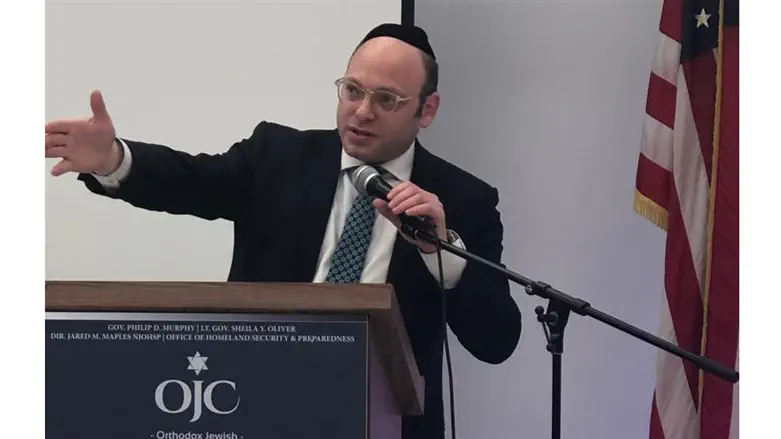
Duvi Honig is Founder & CEO, Orthodox Jewish Chamber of Commerce
President Donald Trump has announced that the United States and Iran have reached an agreement, with a formal signing reportedly scheduled for Friday. Financial markets reacted positively. Governments welcomed the news. Diplomats praised the breakthrough. Commentators immediately began describing the development as historic.
Listening to the reaction, one would think a decades-long conflict had finally been resolved.
The headlines sound almost celebratory. Two adversaries have reached an agreement. A deal has been struck. A ceremony is scheduled. The world is expected to applaud.
To many observers, it sounds glorious. Victorious. As if two companies have agreed to merge after years of negotiations. As if an engagement has been announced and everyone is lining up to offer congratulations and wish the couple mazel tov.
Yet I find myself feeling like the child who said that the emperor has no clothes, the child who is now sitting quietly in the back of the classroom asking what should be the most obvious question of all:
What exactly does it mean that Iran signed a piece of paper?
I ask sincerely because perhaps I am missing something.
Has Iran abandoned its ideology?
Has it stopped calling America the “Great Satan" and Israel the “Little Satan"?
Has it renounced its support for terrorist organizations and proxy groups throughout the Middle East?
Has it recognized Israel's right to exist?
Has it ended its commitment to exporting revolution and influence throughout the region?
Has it fundamentally changed the beliefs that have defined the Islamic regime for nearly half a century?
If the answer is no-and there is little evidence suggesting otherwise-then why is the world behaving as though a historic victory has been achieved?
For years, leaders across both political parties described the Iranian regime as one of the greatest threats to regional and global stability. Sanctions were imposed because policymakers believed the regime could not be trusted with unrestricted access to international financial systems. Economic pressure was presented as a necessary tool because Tehran repeatedly demonstrated a willingness to use resources not simply for domestic development, but to expand its influence and support groups hostile to America, Israel, and many of America's allies.
For years, Iran armed and trained Hamas, Hezbollah and Houthi proxies, created sleeper cells throughout the West, planned and tried to carry out assassinations in the West, all bent on destroying the Great and Little Satan.
That analysis did not suddenly become invalid because a signing ceremony was announced.
A signature is not regime change.
A document is not a transformation of ideology.
A diplomatic agreement is not proof that decades of behavior have disappeared.
History teaches us that governments sign agreements because they believe doing so advances their interests. Sometimes they seek legitimacy. Sometimes they seek economic relief. Sometimes they seek strategic breathing room.
And sometimes they simply seek time.
Time may be the most valuable asset in international politics.
That is why I struggle to share the excitement. To be frank, I find it out of place.
The concern should not be what happens next week.
The concern should be what happens five years from now.
If sanctions are eased or removed, Iran could gain access to billions of dollars in additional revenue. Supporters of the agreement will argue that those funds can improve economic conditions for ordinary Iranians. That may be true, but if the past is any indication, that is not going to happen.
Governments control resources.
Governments determine priorities.
Governments decide where money is invested.
The critical question is whether a stronger Iranian economy ultimately produces a weaker Iranian regime-or a stronger one.
That distinction matters.
A regime with greater financial resources gains options. It gains resilience. It gains flexibility. It gains the ability to strengthen institutions, expand capabilities, deepen regional influence, and better withstand future pressure.
And produce more ballistic missiles, arm proxies, hide its nuclear assets.
While much of the world is focused on Friday's signing ceremony, Iran's leaders are likely focused on what comes after.
They understand political cycles.
They understand that American administrations change.
They understand that presidents come and go.
They understand that policies evolve.
President Trump has demonstrated a willingness to confront Iran in ways many previous administrations were reluctant to do. Whether one agrees with every aspect of his approach or not, there is little question that Tehran understood it was facing a level of pressure that could not simply be ignored.
But Iranian leaders also understood something else.
No administration lasts forever. And an American president has to withstand media, polls, booing and the pressures of his inner circle.
So Iran's calculations are measured not in news cycles but in decades.
If they can secure economic relief, regain access to capital, strengthen their economy, preserve the regime, and simply wait for a future administration that may be less confrontational, why would they not consider that a strategic success?
That is the question few seem willing to ask.
Many analysts are treating the agreement itself as the victory.
I fear it is simply a pause. Like Chamberlain's.
Supporters of diplomacy correctly point out that negotiation is preferable to war. I agree completely. No reasonable person should desire military conflict. The human and economic costs are enormous. But sometimes evil must be eradicated, as Chamberlain learned to the world's sorrow.
Because diplomacy should not be confused with victory.
An agreement should not automatically be confused with success.
A signature should not automatically be confused with peace.
Lasting peace requires more than a ceremony. It requires changes in the other side's goals. It requires changes in their behavior. It requires accountability. It requires evidence that the underlying threat has diminished.
If the ideology remains intact, if support for terrorism remains intact, if hostility toward America remains intact, if calls for Israel's destruction remain intact, and if the regime itself remains fundamentally unchanged, then the core challenge has not disappeared.
It has merely entered a different phase.
Perhaps there are provisions in this agreement that have not yet been fully disclosed.
Perhaps there are enforcement mechanisms strong enough to ensure compliance.
Perhaps there are safeguards that dramatically reduce future risks.
If so, I would gladly welcome them.
I would be delighted to discover that my concerns are misplaced.
But until those facts become clear, I cannot understand why so many are celebrating the signing itself as though the problem has been solved.
What troubles me most is not the agreement. Agreements can be useful.
What troubles me is the willingness to suspend skepticism simply because signatures appear on a document.
The Iranian regime has spent decades showing the world exactly what it believes, exactly what it supports, and exactly what its objectives are.
One signing ceremony does not erase that history.
One document does not rewrite reality.
One photo opportunity does not transform enemies into allies.
Perhaps I am the one missing something. I am the child in the back of the room who He didn't see the emperor' new clothes then, and simply does not understand why everyone else is applauding now.
But until someone explains how a signature changes the nature of a regime that has spent decades threatening America, opposing Israel's existence - and recently launching massive missiles at it, sponsoring terror, and challenging the West, I will continue asking what seems to be the most important question of all:
If Iran’s signature is being celebrated as a victory, then what exactly did we win?