
If Saudi Arabia ever joins the Abraham Accords, it will not be a transaction. It will be the formal recognition of a regional architecture in which Israel has become the indispensable technology and security anchor - and the partner whose innovation ecosystem is needed to build the AI economy to which the Kingdom has committed itself.
A new flagship strategic research report from The Olam uses AI scenario modeling to project what a Saudi-Israeli economic relationship would produce. The base case puts cumulative new Middle East economic activity at between $650 billion and $1.3 trillion by 2046 in the event of normalization.
The Olam report does not predict that the deal will happen. It models what would follow if it does.
The underlying logic of the modeling - anchored to the working precedent of the Israel-UAE corridor since 2020 and scaled by Saudi structural facts - points to a strategic reality Israeli economists should understand clearly.
Israel approaches this conversation from the strongest position in its history.
The Israeli economy in 2026 is the strongest it has ever been. Israeli high-tech contributes between 17 and 20 percent of GDP and over half of total exports. Israeli cybersecurity exports exceed $13 billion annually. Israeli defense exports hit $14.8 billion in 2024, with 12 percent now flowing to Accords countries. Civilian R&D spending of 6.35 percent of GDP is the highest in the world. The startup ecosystem is the deepest in the world per capita. The Iron Dome, Arrow, and David's Sling architecture is operationally validated under conditions no other country's defense systems have faced at scale.
The Iran escalation of 2026 demonstrated Israeli military capability against the most consequential regional adversary. The regional security map was reset on Israeli terms.
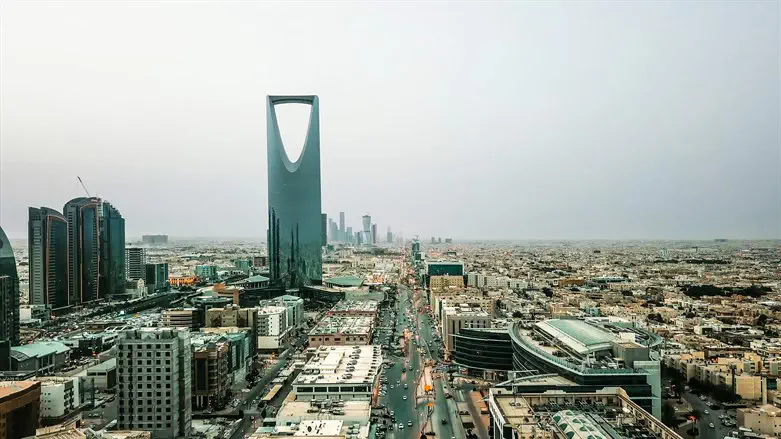
Against that backdrop, Saudi Arabia is building between $90 and $300 billion of AI infrastructure under Humain, chaired by Crown Prince Mohammed bin Salman and launched in May 2025. The Hexagon data center alone is $2.7 billion for 480 megawatts. AWS has invested $5.3 billion in operational Saudi infrastructure. The Kingdom is building the largest non-U.S. hyperscaler footprint outside China.
A buildout at that scale requires the kind of innovation ecosystem only one country in the region has built. The structural complementarity is exact. Saudi sovereign capital at scale - Public Investment Fund at $925 billion AUM - meets the deepest non-U.S. innovation ecosystem on earth.
Saudi capital. Israeli innovation. One stack.
If the deal happens, the Olam report projects Israeli-linked share of Saudi AI infrastructure spending at 5 to 15 percent of total - $200 to $500 billion cumulative by 2046. The combined AI compute capacity of the Accords economic bloc would reach 15 to 25 gigawatts operational, positioning the bloc as a credible third AI concentration alongside the United States and China.
The second axis of the architecture is the India-Middle East-Europe Economic Corridor. The corridor - signed by India, the United States, Saudi Arabia, the UAE, the European Union, Italy, France, and Germany - connects India's western ports through Gulf hubs and Saudi territory to Haifa, and then onward to Europe, avoiding the Hormuz Strait. The corridor's rail spine ends at Haifa. Without Saudi-Israeli normalization, the Saudi-to-Jordan-to-Israel link cannot be built and the corridor does not function. At full operation, IMEC would move between $300 and $600 billion in annual goods value through Haifa.
Haifa is the European terminal of the corridor. That fact is structural, not rhetorical or ideological.
This is what an architecture of strength looks like. Israel does not arrive at this conversation as a supplicant. It arrives as the partner whose innovation, cybersecurity, defense capability, and strategic position make the architecture work - and whose role in the corridor is irreplaceable.
If the deal occurs, it will be because both sides understand what each contributes. Saudi Arabia brings the capital and the scale of demand. Israel brings the technology stack and the geographic anchor. The complementarity is not a balance of leverage. It is a structural fit.
For the Israeli economic class, the historical significance is also worth naming. If normalization occurs, Israeli Sephardic and Mizrahi families - many with roots in Iraq, Yemen, Morocco, Egypt, Syria, Tunisia, and Libya - would see commercial life return to the same regional economy their grandparents fled. Not as supplicants. Not as junior partners. As founders, investors, and counterparts operating from a position of structural strength, in an Accords architecture that Israel helped design.
If the deal happens, the prize the Olam modeling describes becomes available. If the deal does not happen on this timeline, the underlying strategic position holds. Israeli innovation is not a temporary asset. Israeli security capability is not a passing claim. The structural facts that make Israel the anchor of the Western regional architecture do not depreciate.
The Abraham Accords proved that Israel can rewrite regional architecture from strength. Saudi normalization, if it comes, would be the architecture's keystone.
It would be signed on terms commensurate with the position from which Israel signs it - a position built over seventy-eight years of state-building, economic development, scientific achievement, and demonstrated security capability. Those terms are not a demand. They are simply what the underlying facts produce.
Ronn Torossian is the founder and chairman of 5W AI Communications, the AI Communications Firm. He is the publisher of Everything-PR and the author of two best-selling editions of For Immediate Release. (The full 31-page Olam strategic research report is available at olam.business.)