
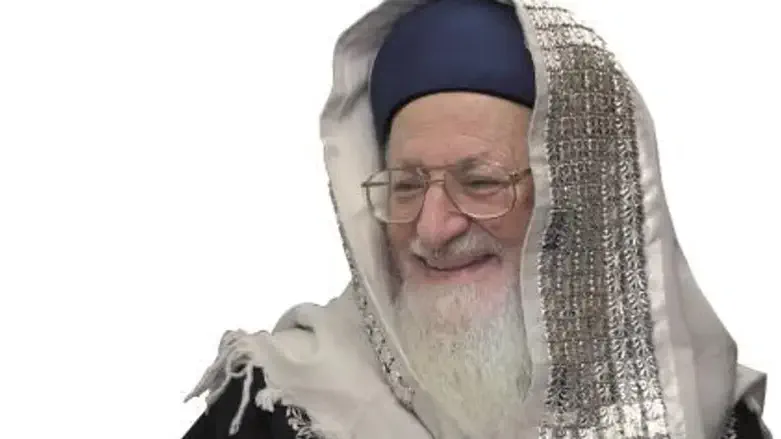
HaRav Shmuel Eliyahu is Chief Rabbi of Tzfat and the son of Rav Mordechai Eliyahu ZT"L
The Midrash (Bereishit Rabbah 56:7) states:
"There is no generation without an Avraham, there is no generation without a Yaacov, there is no generation without a Moshe, and there is no generation without a Shmuel."
These words are based on the teaching of our Sages that:
"Our father Yaacov did not die" (Ta'anit 5b).
Similarly, the Gemara states (Sotah 13b):
"Some say that Moshe did not die. It is written here, 'And Moshe, the servant of the Lord, died there,' and it is written there, 'And he was there with the Lord.' Just as there he stands and serves, so too here he stands and serves."
In other words, the activity and influence of Moshe Rabbeinu continue throughout all generations.
Our Sages similarly interpreted the verse:
"And the Lord said to Moshe: Behold, you are about to lie down with your fathers, and this people will rise up..." (Devarim 31:16).
They understood the verb "will rise up" as referring to Moshe himself, who will one day rise. From here they derived a proof for the resurrection of the dead from the Torah (Sanhedrin 90b).
The Light of Mashiach - the Light of Moshe
The highest revelation of the soul of Moshe will be in Mashiach, whose soul will be the soul of Moshe and who will reveal the secrets of the Torah.
"Fortunate is the generation in which this is revealed, for all of this is destined to be renewed through Moshe in the final generation, fulfilling the verse, 'That which was is that which shall be' (whose initials in Hebrew spell Moshe). His influence spreads throughout every generation in every righteous person and Torah scholar who occupies himself with Torah, up to the number of six hundred thousand, etc. These matters are hidden and sealed" (Tikunei Zohar, Tikun 69, 112A).
Indeed, Mordechai the Jew was a stage in the progress toward Redemption, when the Jewish people willingly accepted the Torah. Another stage was Rabbi Shimon bar Yochai, who revealed the secrets of the Torah. Another stage was the holy Arizal, as it is written in the Introduction of Rabbi Haim Vital to the book “Etz HaHaim."
"Accordingly, do not be surprised by what is recounted at the end of this introduction regarding the holy sage who has been revealed to us in our own times and generation, and I cannot explain further; if you wish, you will understand."
Rabbi Yosef Karo - Constant Divine Revelation
From this we can understand the events of Rabbi Yosef Karo's life. He greatly increased Torah among the Jewish people, and a heavenly voice was revealed to him on the night of Shavuot, instructing him to ascend to the Land of Israel.
He was exceptionally humble and merited continual Divine Revelation through the Maggid (a type of angel). He also renewed the Sanhedrin, which united all the Sages of Israel into one body. Likewise, he authored the Shulchan Aruch, which in essence gathered all of Israel around one table. All of these qualities are qualities of Moshe, who made the people of Israel into "one man with one heart."
The Ohr HaChaim HaKadosh - Awakening the Nation to Ascend to the Holy Land
According to these ideas, we can understand why the Baal Shem Tov said that Rabbi Chaim ben Attar, the Ohr HaChaim, of blessed memory, was a spark of Mashiach.
Rabbi Gershon of Kitov wrote to his brother-in-law, the Baal Shem Tov:
"You once told me that in a vision you saw a sage coming to Jerusalem from the lands of the West, and that he was a spark of Mashiach, although he himself did not know it. He was a great scholar in both the revealed and hidden Torah and a man of deep feeling. Later you told me that you no longer saw him and thought perhaps he had passed away. When I arrived here (in the Holy Land), I investigated the matter and was told wondrous things about this man. His name was Rabbi Chaim ben Attar. He was a great Chassid, sharp-minded and expert in both the revealed and hidden Torah... I told the sages what you had said about him, and they were astonished to hear it."
Rabbi Chaim ben Attar ascended to Jerusalem and established a yeshiva that exists to this day. On his journey he brought additional Jews to the Land of Israel and awakened them to the Redemption.
The righteous must awaken the hearts of the people to leave the exile and ascend to the Land of Israel.
The Ohr HaChaim HaKadosh wrote:
"The Redemption will come by awakening the hearts of people and saying to them: 'Is it good for you to remain outside, exiled from your Father's table? What pleasure do you find in life in this world, apart from the higher company with whom you once sat around your Father's table, He who is the eternal God, blessed forever?'"
Regarding the negligence of righteous Torah leaders who fail to do this, the Ohr HaChaim wrote:
"For this, all the leaders of the land, the great sages of Israel, will one day be held accountable, and from them God will demand an accounting for the humiliation of His desolate House" (Leviticus 25:25).
Sparks of Moshe
We find the extension of Moshe's soul even in a great righteous person and Torah Scholar who teaches Torah publicly, even if he does not possess all of Moshe's qualities. in righteous people and Torah scholars who occupy themselves with Torah and who guide and lead the community according to the ways of Torah, the illumination of Moshe Rabbeinu's soul shines more openly than in the individual soul of every Jew.
The Zohar states that the revelation of Moshe's soul existed even before the generation of the Exodus from Egypt. The soul of Moshe is the soul of the Patriarchs and the soul of Adam HaRishon before his sin. In every generation it becomes more complete and more fully revealed.
Rabbi Mordechai Eliyahu ZT"L
Were it not presumptuous, in our generation, we would say this about my father and mentor, Rabbi Eliyahu, of blessed and holy memory. There are many great and distinguished Torah Scholars. But the one who embodied many of the qualities we listed above regarding Moshe was Rabbi Eliyahu, of blessed memory. Who in our generation was as great as he, both an immense Torah Scholar in the revealed and hidden Torah and one who devoted himself completely to the Land of Israel with tremendous self-sacrifice?
This was true in the struggles against surrendering parts of the Land of Israel in the Oslo Accords and during the Disengagement from Gush Katif Both of these “peace agreements" were later proven to be a great illusion and falsehood. Yet at the time, a misled public followed them and did not understand that they were false, just as with the Sin of the Spies.
Combining the Revealed and Hidden Torah
As mentioned earlier from the Zohar, the soul of Moshe will reveal to the people of Israel the hidden secrets of the Torah. So it was with our father and mentor, who was a great Kabbalist to whom no secret was inaccessible. He taught Torah according to the path of the Ben Ish Chai, whose primary approach was to unite the revealed Torah with the hidden.
This was the path of Rabbi Shimon bar Yochai and the path of Rabbi Yosef Karo, who at times ruled in the Shulchan Aruch according to the Zohar. It was also, of course, the path of the holy Arizal.
Self-Sacrifice for the Jewish People
Rabbi Eliyahu, of blessed memory, was careful never to speak badly about a fellow Jew. He would often quote the Baba Sali's teaching not to curse any Jew. Throughout his life he traveled across the Land of Israel teaching Torah, and after being chosen as Israel's Chief Rabbi, he traveled throughout the world as well.
For the sake of teaching Torah to the Jewish People, he spent nine months in prison in his youth, all for the privilege of teaching Torah to immigrants living in the transit camps during the early years of the State of Israel.
Humility and Modesty
The Torah says about Moshe Rabbeinu:
"Now the man Moshe was exceedingly humble, more than any person upon the face of the earth" (Numbers 12).
He was not concerned about personal insult. So too was Rabbi Eliyahu, of blessed memory, throughout all his ways.
I will tell a story about this:
A few weeks ago, I visited Rambam Hospital in Haifa. There was a seriously wounded patient there who is the grandson of Rabbi Nachman Kahana, may he live long and well, author of the Mei Menuchot series, a commentary on Tosafot throughout the Talmud (ed. note: Rabbi Kahana writes a weekly parasha article for Arutz Sheva).
After the visit, Rabbi Nachman Kahana called me and told me a story about my revered father, of blessed memory. He said that his elderly mother lived in the same building as the Rabbi did. Whenever Rabbi Eliyahu saw her carrying a bag of garbage to the trash bin, he would immediately take the bag from her and throw it away to spare her the burden.
Rabbi Kahana told his mother that Rabbi Eliyahu was a great Torah sage and that such behavior was not befitting the honor of the Torah. But his words did not help because my father continued his practice of honoring the elderly woman who had merited to bring into the world a righteous Torah Scholar such as Rabbi Nachman Kahana.
“I only give advice."
It should also be mentioned that Rabbi Eliyahu, of blessed memory, would often quote the Mishnah (Avot 4:8) in the name of Rabbi Yishmael, who taught:
"Do not say, 'Accept my opinion,' for they are permitted to decide, not you."
Rabbi Eliyahu remarked: "I do not issue rulings in order to compel the public. I only give advice. If they wish, they may accept my opinion, and if not, they need not accept it."
This distinguished him from a number of other Torah Scholars who demanded that the public accept their halakhic rulings and who became upset if someone did not follow their path. Many disputes arose because of this. Rabbi Eliyahu was careful to avoid such situations.
Strength and Humility
The Torah relates that Moshe possessed great courage when he demanded that Pharaoh release the people of Israel, yet he acted with proper respect and humility.
Our Sages say that the seventy elders did not merit ascending Mount Sinai because they lacked the self-sacrifice necessary to go to Pharaoh on behalf of Israel. Furthermore, they later died in the outbreak of fire when they complained.
Like Moshe, Rabbi Eliyahu stood firmly for the observance of Torah and the sanctity of the Land of Israel. More than once he expressed his views forcefully before prime ministers and influential judges. Because of this self-sacrifice, Moshe merited to ascend the mountain to receive the exalted Torah, and so too did Rabbi Eliyahu, of blessed memory.
Holiness and Divine Inspiration
Rabbi Eliyahu was extremely careful regarding holiness, especially concerning food, as is well known.
He would mention that Moshe, even in the heat of Egypt during the month of Sivan, did not nurse from the milk of an Egyptian woman. Therefore, we too must be careful regarding non-Jewish milk.
He also possessed Ruach Hakodesh (Divine Inspiration). There are countless stories about this. For example, an important Rabbi told me that when his son was born, doctors informed him on Friday, after examinations, that the child was completely deaf. Distressed, he came to Rabbi Eliyahu. The Rabbi told him that his son’s hearing was perfectly normal. After Shabbat, the father returned to the hospital, where the doctors informed him that the child was completely healthy. It was truly astonishing.
The Power of Prayer and the Merit of the Forefathers
Moshe prayed on behalf of Israel after the sin of the Golden Calf, after the Sin of the Spies, and for Miriam. He also prayed 515 prayers in order to enter the Land of Israel.
Similarly, Rabbi Eliyahu organized mass prayer gatherings on behalf of the Jewish people.
Moshe also acted through the merit of the forefathers, as described in the Book of Exodus. Likewise, Rabbi Eliyahu would "awaken the sleepers of Hebron" and was deeply connected to the resting places of Rabbi Shimon bar Yochai, Rabbi Yehuda HaNasi, and other righteous sages.
In truth, one could bring countless examples showing how Rabbi Eliyahu followed the path of Moshe Rabbeinu and of all the righteous individuals throughout the generations who continued that path.
May it be God's will that we too cleave to his ways which continue the holy path of our Forefathers.
(Translated and abridged by Tzvi Fishman)