
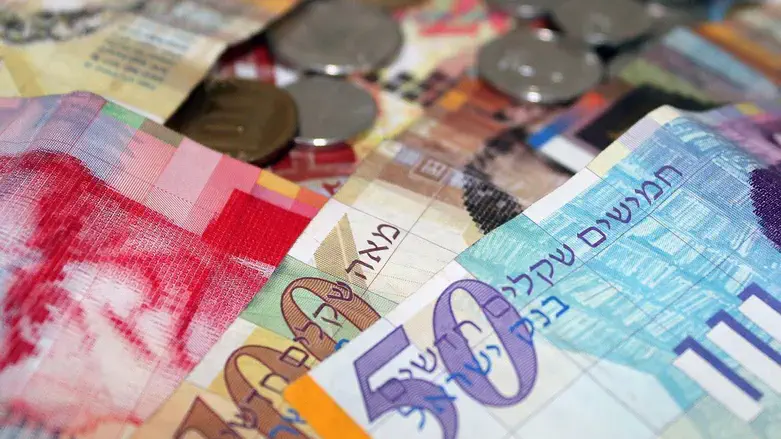
In the middle of a war, with the region still on edge, the Israeli shekel did something no enemy ever wanted to see. It climbed to its strongest level against the U.S. dollar in more than thirty years, slipping below three shekels to the dollar for the first time since 1995.
Read that again. At war, the shekel is winning.
This is not luck. A nation's currency is the world placing a bet, in real money, on whether that country will survive and thrive. And the world is betting big on Israel. Foreign investment poured into Israel at approximately $39 billion in 2024, up from roughly $25 billion the year before. Money looked at the Jewish state surrounded by enemies and decided it was a buy.
To understand why, you have to understand what the world is actually buying.
The most valuable resource on earth is no longer oil. It is intelligence-the chips, the algorithms, the artificial intelligence that will shape the next century. Call it the new oil. And tiny Israel, smaller than New Jersey, sits right on top of the well.
Israel's technological achievements have become essential to the modern world. Israeli innovation has helped power autonomous driving systems, navigation technology, cybersecurity infrastructure, advanced medical technologies, communications systems, and semiconductor design. The world doesn't merely admire Israeli technology-it increasingly depends on it.
And the giants are voting with their checkbooks.
In December, Nvidia, the company at the center of the global artificial intelligence revolution, announced plans for a massive new campus in northern Israel. The facility is expected to employ thousands of engineers and further deepen Israel's role in the future of AI. Nvidia founder Jensen Huang has repeatedly praised Israeli engineering talent and the country's contributions to advanced technology development.
The broader message from global markets is unmistakable. Investors continue pouring capital into artificial intelligence and advanced computing. Companies leading that transformation have become some of the most valuable businesses in history. Israel's position as a global innovation hub has made it a direct beneficiary of that trend.
So why is the shekel rising now, and so fast?
There are several reasons.
Some of the fear that followed the outbreak of war has eased. Foreign investors buying Israeli companies or investing in Israeli assets must first purchase shekels, creating additional demand for the currency. At the same time, Israeli pension funds and institutional investors have reportedly converted portions of their foreign holdings back into shekels, adding further support.
Here is the part many headlines get wrong. This is not simply a story about a weaker dollar.
The shekel has strengthened not only against the dollar but also against the euro. According to Bank of Israel data, in the weeks leading up to its May policy decision, the shekel gained approximately 8.3 percent against the dollar and 7.2 percent against the euro.
When a currency rises against both the dollar and the euro at the same time, the explanation goes beyond weakness elsewhere. This is an Israeli story. The strength is earned.
Israel should be proud of that.
But pride is not a policy.
A medal worn carelessly can become a weight around the neck.
Israel does not live on applause. It lives on what it sells. Exports account for roughly 40 percent of the country's economy, and many Israeli companies earn revenue in dollars and euros while paying salaries and expenses in shekels.
When the shekel rises sharply, those foreign revenues translate into fewer shekels. A company can sell the same product, in the same quantity, and still earn less at home because exchange rates moved against it.
Manufacturers, technology companies, medical-device firms, and exporters across the economy are watching closely. A prolonged period of currency strength can reduce competitiveness, pressure profits, slow hiring, and discourage investment.
Tourism feels the impact as well.
Tourism revenue fell from nearly $6 billion in 2023 to approximately $2.2 billion in 2024 as the war took its toll. Recovery had finally begun, with visitor numbers showing encouraging improvement.
A stronger shekel, however, makes Israel more expensive for international visitors. Every dollar buys fewer shekels. Hotels, restaurants, transportation, and daily expenses become more costly from the perspective of tourists.
For the hundreds of thousands of Israelis whose livelihoods depend directly or indirectly on tourism, that matters.
There is another consequence that receives far less attention.
For generations, young Jewish couples from North America have come to Israel to begin married life, study, work, and build roots. Many rely on savings, support, or income denominated in dollars.
When the shekel strengthens dramatically, rent, groceries, tuition, and daily living expenses effectively become more expensive overnight. Their commitment to Israel may remain unchanged, but the economics become far more difficult.
Every young family that decides it can no longer afford to stay represents a loss Israel can ill afford.
There are benefits to a stronger shekel as well.
A stronger currency lowers the cost of imports, helping reduce inflation and ease pressure on household budgets. Imported food, consumer products, electronics, and other goods should eventually become more affordable.
Recognizing this opportunity, Finance Minister Bezalel Smotrich recently urged importers and business leaders to pass those savings on to consumers rather than keeping them as additional profit. If the shekel is creating benefits, Israeli families should feel them.
The Bank of Israel has also acted. On May 25, it lowered its benchmark interest rate to 3.75 percent, noting that the stronger shekel has helped reduce inflationary pressures.
The question now is what comes next.
If the shekel continues strengthening rapidly, policymakers may face difficult choices. Additional interest-rate reductions, direct currency-market intervention, or other measures could become necessary to prevent success from becoming self-defeating.
That debate will continue.
But the larger lesson should not be missed.
The rise of the shekel is proof that the world believes in Israel. Investors are looking beyond the headlines and recognizing something powerful: Israel has become one of the world's most important centers of innovation, technology, entrepreneurship, and human capital.
That confidence is well earned.
But a nation is not measured solely by the strength of its currency. It is measured by whether the people who create that success can continue to build their lives there.
The strong shekel is both a gift and a warning wrapped into the same number.
It tells us that the world is betting on Israel.
Now we must make sure we do not turn that vote of confidence into a weight carried by the workers, entrepreneurs, exporters, tourism businesses, young families, and future olim who made Israel worth betting on in the first place.
Duvi Honig is the Founder and CEO of the Orthodox Jewish Chamber of Commerce, an international business advocacy and economic development organization dedicated to strengthening commerce, job creation, and public-private partnerships. He works with government leaders, business executives, and nonprofit organizations in the United States and Israel to advance economic growth, innovation, and opportunity.