
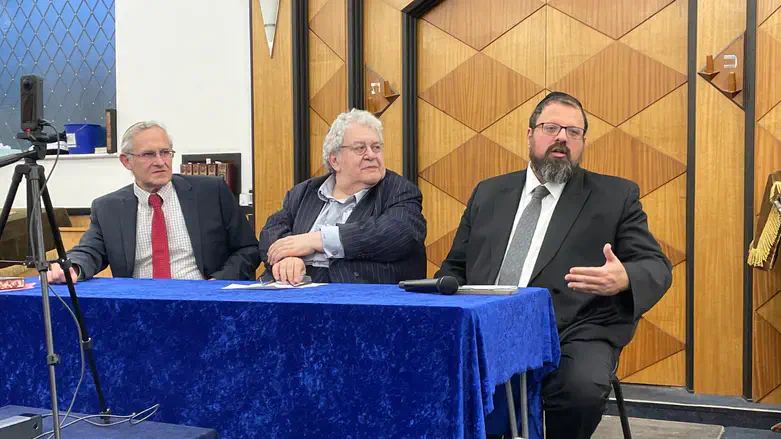
More than 120 people attended a Jewish Ethics Project dinner hosted by the Ner Yisrael Community in northwest London, where Rabbi Mosheh Lichtenstein, Dean of Yeshivat Har Etzion, and Dayan Eliezer Zobin, Rabbi of Ner Yisrael, discussed major challenges facing Jewish communities in Britain, Israel and the Diaspora. The discussion was moderated by Rabbi Michael Pollak.
During the discussion, Rabbi Lichtenstein addressed interfaith relations and the legacy of Rabbi Joseph B. Soloveitchik. He argued that while faith communities must remain committed to their own religious convictions, they also share broader moral concerns, saying, “The major divide today is often not between one faith and another, as it was in medieval times, but between those who believe in a transcendent moral reality and those who do not."
Dayan Zobin said recent events had significantly changed the nature of his rabbinic work. Reflecting on meetings with Muslim and Christian religious leaders in London, he said, “We’re not dealing with interfaith or theology. Together we’re dealing with survival. As like minded faith leaders we are trying to rebuild a basic sense of shared humanity".
Dayan Zobin also warned against negative and materialistic worldviews among young people. “Many teenagers are being drawn into a negative and materialistic worldview that is soul-destroying," he said, adding that restoring spirituality, shared values, and transcendence across Britain and the Western world was essential.
The discussion also focused on campus antisemitism and anti-Israel hostility. While acknowledging troubling trends, Dayan Zobin cautioned against simplistic conclusions about British society and warned against embracing populist allies uncritically, saying, “The terrorists want moderates on both sides to despair. If we allow that to happen, we hand victory to the extremists."
Rabbi Lichtenstein also urged Diaspora Jews not to disengage from Israel because of political or religious disagreements. He encouraged continued learning, listening, and participation in the broader Jewish conversation, and also addressed artificial intelligence, cautioning against issuing definitive religious rulings before the technology and its consequences are fully understood.