
Robert Scott Kellner, a navy veteran and member of the American Legion, is a retired English professor who taught at the University of Massachusetts and Texas A & M University. He is the grandson of the German justice inspector and diarist Friedrich Kellner and is the editor and translator of My Opposition: The Diary of Friedrich Kellner--A German against the Third Reich, Cambridge University Press, United Kingdom, 2020.
“The American president is mostly bluff," said Reich Marshal Hermann Göring in October 1942, explaining to an enthusiastic audience at the Berlin Sports Palace why American troops were not yet in Europe a year after the attack on Pearl Harbor.
“Americans are good at manufacturing things: automobiles, razor blades, and even weapons. But their soldiers are strange. They wobble on a dance floor for 72 hours with flapping arms, rolling eyes, and a completely dopey look to be crowned Marathon King. "That’s not soldiering," laughed the jovial Luftwaffe commander to loud applause. “They are not going to fool us with bluff."
Listening to the radio broadcast of Göring’s speech was the court administrator and diarist Friedrich Kellner. He was not amused. He knew where the bluff really lay. “Our generals ridiculed America in the First World War, too, saying their soldiers would never come to Europe," Kellner noted in his diary. “But the American army made the difference in every respect."
Kellner was also aware of the unease that lay beneath the cloak of derision. When the Americans finally did arrive in Europe, the entire upper echelon of the Third Reich would be held accountable for crimes against humanity. That applied especially to Adolf Hitler’s prized deputy.
Hermann Göring was Hitler’s malign instrument that shaped the Holocaust. Two days after Kristallnacht, on November 12, 1938, he issued an outrageous order that Jews must pay one billion Reichsmarks for bringing the Nazi pogrom upon themselves and causing the widespread destruction of property. “The hostile attitude of Jews toward the German people and Reich requires decisive and strict atonement."
Enthusiastic about this approach to the “Jewish question," Propaganda Minister Joseph Goebbels wrote in his diary, “Göring and I are cooperating wonderfully."
On July 31, 1941, Göring gave Reinhard Heydrich a memorandum authorizing him to make “all necessary preparations" for a total solution of the Jewish question across Europe.
Then he issued an ordinance stripping Germany’s Jews of the last remnants of civil existence, reducing them to workers without rights, forced into segregated labor under state control and excluded from protections, benefits, and dignity.
Friedrich Kellner angrily copied Göring’s draconian regulations into his diary. “Why so many words? Just say Jews are not people but slaves. In this official order is the essence of National Socialism. The Jews who emigrated from Germany should thank God. The treatment of those who remained is cruel, relentless, and inhuman."
When Nazi leaders gathered in the lakeside villa at Wannsee in January 1942 to coordinate and map out the mechanics of genocide coldly, Reinhard Heydrich reminded them that Reich Marshal Göring himself had commissioned and approved the plan.
The Nazis moved swiftly. Just nine months after Wannsee, Friedrich Kellner recorded this: “In the last few days the Jews from this region have been removed. The families Strauss and Heinemann were taken from Laubach. I heard from a reliable source all the Jews were taken to Poland and murdered there by SS brigades. Such atrocities will never be able to be erased from the book of humanity."
By then, cracks were emerging within Nazi Germany’s apparent strength. Earlier victories had not secured final success. German forces occupied much of Europe, but the Soviet Union was mobilizing vast reserves of manpower and producing large quantities of weapons. The war had become one of attrition, and time was not on Germany’s side.
Then in February 1943 came the devastating defeat at Stalingrad. The Nazis tried to minimize it, but it was impossible. About 200,000 German soldiers were killed, and 90,000 captured.
“Dr. Goebbels still dares to step up onto the stage and comfort the people with words," wrote Kellner. “But Hitler and Hermann Göring, with their false prophecies of a final victory, are silent."
The Allies’ progress in liberating conquered territory was slow but relentless. From North Africa to Italy and Southern France, American and English troops and weapons proved more than a match for the Germans.
All the while, Dwight Eisenhower was mustering a massive force in England to cross the Channel and break through Hitler’s so-called “Atlantic Wall" along the French coastline: a confounding barrier of trenches, crossbars, barricades, bunkers and machine gun emplacements, with elongated muzzles of super-heavy cannons pointing at the sea to sink approaching ships.
“Should anyone miraculously get through," declared Hitler, “It will be only luck if he survives for even a few hours."
“We bid the English a cordial welcome," taunted Propaganda Minister Joseph Goebbels. “Hopefully they will bring along a few Americans."
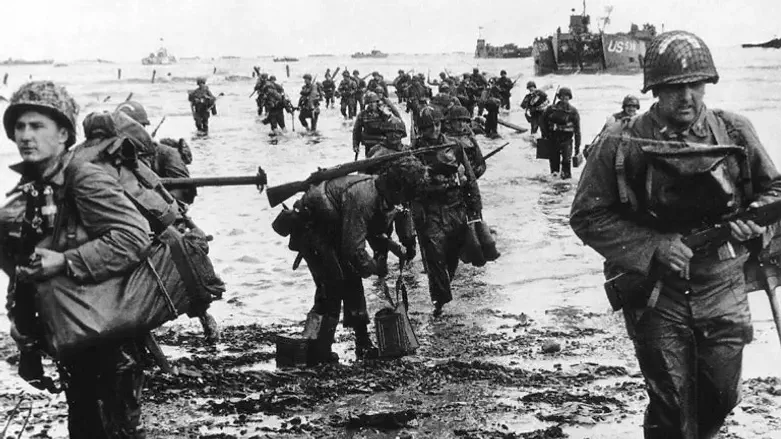
On June 6, 1944, D-Day, the Allies launched the largest amphibious invasion in history to liberate France. Thousands of battleships, cruisers, destroyers, landing craft and support ships crossed the English Channel with over 150,000 soldiers from the United States, Britain, Canada, and other Allied nations.
The landing zones covered a 50-mile stretch of Normandy beaches. The German fortifications were formidable, but despite the intense fire and the difficult landing in the rough seas, Allied troops overcame all obstacles.
Hermann Göring’s “dopey Marathon Kings" successfully landed on the European continent and shattered the illusion of German invincibility.
The chastened Göring, in an address to Germany’s remaining Luftwaffe pilots, glumly admitted, “We have learned how strong the enemy is."
After the war, when faced with justice at Nuremberg, Hermann Göring, who had planned and authorized the murder of six million Jews, feigned ignorance of what occurred within the concentration camps, blaming others.
His true nature, however, was revealed in the prison yard. “Someone said something about Jewish survivors in Hungary," wrote Albert Speer, Hitler’s architect, in his 1969 autobiography. “Göring remarked coldly: ‘So, there are still some there? I thought we had knocked off all of them. Somebody slipped up.’"
It is unlikely, but to be wished, that the sadistic Göring learned in Nuremberg that 500,000 Jewish men and women were in the United States Armed Forces. A reasonable estimate is that 2,000 Jewish soldiers and sailors were in the Normandy landings, personally helping to ensure that the arrogant and vainglorious "Thousand-year Reich" collapsed after a mere dozen years.
Beyond that participation, in 1948 more than a thousand American and Canadian Jewish veterans went to the nascent State of Israel to join the Makhal (the Hebrew acronym for “Volunteers from Abroad") to stave off attacks by Arabs who had aligned themselves with Adolf Hitler’s killing squads.
But by then, Hermann Göring had met his fate. Convicted at Nuremberg on all counts and sentenced to death, Göring escaped the gallows by taking a cyanide pill in October 1946.
The tribunal’s judgment against him was unequivocal: “Göring was the leading war aggressor, the director of the slave labor program, and the creator of the oppressive program against the Jews. His guilt is unique in its enormity."
A legacy almost as dark as Adolf Hitler's.