
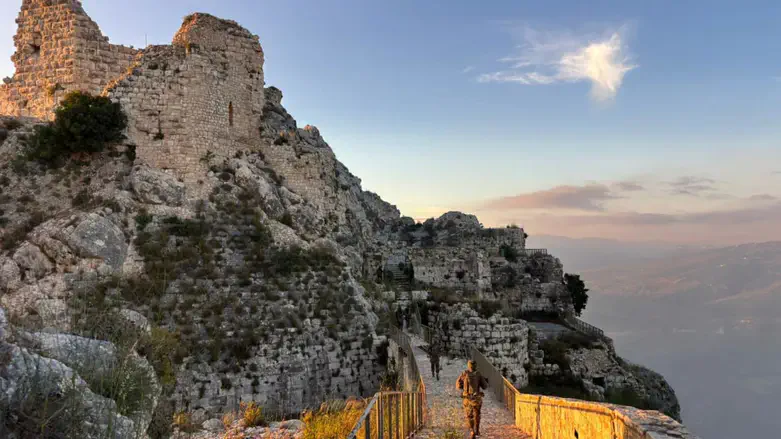
On May 31, it was reported that IDF forces had taken control of the Beaufort Castle area and the Ali al-Taher Ridge.
The IDF’s takeover of the Beaufort area, a strategic mountain topped with a Crusader-built castle, marks a significant milestone in the ongoing campaign against Hezbollah. Control of this area carries both operational significance, as it constitutes a strategic zone in southern Lebanon, and psychological significance for all parties involved in the conflict.
The importance of the Beaufort area stems first and foremost from its geographic location. The area overlooks the city of Nabatieh to the northwest and the Marjayoun region to the northeast. These areas are connected by key access routes used by Hezbollah for reinforcements and logistical supply from north of the Litani River and from the southern Beqaa Valley.
Nabatieh and its surrounding region constitute one of Hezbollah’s most important centers of gravity in southern Lebanon. The area falls within the area of responsibility of the Badr Unit, currently regarded as Hezbollah’s primary formation operating against the IDF on the southern front. Hezbollah’s loss of control over the Beaufort area therefore represents a direct operational setback for the organization.
In addition, the area serves as a strategic observation point overlooking parts of northern Israel and several Israeli communities located near the border.
A video filmed by a local Lebanese resident is attached, explaining the strategic importance of the Beaufort Ridge in terms of observation and control over Israeli territory (February 2025).
The importance of the Beaufort area for Hezbollah derives not only from its geographic position but also from the central role this terrain has played in the organization’s military infrastructure over the years. The area served as a major hub for military activity, weapons storage, and the management of Hezbollah’s fire and defensive systems.
Its significance was already demonstrated in November 2024 during Operation Northern Arrows, when IDF forces uncovered large weapons stockpiles hidden near the Litani Bend adjacent to the ridge. In addition, Hezbollah operated a command site in the ridge area responsible for managing the organization’s fire and defensive systems. The site included underground infrastructure used for storing thousands of rockets and directing Hezbollah’s operational activities throughout southern Lebanon.
Even after the IDF struck the compound multiple times during the most recent ceasefire period (November 27, 2024 - March 2, 2026), Hezbollah continued investing resources in its restoration, underscoring both its operational and symbolic value to the organization.
Further evidence of the area’s importance emerged in August 2024, when footage was published showing rocket launches toward Israel from an area adjacent to the Beaufort Ridge, beneath the Christian village of Deir Mimas.
The critical importance of the Beaufort area to Hezbollah can also be seen in the organization’s reported plan to destroy the Qaraoun Dam in order to flood the Litani River basin and prevent an IDF advance toward the Beaufort area-even at the cost of causing a national disaster in southern Lebanon (see our May 31 article: “Hezbollah Planned to Destroy the Qaraoun Dam to Halt an IDF Maneuver North of the Litani").
Similarly, Hezbollah increased its attacks against Israeli territory and communities during May as IDF forces advanced toward the area (see data in the weekly summary report: Hezbollah Attacks Against Israel, May 25-31).
Moreover, it was impossible to ignore Iran’s deep concern over the IDF’s advance toward and eventual takeover of the Beaufort area. Iranian officials clearly understand the implications of this move for Hezbollah. The primary-and most significant-lever available to Tehran remains its negotiations with the United States. Israeli threats directed at Beirut’s Dahiyeh district only heightened and reinforced Iranian concerns.
Against this backdrop, Israel’s capture of the Beaufort area should not be viewed merely as the seizure of additional terrain. Rather, it constitutes a blow to a major center of power that Hezbollah had invested considerable effort in preserving and defending over many years.
The Israeli takeover of the Beaufort area is not merely a localized achievement but part of a broader trend of degrading Hezbollah’s assets, capabilities, and strategic standing while demonstrating Israeli operational effectiveness.
Beyond its operational implications, control of the Beaufort Ridge carries significant psychological value.
The accumulation of Israeli achievements throughout the campaign undermines the image of strength that Hezbollah has cultivated for decades and weakens its ability to portray itself to its Shiite support base as the defender of Lebanon and an invincible force. While, at the time of writing, these developments are not sufficient to undermine the loyalty of Hezbollah’s Shiite constituency, they constitute another layer in the gradual erosion of the organization’s status and image, both domestically and internationally.
At the same time, the capture of the Beaufort area strengthens Hezbollah’s opponents within Lebanon and deepens criticism of the price that the organization-acting primarily in pursuit of its own interests-imposes on the Lebanese state and society. For many of Hezbollah’s critics, the loss of the Beaufort area reinforces the argument that Hezbollah drags Lebanon into costly confrontations that undermine the country’s national interests.
Within Israel, the capture of the Beaufort area also carries significant meaning. As Herb Keinon wrote in the Jerusalem Post:
"For most Israelis born in the last four decades, Beaufort conjures up not the bloody battle for the castle during the opening days of the 1982 First Lebanon War, but the 2007 movie of the same name.They remember the film more than the fortress itself. And through Joseph Cedar’s lens, Beaufort became synonymous with futility. The movie tells the story of soldiers manning the outpost in the final days before Israel’s withdrawal from Lebanon in 2000. Through that prism, Beaufort became the symbol of the final, weary chapter of Israel’s long stay in Lebanon.
"The sight of the Israeli flag and the Golani Brigade flag once again fluttering atop the castle conjures up futility as well - but of a different kind. Not the futility of remaining in Lebanon, but the futility of believing that withdrawal would bring peace.
"The Israeli flag flying once again over the Beaufort fortress reflects that change in thinking. It symbolizes not only a military operation but also a profound loss of faith in the idea that if Israel simply leaves territory, others will assume responsibility and somehow solve the problem.
"That is one reason Beaufort is significant.
"It is not just another hilltop. It is perhaps the most potent symbol of Israel’s previous Lebanon entanglement. Yet the return there was not met by a public asking, 'How could you?' It was met largely by a public comfortable with the move and, in many cases, demanding even more aggressive military action.
"For years, the Beaufort outpost was associated with the bloody battle in 1982, with casualties, convoy attacks, roadside bombs, and the question of why Israel was in Lebanon in the first place. Today, the same site is being viewed through a completely different lens. Not as a symbol of a military quagmire, but as part of a campaign designed to prevent another October 7-style threat from emerging along Israel’s northern border."
For the Israeli public in general, and for IDF soldiers in particular, the seizure of a target with such historical and symbolic value serves as proof of capability and the fulfillment of military objectives. It demonstrates that military efforts are not limited to isolated strikes but are producing tangible changes in the operational reality.
The capture of the Beaufort area symbolizes the combination of an operational achievement and a psychological one. Alongside the damage inflicted on one of Hezbollah’s most significant military areas, it strengthens Israel’s position in the campaign while deepening the erosion of Hezbollah’s standing and image among both its adversaries and its supporters.