

Ukraine carried out a large-scale drone attack inside Russia overnight (Wednesday), striking, among other targets, St. Petersburg, Russia’s second-largest city and the birthplace of President Vladimir Putin.
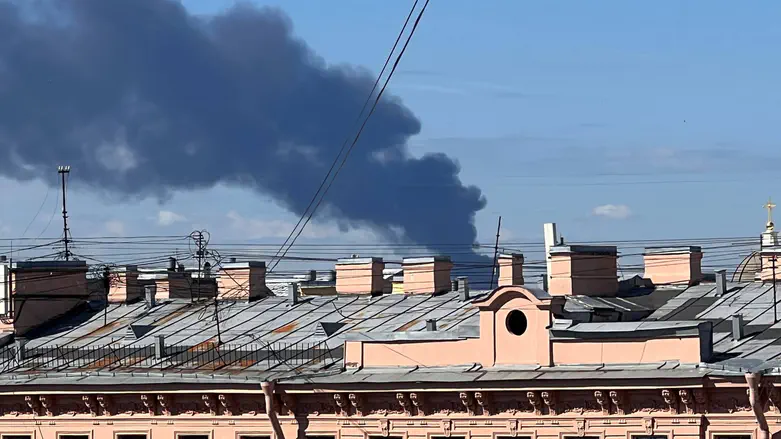
The attack reportedly targeted an oil export terminal and a nearby military facility. By morning, reports emerged of thick smoke rising over various parts of the city, accompanied by powerful explosions.
Ukrainian President Volodymyr Zelensky confirmed that Ukrainian forces were responsible for the strike on the fuel facility and military site.
The timing of the attack is considered particularly sensitive for the Kremlin, as it occurred just hours before the opening of the St. Petersburg International Economic Forum, often referred to as “Putin’s Davos." The forum is intended to showcase Russia as a stable economic power and attract foreign investment. In an unusual development, a senior representative of the US administration is expected to attend the event for the first time since 2018.
Following the attack, Pulkovo Airport in St. Petersburg imposed temporary restrictions on operations, and more than 30 flights were delayed or canceled. The city’s mayor said that several infrastructure sites in three different districts were damaged during the assault.
Meanwhile, the governor of the Leningrad region announced that Russian air defense systems intercepted 59 drones overnight. Russia stated that a total of 354 Ukrainian drones were intercepted across the country during the night. The latest attack comes as the war, now in its fifth year, enters a new phase of escalation in which Ukraine has significantly expanded its long-range strikes while Russia struggles to achieve its objectives.
According to a report in The Washington Post, Russian and European officials believe the Ukrainian attack is part of a broader trend eroding Russia’s advantage. Russian military advances on the front lines have slowed, the country’s economic resources are becoming strained, and attacks deep inside Russian territory are increasing.
These strikes have caused significant disruptions to logistical supply routes, particularly along the land corridor connecting Russia to Crimea and occupied territories in southern Ukraine. Kremlin-linked analysts reported that, due to ongoing damage, authorities in Crimea were forced to restrict fuel supplies, and widespread gasoline shortages were reported in the region over the weekend.
Alongside military pressure, Russia is facing mounting economic challenges. Russian Finance Minister Anton Siluanov warned that the government is preparing major spending cuts across nearly all areas of the budget except defense and welfare. Siluanov said that state reserves are not unlimited and that the cost of the war has far exceeded initial projections.
At the same time, an article published by Russian academic Vasily Kashin in one of Russia’s leading foreign-policy journals argued that the war aims set by Putin-chief among them the conquest of the Donbas region-are no longer achievable due to continued Western support for Ukraine and Kyiv’s ability to mobilize forces.
European officials believe the Kremlin is attempting, through threats and escalation-including indirectly fueling concerns about potential attacks on NATO’s Baltic member states-to create pressure that could lead to renewed negotiations on terms favorable to Moscow. However, those same officials say that developments on the ground point to the opposite trend: a gradual erosion of Russia’s advantage and an expansion of Ukraine’s military operations. In recent months, a new pattern has emerged in which Ukraine has succeeded in liberating more occupied territory than the additional territory Russia has managed to capture.