
There seems to be renewed confusion about whether Israel may legitimately define itself as the nation-state of the Jewish people. Odeh Bisharat, an Arab Israeli journalist, writer, and social activist, recently raised this question in Haaretz, asking whether “our nation-state" is not also the state of the Arabs, who constitute approximately 20 percent of Israel’s population and “to their misfortune are not Jews."
The question is not new. It goes to the heart of the permanent campaign to challenge Israel’s legitimacy: not merely its borders, not merely its policies, but its very identity as the restored sovereign home of the Jewish people.
Let us be clear.
The right of the Jewish people to re-establish sovereignty in their ancestral homeland is anchored in natural right, historical continuity, religious identity, and international law. Like every other nation, the Jewish people possess the inherent right to self-determination-to be masters of their own fate in a sovereign state. But in the Jewish case, this right is not abstract. It is tied to a three-thousand-year connection to the Land of Israel, a continuous physical presence, and an unbroken spiritual bond to the land where Jewish identity, prophecy, monarchy, language, law, and national consciousness were formed.
The late Abraham Joshua Heschel, professor of Jewish Ethics and Mysticism explained that Israel is not a mere political refuge, but “an intimate ingredient of Jewish consciousness, at the core of Jewish history, a vital element of Jewish faith." For the Jews, he wrote, this was “the one and only Homeland, the only conceivable place where they could find liberation and independence, the land toward which their minds and hearts had been uplifted for a score of centuries and where their roots had clung in spite of all adversity." It was the homeland with which “an indestructible bond of national, physical, religious, and spiritual character had been preserved."
Modern international recognition did not create the Jewish connection to the land. It acknowledged it.
-The 1917 Balfour Declaration recognized the need for a Jewish national home.
-The San Remo Resolution of 1920 transformed that principle into part of the postwar international settlement.
-The 1922 League of Nations Mandate for Palestine formally recognized “the historical connection of the Jewish people with Palestine" and the grounds for “reconstituting their national home."
-Article 80 of the UN Charter later preserved existing rights granted under League of Nations mandates unless lawfully altered.
In other words, Jewish sovereignty was not a colonial invention. It was the international recognition of an ancient people returning to its historic homeland.
The modern legal framework of Jewish sovereignty
Israel’s domestic legal framework gives practical expression to this principle. The Law of Return, enacted in 1950, grants every Jew the right to immigrate to Israel and receive citizenship. This law is not discriminatory in its essence; it is restorative. It exists because the Jewish people were exiled, persecuted, dispersed, and nearly annihilated in the lands of others. It provides the legal mechanism for the ingathering of the exiles.
The Basic Law: Israel as the Nation-State of the Jewish People, enacted in 2018, further codifies what had always been the foundational premise of Zionism and of the State of Israel: that the Land of Israel is the historical homeland of the Jewish people, and that the right of national self-determination in the State of Israel is unique to the Jewish people.
This does not mean that non-Jewish citizens have no civil rights. It means that Israel, like many democratic nation-states, distinguishes between individual civil equality and collective national identity. France is the nation-state of the French people. Greece is the nation-state of the Greek people. Poland is the nation-state of the Polish people. Israel is the nation-state of the Jewish people.
That principle should not require an apology.
Historical reconstitution, not new creation
A critical distinction must be made between “historical reconstitution" and “new creation."
Israel did not emerge as a new artificial identity carved out by colonial administrators. The League of Nations Mandate itself used the language of reconstitution, recognizing that the Jewish national home was being restored, not invented. Israel’s 1948 Declaration of Independence likewise speaks of the Jewish people re-establishing their sovereign state in their ancestral land.
The word matters. Re-establishment means continuity. It means that the modern State of Israel is connected to the ancient kingdoms of Israel and Judah, to Jerusalem, to Hebrew, to Jewish law, to the Temple, to exile, to return, and to the national memory that sustained Jews for two millennia.
The Law of Return embodies this idea. Jewish immigration to Israel is not simply migration. It is homecoming.
The new creations of the Middle East
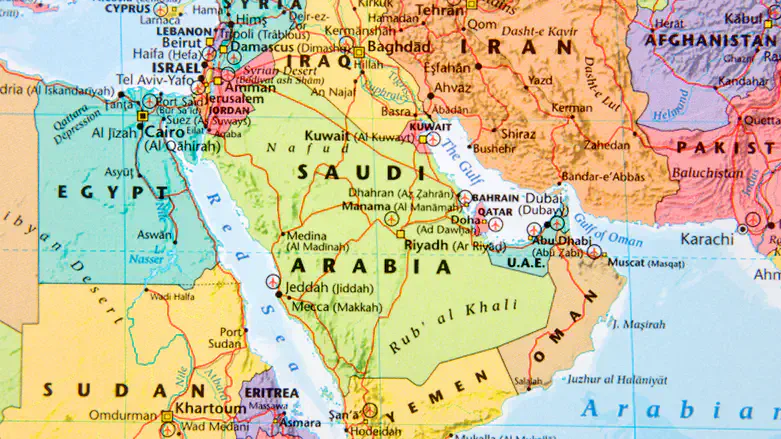
By contrast, many neighboring Arab states are modern political constructs whose borders and identities were shaped in the twentieth century out of Ottoman provinces, tribal regions, colonial mandates, and European strategic arrangements.
Political scientist Gabriel Scheinmann has noted that names such as Syria, Libya, and Palestine were revived from earlier historical or geographic usage. Libya reappeared in 1934 when the Italians combined Cyrenaica, Tripolitania, and Fezzan. “Syria" became the name of a modern state under the French Mandate. Iraq had once been a medieval province of the caliphate. Lebanon referred originally to a mountain. Jordan referred only to a river.
These borders were often not created by coherent demography, natural geography, or ancient national identity. Large populations were divided across newly drawn frontiers. The Kurds were split among Turkey, Iran, Iraq, and Syria. Shiite Arabs were divided among Iraq, Kuwait, Bahrain, and the eastern provinces of Saudi Arabia. Alawites were dispersed along the Syrian, Lebanese, and Turkish coastal regions.
States such as Iraq, Jordan, Syria, and Lebanon had to build national identity after the fact, often by merging religious, tribal, ethnic, and sectarian communities into political frameworks that had never previously existed as unified modern nations. The result has often been chronic instability, identity crisis, sectarian conflict, and the reliance on monarchy, military rule, or state nationalism to impose cohesion.
Israel’s critics rarely acknowledge this contrast. They treat Israel, the restored nation-state of an ancient people, as illegitimate, while accepting without hesitation the legitimacy of states whose borders were drafted by imperial powers only a century ago.
The Arab minority inside Israel
What is also often ignored is that Israel is not a racial state. It is a multiethnic, multiracial, multilingual society in which Arab citizens participate actively in civic, political, judicial, academic, medical, diplomatic, and even security institutions.
Khaled Kabub served as a justice on Israel’s Supreme Court. Issawi Frej and Raleb Majadele have served as cabinet ministers. Arab parties have sat in the Knesset since Israel’s founding.
Arab citizens serve as hospital directors, university professors, judges, diplomats, senior police officials, and military officers. Professor Masad Barhoum has served as director general of Galilee Medical Center. George Deek has represented Israel as a senior diplomat. Jamal Hakroush rose to a senior rank in the Israel Police. Ghassan Alian has served in senior leadership in the IDF.
This does not mean Israel is free of social tensions. No country is. But it does expose the dishonesty of the claim that Jewish sovereignty is inherently incompatible with minority rights. The Jewish character of the state coexists with civic participation by non-Jews at the highest levels of Israeli public life.
The real objection is not that Arabs lack civil rights in Israel. The real objection is that Jews have national rights in Israel.
How much is enough?
The Allied Powers recognized Arab self-determination across the overwhelming majority of the Middle East. Today, there are more than twenty Arab states stretching across millions of square miles. The combined territory of the Arab states is roughly six hundred times larger than the State of Israel.
And yet the one Jewish state-tiny, embattled, and located on the ancestral land of the Jewish people-is treated as the great moral anomaly of the region.
The question must be asked plainly: how much is enough?
How many Arab states are sufficient before the Jewish people may be permitted one? How many millions of square miles must surround Israel before the world stops pretending that the core injustice in the Middle East is Jewish sovereignty in Jerusalem?
The shrinking of the Jewish national home
The original Mandate for Palestine included territory on both sides of the Jordan River. But in 1921-1922, Britain severed Transjordan from the Mandate framework and placed it under Abdullah’s rule, effectively removing roughly 77 percent of the Mandate territory from the area available for the Jewish national home.
This was not a minor administrative adjustment. It was a major geopolitical concession designed to appease Arab unrest and British strategic interests. Jewish national aspirations were confined to the territory west of the Jordan River.
Then came the 1947 UN Partition Plan, which proposed dividing the remaining territory into a Jewish state and an Arab state. The Jews accepted partition. The Arab side rejected it and launched a war of annihilation.
Note: The 1949 Armistice Lines-the so-called Green Line-were not internationally recognized borders, but ceasefire lines drawn after Israel survived the assault.
Judea and Samaria was occupied and annexed by Jordan. Gaza was controlled by Egypt. No Palestinian Arab state was created in either territory during those nineteen years. The demand for a Palestinian Arab state became urgent only after Israel, not Jordan or Egypt, controlled the territories after 1967.
That historical fact is devastating to the conventional narrative.
The issue is legitimacy
Ultimately, the issue is not geography. It is legitimacy.
For Israel’s most implacable enemies, no border will be enough, no concession will be final, and no sliver of a Jewish state-no matter how small-will ever be acceptable. If Israel withdraws, they call it insufficient. If Israel defends itself, they call it aggression. If Israel appeals to history, they call it mythology. If Israel cites international law, they call it colonialism. If Israel grants civil rights to minorities, they still deny its right to define itself as Jewish.
This is why the campaign is not only on the battlefield but in the courtroom, fought by invasion armies as well as NGOs, in tanks and tribunals, from terror tunnels to academic departments, media platforms, and international institutions.
The objective remains the same: to make Jewish sovereignty appear morally suspect, legally unstable, and historically fraudulent.
But Israel is not a historical fraud. It is the restored nation-state of the Jewish people. It is the answer to exile, dispersion, persecution, and genocide. It is the only place on earth where the Jewish people exercise collective sovereignty, speak their ancient language as a living tongue, defend themselves by their own army, and shape their national destiny by their own will.
There are more than twenty Arab states. There is one Jewish state.
That is not an injustice. It is the minimum justice history demands.