
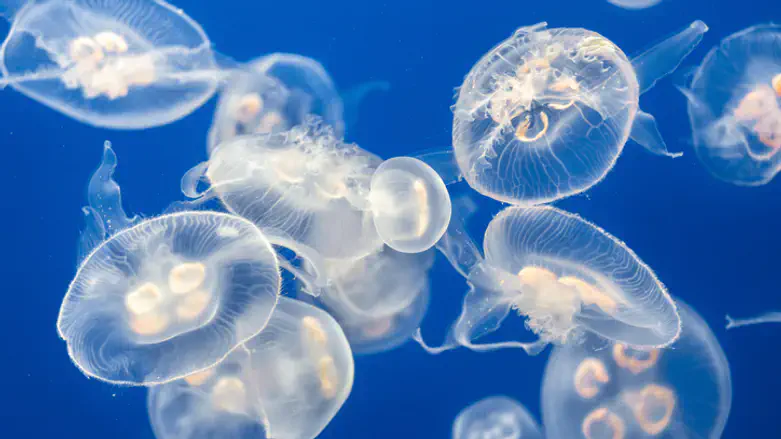
With the start of jellyfish season in Israel, marine biologist Dr. Razi Hoffman, a lecturer at the Levinsky-Wingate Academic Center, tells us how to identify jellyfish from a distance, how their stings work, the proper treatment for a sting, and what you should definitely not do afterward.
To find out whether the sea is full of jellyfish, Dr. Hoffman says, “One of the most interesting and useful tools for the public is a website created specifically to provide real-time information on jellyfish activity. You can access it from your phone or computer. The site, called "Meduzot Ba’am" (‘Jellyfish Co.’), features a map showing the jellyfish sightings along Israel’s Mediterranean coastline." The site provides numerical reports indicating how many jellyfish have been spotted at specific beaches and what species they are.
If you do not have access to the website but still want to know whether a swarm is waiting offshore, Hoffman recommends a simple method: walk along the beach and see whether dead jellyfish have washed ashore. If there are dead jellyfish on the beach, there are likely live jellyfish in the water.
Hoffman notes that when it comes to the smooth blue-rimmed jellyfish, there is little cause for concern because its sting is mild. The same applies to the spotted bell jellyfish, which he describes as “the most beautiful jellyfish, with a bluish bell and blue spots." It is also considered harmless.
“The problematic one is the nomad jellyfish," he says. “It got its name because people believed it arrived from different parts of the world, but it turns out that’s not the case. They reproduce south of us, near Egypt."
Explaining how the nomad jellyfish stings, Dr. Hoffman says that every jellyfish has hunting tentacles. In the nomad jellyfish, these tentacles contain a powerful venom-delivery system.
“There are tens of thousands of stinging cells in each tentacle. At the end of each cell is a tiny harpoon-like structure that embeds itself in the skin and injects venom. Contact with a tentacle means hundreds or even thousands of these microscopic harpoons can become lodged in the skin, causing the sting."
As for the body’s reaction, Hoffman says it depends on a person’s sensitivity. People who know they are sensitive should take precautions, such as wearing a Lycra suit when entering waters known to contain jellyfish swarms.
“For people who are not particularly sensitive, it’s usually just an unpleasant sting and nothing more," he says.
For those who are more sensitive, however, “the venom can remain in the affected area for a long time, and the site may become infected. In rare cases it can even become life-threatening, although most people are never in real danger."
He adds that the immediate reflex to pull away from the sting usually helps prevent additional contact and further stings.
So what should you do after being stung?
“If you’ve been stung by a nomad jellyfish, don’t panic," Hoffman says. “It burns and can remain uncomfortable for several days. The best approach is to stay in the water at a safe distance and rinse the area with seawater for 10 to 20 minutes without applying pressure."
He stresses what should not be done: “Do not rinse with fresh water. If fragments of tentacles remain on the skin, fresh water can trigger them to release even more venom."
“When it comes to a small child or an infant, it’s more complicated because it’s difficult to stop them from scratching the area, which only increases the irritation," he adds. “The recommendation is to rinse the area for a period of time and preferably apply aloe vera-based products, which can help soothe the sting."