
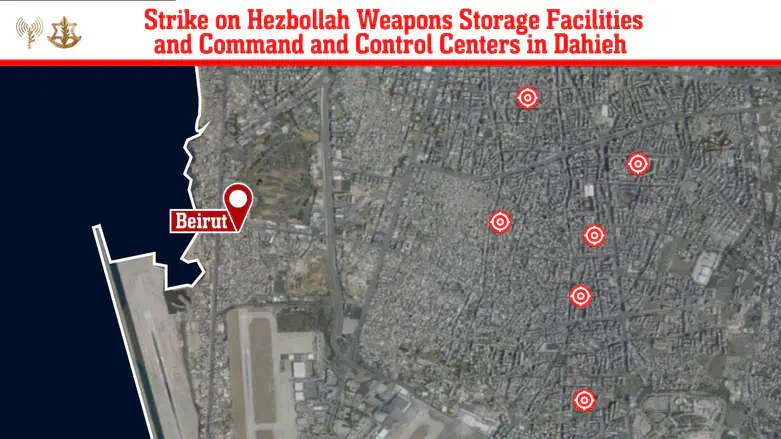
Israel should conduct targeted strikes in the Dahieh with a clear and relevant operational purpose, namely against Hezbollah infrastructure and operatives. The Dahieh constitutes one of Hezbollah’s three main centers of power in Lebanon.
What is meant by the term “Dahieh"? Which area does it refer to? How is it geographically divided? Which municipalities formally belong to the Dahieh, and which neighboring areas, while not officially part of it, are commonly considered part of the broader Dahieh area? How many residents live in the Dahieh?
The term “Southern Dahieh" (الضاحية الجنوبية), or the “southern suburb of Beirut," is used in two different senses: an administrative-formal sense and a broader geographic-urban sense. Formally, the Dahieh is represented by the Union of Municipalities of the Southern Dahieh (اتحاد بلديات الضاحية الجنوبية), which includes only four municipal entities: Haret Hreik (حارة حريك), Ghobeiry (الغبيري), Borj al-Barajneh (برج البراجنة), and Mreijeh-Tahwitat al-Ghadir-Laylaki (المريجة - تحويطة الغدير - الليلكي). These municipalities officially constitute the Dahieh.
However, from a geographic and urban perspective, and in public, media, and academic discourse, the term “Dahieh" is often used to describe a broader urban area south of Beirut that includes four additional districts. Under this broader definition, areas such as Hay al-Sellom (حي السلم) and Ouzai (الاوزاعي) are also included, even though they are not part of the official municipal union. Likewise, areas such as Chiyah (الشياح) and Hadath (الحدث), which are not formally part of the Dahieh, are sometimes included in geographic and planning descriptions of the area because of the continuous urban fabric and their close urban connections with the formal Dahieh municipalities. The area of Aamroussieh (العمروسية), located in the southern part of the attached map, is not generally considered part of Greater Dahieh, although Hezbollah also maintains a presence and influence there.
The population of the Dahieh is currently estimated within a broad range of approximately 300,000 to 800,000 residents, depending on how its boundaries are defined. According to the most commonly cited estimates, the population is approximately 600,000-700,000.
All eight areas mentioned above are under Hezbollah’s influence and host a significant presence of Hezbollah members and supporters. Haret Hreik is considered the center of the Dahieh, where Hezbollah established its “main security zone" - an area that, until 2024, served as the organization’s primary headquarters district.
As part of the lessons learned from the fighting over the past two and a half years, Hezbollah dispersed some of its military infrastructure to other areas in Beirut and across Lebanon. Some of these assets were relocated from the Dahieh in general, and from Haret Hreik and the main security zone in particular.
Nevertheless, the Dahieh still contains numerous Hezbollah operational facilities that continue to serve a variety of operational purposes.