

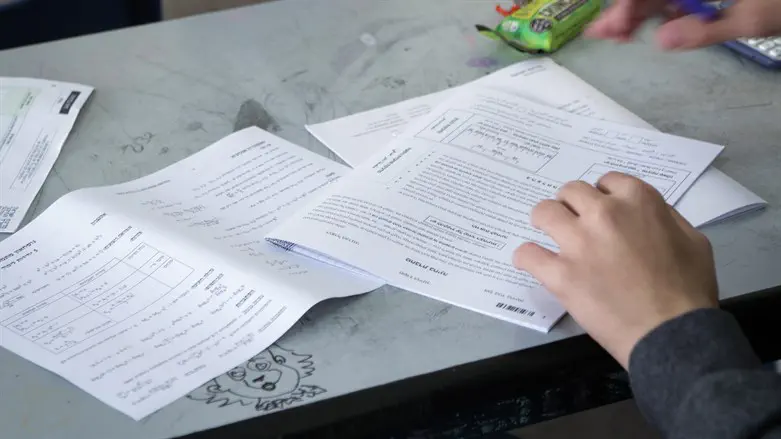
Israel's Ministry of Education announced on Sunday the postponement and cancellation of the matriculation exams that were scheduled to be held this week in dozens of localities in the north of the country, due to the serious escalation in the security situation and the heavy barrages by Hezbollah.
Minister of Education Yoav Kisch made clear that the ministry would not allow the endangerment of students and teaching staff, and declared: "No exams under fire."
According to the decision, students in communities along the border, as well as students in many additional communities in northern Israel, will receive special accommodations for all matriculation exams scheduled between May 31st and June 5th.
As part of the division, the national matriculation exam in history, scheduled for Monday, will be cancelled for those students, and the internal grade given by the school will be counted as their final matriculation grade.
A similar decision was made regarding the matriculation exam in Arabic for Arabic speakers scheduled for Tuesday. Examinations in advanced-level subjects (5-unit matriculation courses) scheduled for Wednesday have been postponed for the time being. The Examinations Division will announce alternative dates or other solutions at a later stage.
The directive will apply to students in communities located along the border, as well as students in the following localities: Or HaGanuz, Meron, Bar Yochai, Safsufa, Yesud HaMa'ala, Kisra-Sumei, Beit Jann, and Sde Eliezer.
It will also apply to students in the following communities, in addition to those already defined within the third security ring: Abu Snan, Bi'ina, Jdeideh-Makr, Julis, Deir al-Asad, Hatzor HaGlilit, Tuba-Zangariyye, Yanuh-Jat, Yarka, Kafr Yasif, Karmiel, Majd al-Krum, Mazra'a, Nahf, Sajur, Acre, Safed, and Rama.
“Decisions regarding the continuation of the examination period will now be made on a weekly basis," the education minister emphasized. “Our goal is to provide students, parents, and educational staff with as much certainty as possible during these complex days, while maintaining the maximum flexibility required in a changing and dynamic security reality."