
Negar Karamati is a journalist and former Persian language news editor, and an anchor who works in the legal field. She writes on Iran‘s political and social issues, including women's rights and Iran's religious minorities, particularly the Baha’i.
Today’s Iran feels like a society on the verge of explosion, a nation exhausted, wounded, humiliated, and trapped between fear and anticipation.
In the silent streets of Tehran, Mashhad, Shiraz, Ahvaz, and Tabriz, people no longer speak of a brighter future. Instead, they talk about “when the next war will begin." This may be one of the darkest moments in modern Iranian history: a point where part of society no longer sees foreign intervention as a threat, but as the last remaining path to salvation. Meanwhile, each night, the regime’s propaganda machine continues its theatrical performances.
Years of repression, executions, corruption, poverty, lies, and humiliation have pushed Iranian society to a breaking point. Many young Iranians no longer believe the Islamic Republic can be reformed from within. A generation that shed blood during the protests of December 2017, November 2019, and the “Woman, Life, Freedom" movement has increasingly concluded that without an external shock, without the collapse of the regime’s security apparatus, no path to liberation remains.
For many protesters, the United States and Israel are therefore no longer viewed merely as foreign powers, but as forces that may ultimately help bring an end to this 46-year nightmare.
To this generation, even destruction appears less costly than the continuation of the current reality. They argue that a country ruled by the Islamic Republic is already devastated: the economy has collapsed, the national currency has been destroyed, executions are rampant, social hope has vanished, and young people are either imprisoned or dreaming of escape. A society humiliated day after day no longer fears war, because it has already spent years living through a permanent war against life, freedom, and human dignity.
Since the ceasefire and Donald Trump’s renewed talk of diplomacy and deals with Tehran, the Islamic Republic’s machinery of repression has regained momentum. The regime interpreted the ceasefire not as a sign of peace, but as an opportunity to rebuild an atmosphere of fear.
Figures such as Ahmadreza Radan and Gholam-Hossein Mohseni-Eje'i have once again returned with the language of threats, prisons, and executions in an effort to silence dissent. The regime knows well that beneath the ashes, the anger of Iranian society is still burning and that if security pressure weakens even briefly, the next eruption may become impossible to contain.
Internet access, though returned, remains restricted. Authorities continue using security concerns and the threat of war as justification for tighter control. Censorship has intensified, arrests continue, and the country’s atmosphere has become deeply securitized.
At the same time, inflation, shortages, the collapse of the national currency, and what many describe as a hidden famine have pushed daily life to the edge of breakdown. Families once considered middle class now struggle to meet even their most basic needs. Yet instead of accountability, the regime devotes its energy to psychological warfare and state propaganda.
Perhaps most painful of all is the silence of the world.
Many Iranians feel abandoned by the same international community that speaks of human rights while continuing to negotiate with Tehran, keep embassies open, and advocate for “constructive engagement." Europe, in particular, appears trapped in a growing moral contradiction. European leaders issue statements about freedom and women’s rights while simultaneously maintaining political and economic ties with the Iranian regime. To many Iranians, this amounts to nothing less than legitimizing repression.
Amid this reality, one of the few international voices consistently attempting to keep Iran at the center of global attention is Crown Prince Reza Pahlavi. In conferences, interviews, and public appearances, he continues warning the world about the dangers of the Islamic Republic’s survival and the suffering of the Iranian people.
Networks linked to the regime and ideological groups abroad work relentlessly to discredit him. They understand that within a fragmented and leaderless opposition, he remains one of the few figures capable of keeping the Iranian issue visible on the international stage.
The reality is that Iran’s opposition is itself in deep crisis. Personal rivalries, internal divisions, security infiltration, and the absence of a practical roadmap have paralyzed much of the anti-regime movement. Many speak, issue slogans, and publish statements, but few offer a realistic plan for a post-Islamic Republic transition.
In this environment, exhausted Iranian society feels more abandoned than ever.
And yet, beneath this heavy layer of despair, sparks of resistance remain alive.
Young Iranians continue using every available opportunity to break censorship. Images of those killed, videos of repression, and testimonies from political prisoners continue circulating across social media. The regime seeks to erase the collective memory of the people, but a generation that witnessed the blood of its friends in the streets does not forget.
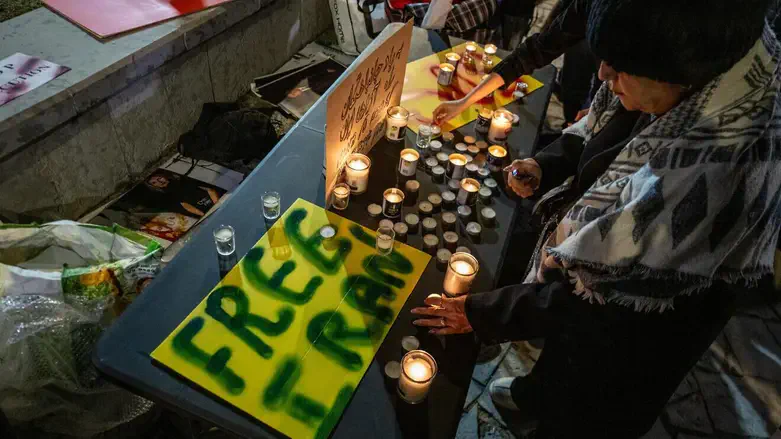
Outside Iran, protesters and activists continue trying to keep the issue alive through demonstrations, campaigns, gatherings, and media work. Many believe that if the world forgets Iran, the Islamic Republic will feel even freer to intensify its repression.
Iran today is a country suspended between explosion and oblivion: a weary society that no longer believes in reform, and a government that understands only the language of force.
The world may still not fully grasp the depth of this crisis, but beneath the surface of Iran’s cities, something is taking shape, the anger of a generation that no longer has anything left to lose.
And today, more than ever, national anger and hatred toward the Islamic Republic have spread across Iran, accumulating quietly but relentlessly beneath the surface of society.