
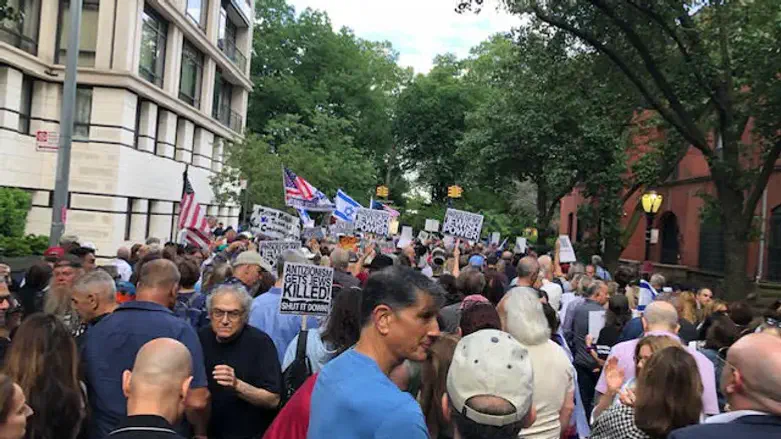
I attended the May 26 rally protesting Mamdani.
It is hard to be critical because I have been calling for a 10,000-man march for quite a while now, and the turnout was respectable. People came with their hearts in the right place and with good intentions.
I came with three of my sons. One carried a massive American flag. We wore shirts I designed. One depicted two soldiers facing one another beneath the message that Jewish self-defense is a moral imperative.
Our Sons Left and Tee Created for our hotel’s Restaurant- Art Gallery - Center
The other showed a superhero bearing the Hebrew letter צ for Zion on his chest, confronting antisemitism.
Tees Created for the Blue Moon hotel’s Restaurant- Art Gallery - Identity Center
The message was simple: we are a peaceful people, but we will not allow ourselves to be programmed for abuse. Jewish defense is not aggression. It is civilization defending itself. There are consequences when Jews are struck, and there must be consequences when evil is tolerated.
This was the message I had hoped to hear from the stage.
Alas, the rally was mostly about Mamdani. Although obviously important, that meant it was far less about us: what we must do to overcome apathy, build institutions, strengthen ourselves, and move forward as a coalition of Democrats, Republicans, independents, civil-rights advocates, and all who understand that antisemitism is a threat to civilization itself.
I do not believe it is wise for Jews to place all their eggs in one political basket. History has taught us that lesson too many times.
Still, there were positives. The turnout was sizable. The people who came had their hearts in the right place. Many prominent Jewish voices and internet personalities were present. Yet little of substance was said about the responsibilities before us.
Upon arriving, I encountered perhaps the day’s most revealing optics. Mamdani’s camp had dispatched members of the fringe group Neturei Karta to serve as a visual prop. How pathetic, how sad.
Later, two of my sons and I pushed our way toward the stage to find my son Pace, who stood proudly holding the American flag. We listened. We cheered when appropriate. We tried to interject what we believed was missing.
Not anger. There was plenty of anger.
Not attendance. The turnout was respectable.
Not concern. Everyone understood the stakes.
What I felt was missing was unity and faith in G-d.
Jewish unity.
A call for Jewish unity, which includes G-d. The pivotal force in the People of the Book and the core basis for our fundamental support in America.
The two forces that have carried the Jewish people through exile, persecution, expulsions, pogroms, and genocide.
The kind of unity that history demands. The kind in which our petty differences vanish before greater responsibilities. The kind that remembers that divided Jews are vulnerable Jews.
People came angry, but few came with a vision.
These were, by and large, the unidentifiable Jews: suburban Jews, Upper East Side and Upper West Side Jews, urban professionals with little reference to what it is like to live as an identifiable inner-city Jew. Perhaps that is changing.
It is a fact I learned early in life. When I was nine years old and first put on a yarmulke, my Italian Catholic father looked at me with pride and told me pointedly that it would be a bullseye. Not to be intimidated. Not to be confrontational. But to understand reality and make sure that, if necessary, I could be a devastating counterpuncher.
The yarmulke people were widely missing, save for the Neturei Karta paid shills. Sadly, the Jews who live with daily hate were not there. The day schools. Brooklyn. Queens. Riverdale. Staten Island. The community synagogues and Jewish centers.
Had they been there, it might have moved beyond a feel-good moment and become something redemptive.
The lesson is that Jewish activism cannot be sustained solely by social media personalities, political operatives, or occasional demonstrations. It must be rooted in the people themselves.
In the neighborhoods. In the schools. In the synagogues. In the families.
If we cannot inject pride into our people, reconnect spiritually with one another and with G-d, and inspire Jews to stand visibly and unapologetically as all kinds of Jews, we will continue to witness the dissolution of our city and the erosion of our daily lives.
The rally showed that Jews are worried, but not yet ready to embrace one another, reclaim our story, and move forward as a people.
Randy Yisroel Settenbrino is a writer, artist, and public intellectual, a passionate advocate for Israel and Jewish-Christian solidarity, and the founder of the Historic Blue Moon Hotel, recognized by National Geographic as one of the 150 most unique projects in the Western Hemisphere. Founder of Ohr Chodosh L’Zion, a cultural and spiritual initiative dedicated to restoring Jewish identity, courage, and moral clarity through the fusion of art, history, and living faith. His newest release on Amazon Between the Altar and the Sanctuary: The Life, Faith, and Fire of Rabbi Meir Kahane,