
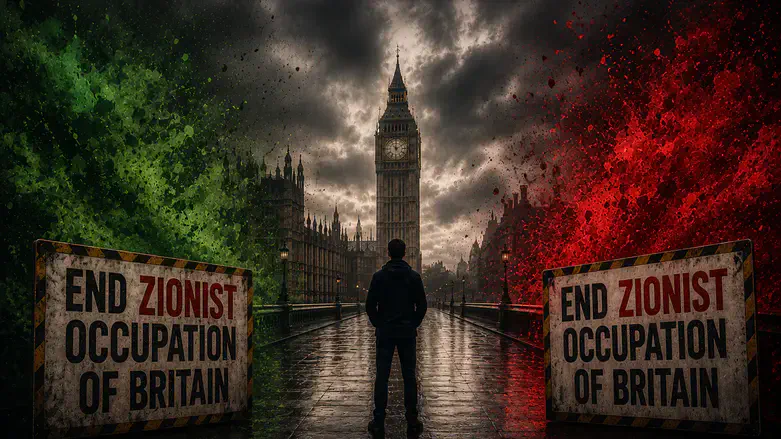
There was a time when the political extremes in Britain existed largely on the fringes. Loud, certainly, occasionally dangerous, but contained on the outskirts nonetheless.
Today, they are no longer knocking at the gates of mainstream politics, they are the gates.
Years ago, Nigel Farage offered a warning that many dismissed as self-serving hyperbole. If people thought he was an extremist they should realise that, if he failed, the populist leaders who came after him would make him appear a pillar of moderation.
Those words now feel less like arrogance and more like prophecy and in truth, the same could equally have been said of Jeremy Corbyn.
Regardless of your politics, regardless of whether you view either man as hero or villain, both understood something fundamental about modern political culture before much of the establishment did: anger mobilises faster than hope, division spreads quicker than unity. What they failed to acknowledge or certainly never managed to successfully address, was that if you build a movement around grievance, eventually grievance becomes the movement’s only purpose.
Corbyn did not merely lead the Labour Party, he transformed it into something unrecognisable. A mainstream political institution hollowed out and repopulated by ideologues, activists and antizionist obsessives who viewed moderation itself as moral weakness.
Farage, meanwhile, dragged insurgent populism from the political wilderness into the bloodstream of British politics. What once sat outside the establishment now shapes it. Former Conservative ministers queue to stand beside him, television networks hang on his every word. Reform is no longer a protest movement, it is a genuine political force.
Herein lies the uncomfortable symmetry.
By the time Corbyn had finished reshaping Labour, and Farage had finished legitimising permanent outrage politics on the right, the distance between establishment and insurgency had all but collapsed. One mainstream party descended into radicalism while one radical movement climbed towards legitimacy, until both effectively met somewhere in the middle, not ideologically, but structurally, positionally.
Two cults of personality, two movements fuelled by resentment, two ecosystems that rewarded anger over nuance and purity over pragmatism.
As ever in politics, the next generation learned from the pioneers.
On the left, we now witness the rise of Zack Polanski, a figure so performatively progressive and ideologically assembled that at times he feels less like a serious political leader and more like a social experiment designed to test whether the modern activist left will applaud absolutely anything, provided it is wrapped in the language of oppression, identity and resistance. Around him sits a Green movement that increasingly appears less concerned with environmentalism than with performative revolutionary politics, anti-Western grievance and obsessive hostility towards Israel. A movement where the line between activism and sectarianism grows thinner by the day.
On the right, figures like Rupert Lowe emerge from the same politics of permanent fury. Louder, harder, more conspiratorial. More willing to weaponise cultural fracture for political gain.
Look closely at some of the rhetoric already emerging around his Restore movement and the mask slips quickly. One policy proposal would seek to ban religious slaughter practices under both Jewish and Muslim law, a position that would make meaningful Jewish and Muslim life in Britain practically impossible. This is always how exclusionary nationalism presents itself in its early stages: not as hatred, but as “common sense", “British values" or “cultural protection".
Then come the inevitable hangers-on, candidates and campaigners sharing antisemitic tropes online, one reportedly even posting birthday wishes to Hitler. The kind of behaviour that, years ago, would have instantly disqualified someone from public life, but which now barely survives a single news cycle before the outrage machine moves on to its next target.
Which is why the old lyric from Stealers Wheel feels less like classic rock nostalgia and more like a diagnosis of modern Britain:
'Clowns to the left of me, jokers to the right…"
Only now, the joke no longer feels particularly funny, because while Britain tears itself apart in an endless culture war, the world outside grows darker still.
This week, Iran’s new Supreme Leader, Mojtaba Khamenei, declared that Israel “will not live to see another 15 years." State television once again broadcast the familiar chants of “Death to Israel" and “Death to America." The language of annihilation remains not merely tolerated by the Islamic Republic, but foundational to it.
Yet, sitting here in Britain as a Jew, I increasingly find myself asking an uncomfortable question.
Which threat should concern us more?
The openly declared enemies abroad who wish to destroy the Jewish homeland?
Or the slow corrosion at home, where politics on both the hard left and hard right increasingly treats Jews not as fellow citizens, but as symbols onto which every grievance, conspiracy and ideological obsession can be projected?
What begins as anti-Zionism rarely stays confined to Israel and what begins with “protecting British culture" has a habit of ending with minorities being told they no longer truly belong here.
The extremes do not oppose one another nearly as much as they pretend, in truth, they sustain one another. Each side points to the other as justification for becoming even more radical themselves, each needs the other to survive.
Trapped between them sits an exhausted majority of ordinary people who simply want a country that functions, communities that cohere and politics that lowers the temperature rather than permanently setting fire to it.
Increasingly, the centre feels politically homeless, while Jews simply happen to be the minority through which societies most reliably reveal what they are becoming.
So perhaps Gerry Rafferty’s lyric needs updating for modern Britain.
A clown to the left of us
A racist to the right
Here I am, stuck in the middle with Jews.
Leo Pearlman is a London based producer and a loud and proud Zionist. His most recent film about the Oct 7 Nova Music Festival massacre, ‘We Will Dance Again’ has won the 2025 Emmy of the 46th Annual News & Documentary Awards for most ‘Outstanding Current Affairs Documentary’.