

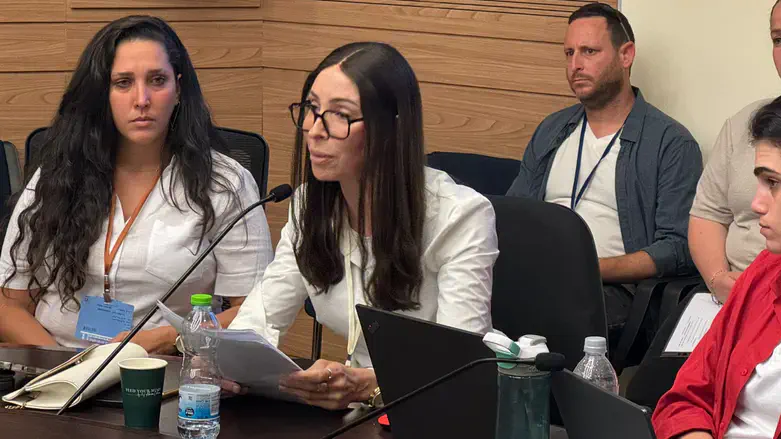
The Knesset Committee for the Advancement of the Status of Women and Gender Equality held a special hearing on Tuesday following allegations of underage marriages in the northern town of Yavne’el, with lawmakers, survivors, and officials describing what committee members called a longstanding and deeply troubling phenomenon.
In 1986, a Breslov community largely consisting of baalei teshuvah (newly religious) adherents was established in Yavne'el by Rabbi Eliezer Shlomo Schick. The community numbers several hundred families and supports and promotes marriage at a very young age, with women marrying at age 15-16 and men at age 18.
Committee chair MK Merav Cohen opened the hearing by saying the issue has persisted for years despite repeated warnings and alleged failures by authorities to stop it.
“This has been in the background for two decades," Cohen said. “This is a principled debate about minors who are forced into marriage and sexual relationships at a young age. Time and again, the public is shocked, but nothing changes, and the authorities fail to stop a phenomenon that endangers lives."
Cohen said findings from an investigative team were “very serious" but had not been made public, adding that the committee would seek answers regarding how the practice was allowed to continue for so long.
During the hearing, women and men from within the community shared personal testimonies describing being forced into marriage as teenagers.
Sarah Maimoni, a mother of eight and grandmother of five who has campaigned against alleged underage marriages in Yavne’el, told lawmakers she was married at 15 and became a mother at 16.
“This is how my childhood was taken from me," she said, describing years of trauma and alleging that girls as young as 14 were being forced into marriage and pregnancy. Maimoni accused welfare authorities of failing to protect children and called for the establishment of a joint police and welfare task force to address what she described as “complete lawlessness" in Yavne’el.
Maimoni further alleged that leaders within the community had consolidated power and used it to perpetuate the practice, saying families who opposed the marriages faced retaliation.
Ruth Reichman also testified that she was married at 16 to a man roughly a decade older than her, despite not wanting the marriage. She said she realized at age 15 that arrangements were being made for her wedding but was forced to keep it secret.
“I wanted to study and build a future," she told the committee. “Instead, I knew I was going to be married off."
Nachman Boltin, who grew up in the Yavne’el community, said he married a 14-and-a-half-year-old girl when he was 18, describing a culture in which teenagers were encouraged to marry young and were taught that it was the correct path.
“We were brainwashed for years that this was the right thing," he said, adding that many children in the community experienced severe untreated trauma.
Social activist Heidi Mozes shared a similar account, saying she was married at 16 against her will despite telling her family she did not want to marry.
“Why wasn’t there an adult there to protect me?" she asked during emotional testimony, criticizing what she described as a lack of enforcement tools to intervene in such cases.
Representatives from the Ministry of Social Affairs and the police addressed the authorities’ handling of the allegations.
Ilan Sharif, head of the cults department at the Ministry of Social Affairs, said the ministry has been aware of concerns in Yavne’el and has worked in recent years to strengthen the local welfare department and improve coordination between agencies.
“This situation is horrific, and we are not minimizing it," Sharif said, noting that welfare staffing in the town had been expanded and that a report on the issue was nearing completion.
Deputy Chief Avi Ayish said police had handled several incidents related to suspected underage weddings, but said such cases are often difficult to prove because events are sometimes presented as “introduction parties" rather than weddings.
Welfare official Ami Romano said social workers had intervened in some cases involving minors dressed for marriage ceremonies and stressed that enforcement powers ultimately lie with law enforcement authorities.
Batya Menachem, a local social worker, said reports often arrive only after the fact, making intervention difficult.
Representatives from the Knesset Research and Information Center presented data showing that between 2023 and 2025, 321 reports of underage marriages conducted without permits were received, but only four indictments were filed.
The Ministry of Health told the committee that there is currently no legal obligation to report pregnancies involving girls over the age of 16, and said legislative changes on the issue may need to be considered.
The hearing highlighted growing calls for stronger enforcement and legislative action amid allegations that underage marriages in Yavne’el have continued for years despite repeated warnings from survivors and activists.