
Dr. Alex Grobman is the senior resident scholar at the John C. Danforth Society, a member of the Council of Scholars for Peace in the Middle East, and on the advisory board of The National Christian Leadership Conference of Israel (NCLCI).
History is again repeating itself in the lecture halls and quadrangles of Western academia. In his book The Third Reich in the Ivory Tower, historian Stephen H. Norwood showed how some of America’s most prestigious universities adopted a hear-no-evil attitude toward Hitler’s Germany that amounted, at times, to moral complicity. Administrators, alumni, faculty, and student leaders at elite institutions often treated Nazism not as a civilization-threatening ideology, but as an uncomfortable political development best managed through courtesy, exchange programs, and silence.
Norwood’s indictment is not that every university leader admired Hitler. Some did not. Harvard President James Bryant Conant, for example, formally opposed Nazi ideology. The deeper failure was institutional: from 1933 through 1937, Harvard still cultivated contacts with German universities and officials, even after those institutions had been “Nazified" and Jewish faculty had been purged. Nazi diplomats and scholars were welcomed onto campuses. Academic exchanges continued. Protesters who tried to expose Nazi brutality were treated as embarrassing disruptors rather than moral witnesses.
Columbia University offered another revealing example. Seven months after the Nazi book burnings of May 1933, Columbia President Nicholas Murray Butler welcomed Dr. Hans Luther, Germany’s ambassador to the United States, to campus. When students objected, Butler dismissed their criticism. A year later, when he had the opportunity to appear with Gerhart Seger, an anti-Nazi refugee and former Social Democratic member of the Reichstag who had escaped Germany, Butler declined. Seger’s testimony could have helped alert students and faculty to the reality of Nazi rule. Butler chose distance instead.
This was not an isolated failure. Vassar, Smith, Mount Holyoke, Wellesley, Bryn Mawr, Radcliffe, Barnard, Yale, Princeton, Harvard, Columbia, the University of Delaware, and others maintained or participated in exchanges, receptions, or cultural engagements with German institutions. German departments and student clubs at American universities hosted Nazi diplomats. Some professors received German honors for promoting friendship between Germany and the United States.
At the University of Virginia’s Institute for Public Affairs, conferences and seminars gave German diplomats and sympathetic scholars an academic platform to soften Germany’s image and revise its responsibility for the First World War.
Until Kristallnacht, much of the academic world treated the Jewish catastrophe as a secondary issue, if it registered at all. Some Catholic universities viewed Soviet communism, not Nazism, as the greater civilizational threat. Others were more invested in cultural diplomacy than moral clarity. By the time the violence became impossible to deny, the habits of accommodation were already deeply entrenched.
The lesson is that elite academic institutions helped normalize a regime whose antisemitism was visible from the beginning. They transformed a moral emergency into an academic difference of opinion. They mistook politeness for sophistication and neutrality for wisdom.
That blindspot has returned.
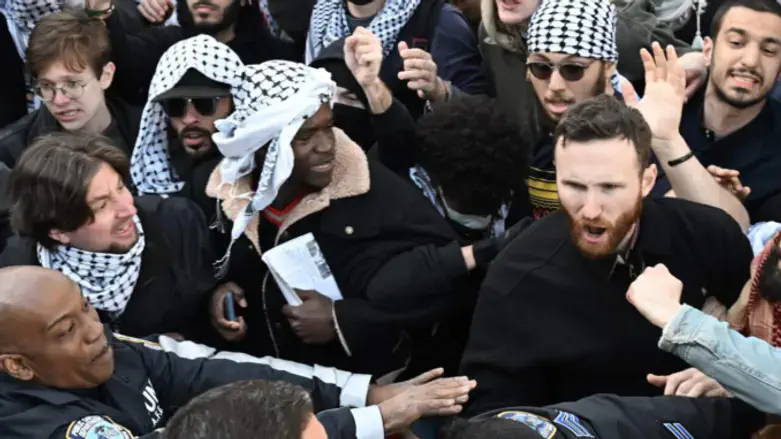
Today, elite campuses are consumed by relentless, highly coordinated activism over Gaza. Students and faculty have every right to debate Israeli policy, criticize the conduct of war, and advocate for Palestinian Arab civilians. That is not the issue. The issue is the grotesque selectivity of the outrage. Gaza has become, for many activists, the defining moral test of the age, while vastly larger or clearer humanitarian catastrophes barely register.
The pattern is not universal compassion. It is ideological targeting.
Hamas is not a misunderstood civic movement. It is a U.S.-designated foreign terrorist organization that governed Gaza, embedded itself among civilians, and launched the October 7 massacre that triggered the current war. Yet on too many campuses, these basic facts are minimized or omitted. Israel is treated as the sole author of Palestinian Arab suffering, while Hamas is treated as background noise.
That is not scholarship. It is narrative laundering, and distorting history.
Meanwhile, where are the encampments against the Islamic Republic of Iran? Where are the mass faculty petitions, divestment campaigns, and student occupations over a regime that hangs dissidents, brutalizes women, sponsors terror, and crushes its own population? According to Amnesty International, Iranian authorities carried out at least 2,159 executions in 2025 alone, more than double the previous year’s total and nearly 80 percent of known executions worldwide. This is not a disputed battlefield allegation. It is documented state murder at industrial scale. Yet Tehran does not inflame the academic conscience the way Jerusalem does.
The same silence surrounds Sudan. Since the war between the Sudanese Armed Forces and the Rapid Support Forces erupted in April 2023, Sudan has become the world’s largest displacement crisis. UNHCR reports that some 14 million people have been forced to flee their homes, roughly one in four Sudanese. International humanitarian organizations report that more than 21 million people face acute food insecurity. Entire communities have been uprooted. Famine conditions have appeared. Civilians have been slaughtered, raped, starved, and driven across borders. Still, Sudan remains a footnote in Western academic life.
This disparity cannot be explained by humanitarian concern. If concern for human life were the governing principle, Iran and Sudan would dominate campus activism. They do not. If opposition to state violence were the governing principle, Syria, Yemen, Afghanistan, China, North Korea, and Nigeria would receive sustained attention. They do not. The academy’s moral imagination expands dramatically when Israel can be indicted and contracts just as dramatically when Jews are not the accused party.
This does not mean criticism of Israel is antisemitic. That argument is absurd and false. Democracies must be criticized, and Israel is no exception. But when Israel is singled out as uniquely evil, when Jewish national self-determination is treated as illegitimate, when Hamas atrocities are excused or contextualized, when Jewish students are told that their identity makes them complicit in genocide, and when chants for Israel’s destruction are rebranded as liberation rhetoric, the line has been crossed.
As demographer Gary A. Tobin argued, asking universities to confront antisemitism is not a demand for censorship. Universities already claim to reject racism, sexism, intimidation, and bigotry. The question is whether antisemitism is included in that moral vocabulary or exempted whenever it appears in the language of anti-Zionism. Academic freedom does not require universities to tolerate harassment, demonization, or speech that normalizes violence against Jews and the Jewish state. It requires intellectual honesty.
The failure of the 1930s was not merely that universities failed to oppose Hitler early enough. It was that they dignified the wrong actors and isolated the wrong witnesses. They hosted Nazi officials but cooled toward anti-Nazi refugees. They maintained exchanges with corrupted German institutions while treating Jewish protest as parochial agitation. They presented indifference as balance.
That is the danger today. University leaders insist they are managing complexity. Too often, they are managing cowardice. They issue careful statements, appoint committees, and hide behind procedural neutrality while Jewish students are intimidated and other mass atrocities are ignored. They teach students to confuse noise with conscience and fashion with morality.
Historian Ruth R. Wisse has observed that antisemites can often rely on the smallness of the Jewish people: persecution of Jews is unlikely to provoke retaliation of equal magnitude, and bystanders can persuade themselves that the matter is marginal to their own lives. The more lethal antisemitism becomes, the more many people prefer not to see it. That is how passive collusion works. It does not always march. Sometimes it merely looks away.
The academy failed that test once. It should not be allowed to fail it again.