
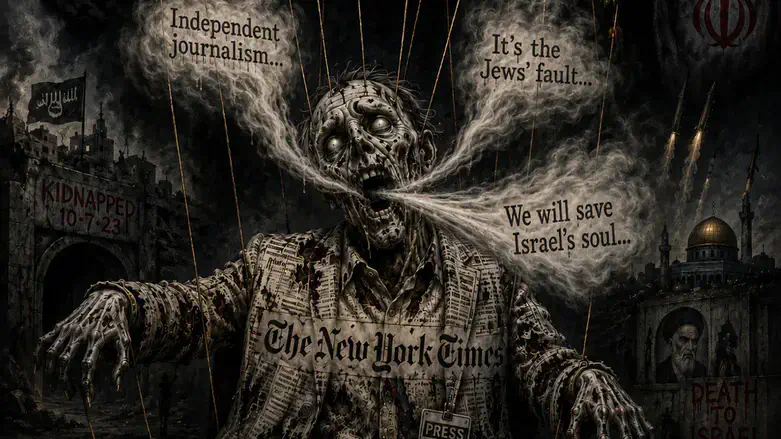
The New York Times still struts around draped in the fading moral velvet of "independent journalism," the walk of a zombie that hasn't yet noticed it's dead. Every outward function of a living newsroom remains intact: it moves, files, publishes, wins awards. What it lost somewhere along the way was the animating soul of the once honorable enterprise of journalism: honest skepticism, proportionate judgment, the willingness to follow evidence somewhere inconvenient. The body still works. The conscience is gone. And Jew-hatred abounds.
Whenever critics expose its frequent distortions, selective framing, manipulative headlines or ideological activism disguised as reporting, the paper erupts in ritualized indignation. Critics are accused of "threatening journalism," "attacking democracy" or "undermining the free press."
Most recently, a spokesperson for the Times accused Israel of attempting to "undermine independent reporting and stifle journalism" after the Israeli Prime Minister's Office threatened legal action over Nicholas Kristof's column alleging widespread sexual abuse of Palestinian Arab detainees, including the use of trained dog rapists. Israel's prime minister and foreign minister called it a defamatory "blood libel," while the Times wrapped itself in the usual reflexive sanctimony about its careful fact-checking and journalistic integrity.
The timing itself raised unavoidable questions. A moment before release of a heavily documentedreport about Palestinian Arab rape culture and the systematic sexual brutality unleashed during the October 7 massacre, the Times suddenly elevated grotesque and unsubstantiated counter-allegations portraying Israelis as the true sexual monsters. The effect was unmistakable: moral inversion, narrative displacement and reputational cover for one of the most barbaric atrocities committed against Jews since the Holocaust.
The Times invokes the sanctity of independent journalism, but the deeper problem is precisely that it is not independent. It is ideologically enslaved to a progressive moral framework that treats Israel, Jewish self-defense and Western power as inherently suspect, while filtering reality through perennial grievance, victimhood and anti-colonial redemption narratives. Zombie journalism does not suppress truth through censorship. It does something more insidious. It alters reality through a living-dead ideological digestive system until what emerges looks like reporting but functions as advocacy.
This is more than bias. Bias implies unevenness. What afflicts the modern Times is a uniquely perverse systemic moral and intellectual servitude. The paper does not merely lean left. It submits, reflexively, almost devotionally, to an ideological catechism in which Israel is guilty before evidence is weighed and Hamas-adjacent claims are dignified before verification.
Among the allegations elevated by the Times was the lurid claim that Israeli forces trained dogs to rape Palestinian terrorist prisoners. The allegation was so grotesque, so anatomically absurd and so perfectly calibrated for Hamas propaganda that any newsroom still possessing a functioning conscience should have treated it like radioactive waste. Instead, the Times elevated it into the bloodstream of respectable discourse.
Which raises a natural question: what comes next?
The Middle East has generated a rich and well-documented tradition of zoological conspiracy theories about Israel, none of which have ever been substantiated. Egypt accused Israel of deploying remote-controlled sharks to attack tourists in the Red Sea. Saudi Arabia detained a griffon vulture on suspicion it was a Zionist spy. Hezbollah captured spy eagles. Iran's military accused Israel of sending lizards to sniff out uranium deposits. Hamas has repeatedly claimed to have captured killer dolphins trained by the Mossad. One waits, with diminishing patience, for the Times to assign a 4,000-word investigation into Israel's alleged army of aquatic assassins and feathered intelligence operatives. Given its recent editorial standards, the pitch would clear every desk in the building.
Unfortunately, the Kristof controversy is not an isolated embarrassment. It is the zombie mechanism laid bare. Kristof was not dealing with transparent evidence, neutral institutions or sources operating in anything resembling a free evidentiary environment. He was operating in the swampiest terrain of modern war propaganda, where detainee testimony, activist intermediaries, hostile "human rights" networks and Hamas-oriented information channels converge around atrocity narratives that are politically priceless. Yet the Times did not recoil from that convergence. It genuflected before it. A claim too obscene and too useful to enemy propaganda was not proven. It was deodorized, elevated and passed through the prestige source-laundering system of the New York Times until it emerged morally weaponized as a "serious allegation."
Today the Times inhabits an ideological ecosystem in which Israel is cast as the permanent oppressor class. Jews may still be tolerated as approved minorities, but Jewish sovereignty, Jewish military power and Jewish refusal to die quietly increasingly violate the emotional grammar of elite progressive culture. This is why the paper's coverage repeatedly bends reality into moral hallucination.
When Hamas massacres civilians, rapes women, burns families alive and kidnaps children, the Times instinctively searches for contextual mitigation. The emotional center of gravity shifts almost immediately toward Palestinian Arab grievance, rage or "cycles of violence." Israeli suffering is acknowledged briefly before being submerged beneath the larger emotional architecture of Palestinian Arab victimhood. The framing itself becomes the propaganda.
A synagogue attacker becomes "a neighbor" struggling with grief. Every Israeli military action is magnified through humanitarian optics while Hamas's embedding inside civilian infrastructure dissolves into atmospheric haze.
When an image of an emaciated Gazan child ricocheted across the globe as implicit proof that Israel was deliberately starving children, the emotional conclusion landed instantly. Later came additional context indicating the child suffered from serious pre-existing medical conditions, followed by quiet corrections buried with infinitely less emotional force than the original imagery.
Scream the accusation. Whisper the correction.
That is how the zombie sustains itself. Not through lies exactly, at least not usually, but through the relentless management of emotional weight: what gets amplified, what gets buried, what gets framed as outrage and what gets framed as context.
The dog rape allegation was something else entirely. It was not a matter of framing or selective emphasis. It was a blood libel, medievally grotesque, published under the Times masthead with minimal verification and maximum global impact. Even by the paper's elastic standards, it stands apart, a reminder that the zombie, given the right ideological conditions, is capable of anything.
The paper portrays itself as courageously speaking truth to power. In reality, hostility toward Israel is among the safest and most rewarded postures available across elite institutions. Universities reward it. NGOs reward it. International bureaucracies reward it. Entire media ecosystems reward it.
The paper is not resisting power. It is serving it.
The Times did not merely become biased. It became undead, still moving, still publishing, still self-righteously wrapping itself in the sacred language of a free press, while the conscience that once perhaps gave those words meaning rotted away long ago.
Daniel Winston is an American-Israeli marriage therapist, trainer of therapists, lecturer and author. He volunteers in the IDF reserves, as a MDA medic, and in the Israel Police Search and Rescue Team. His articles have appeared in Jewish News Syndicate, Israel National News, The Jerusalem Post, Breitbart and elsewhere.