
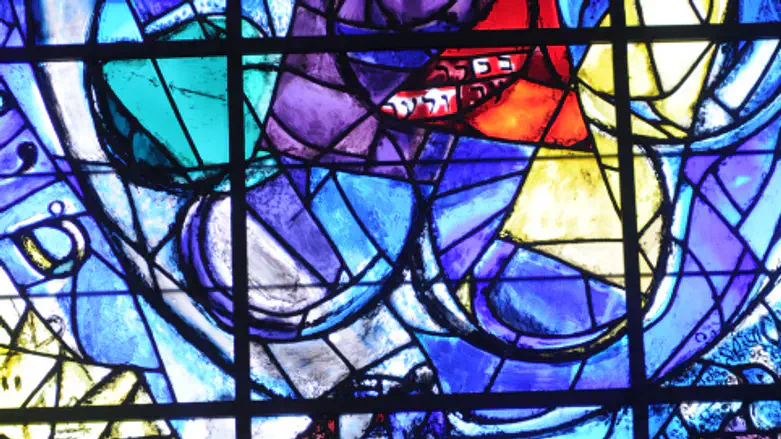
The world appears solid, fixed, and immovable. A wall is a wall, a window is a window, and the difference between them seems obvious: one blocks vision, the other allows it. Yet upon closer examination-through both modern physics and the teachings of Torah-this certainty begins to dissolve. A wall and a window are, in truth, both made of solid matter. The distinction between opacity and transparency is not absolute; it results from an interaction among the observer, the material, and the nature of light itself. This subtle yet profound idea opens a doorway to a deeper understanding: the world we perceive is not as rigid as it seems, and under the guidance of Torah, a person can refine his perception to the point that even a “wall" can become transparent.
From a scientific perspective, the difference between a wall and a window lies not in their solidity but in how their atoms interact with light. All matter is composed of atoms, and within those atoms are electrons that occupy specific energy levels. These energy levels function like a staircase-fixed and discrete. Light, composed of photons, carries energy in discrete amounts. When a photon encounters a material, it can transfer its energy to electrons. If the energy matches exactly what is needed to move an electron from one level to another, the photon is absorbed. If not, it continues onward.
In materials such as wood, brick, or drywall, the energy levels of electrons closely match those of visible light. As a result, visible light is absorbed almost immediately, making the material appear opaque. Glass, however, is structured differently. Its electrons require much higher energy to transition between levels. Visible light does not have enough energy to be absorbed, so it passes through. The same solid object becomes a “window" rather than a “wall." In other words, transparency is not the absence of matter-it is a specific relationship between matter and perception.
This leads to an even more striking realization: what we see is only a narrow slice of reality. If human eyes were sensitive to other wavelengths-such as radio waves or X-rays-walls would appear transparent. Indeed, radio waves pass through walls effortlessly because their energy is too low to be absorbed. X-rays, with extremely high energy, can also pass through many materials. The world itself has not changed; only the observer’s capacity has. Thus, the difference between opaque and transparent is not solely in the object but in the interaction between the object and the observer.
This concept finds a powerful parallel in Torah thought. According to Chassidut and Kabbalah, the physical world is not an independent, self-sustaining entity. Rather, it is continuously sustained by Divine energy. What we perceive as solidity is, in a sense, a concealment-a “garment" that hides the underlying spiritual reality. The Hebrew word for world, “olam," shares a root with “he’elem," meaning concealment. The world is a filtered expression of a deeper truth.
A striking illustration of this idea appears in a well-known story involving the Alter Rebbe, Rabbi Schneur Zalman of Liadi, and Rabbi Levi Yitzchak of Berditchev. At a grand wedding in 1807, the two great tzaddikim approached a narrow doorway. Out of deep mutual respect, neither wished to enter first. As they stood in this respectful stalemate, their chassidim intervened, physically breaking down the walls around the doorway to widen the entrance.
As they passed through, Rabbi Levi Yitzchak remarked with a smile that such drastic measures were unnecessary-they had the spiritual ability to simply walk through the wall. The Alter Rebbe responded with characteristic depth: not everything within one’s power should be exercised. God created a natural order, and one must respect it.
On the surface, this exchange appears to be a discussion of miracles versus nature. But within the scientific framework we have described, it can be understood more deeply. The ability to “walk through a wall" need not violate reality-it may instead reflect access to a deeper layer of reality. Just as different wavelengths of light can pass through matter depending on their energy, so too may a person refined in spirituality interact with the physical world in ways that transcend ordinary limitations. The “wall" remains, but its opacity is no longer absolute.
This is not merely about supernatural ability; it is about perception and alignment. The tzaddik does not see the world as an independent obstacle but as a manifestation of Divine will. When one’s consciousness is fully aligned with that Divine source, the barriers of the physical world lose their rigidity. The same wall that blocks an ordinary person may be perceived differently by one who grasps its inner essence.
A related idea appears regarding the mezuzah. The mezuzah is affixed to the doorway of a Jewish home as a source of protection and blessing, as the Torah states: “So that your days and the days of your children may be prolonged" (Deuteronomy 11:21). The Rebbe, drawing on earlier sources, advised against placing a mezuzah in a metal case. On a simple level, this reflects the symbolism of the Temple: metal, particularly iron, is associated with weapons that shorten life, whereas the altar and the mezuzah represent life, peace, and longevity.
But here too, one can detect a deeper dimension that resonates with the physics of light and matter. Metals behave uniquely because they contain free electrons-particles not bound to specific atoms. When electromagnetic waves, including light or radio signals, strike a metal surface, these electrons move in response and reflect the energy outward. This is why metals are opaque and reflective: they do not allow light to pass through; instead, they reflect it.
In this sense, a metal casing around a mezuzah does more than symbolize obstruction-it physically embodies it. The mezuzah represents the flow of Divine protection into the home, a kind of spiritual “light." A material that inherently reflects and blocks incoming energy serves as a fitting metaphor for interference with that flow. While halacha is not the result of physics, the correspondence is striking: the same material that blocks physical waves also symbolizes, and subtly reinforces, the obstruction of spiritual transmission.
This convergence of Torah and science points to a unified insight: reality is structured, not rigid. Every material filters certain energies and allows others to pass. Every observer perceives only a limited band of what truly exists. The physical world is not a fixed barrier but a dynamic interface, shaped by precise yet deeply layered laws.
The implications for human life are profound. If a wall’s opacity depends on the interaction between light and matter, then the “opacity" of life’s challenges may likewise depend on the interaction between the individual and the situation. Torah teaches that through refinement-through one’s faith and trust in God Almighty, mitzvot, learning, and spiritual service-a person can elevate his perception. He begins to see beyond the surface, recognizing the Divine energy within all things.
In such a state, obstacles are not necessarily removed but transformed. What once seemed an impenetrable wall may reveal itself as a window-a conduit for growth, insight, and connection. The external world remains the same, but the observer's internal framework has changed.
This idea can be illustrated by returning to the image we began with. A human and a moth may both approach a pane of glass. The human sees through it; the moth, lacking the same visual processing, may perceive it as a barrier and repeatedly collide with it. The difference is not in the glass but in the observer. So too, two individuals may encounter the same life circumstance-one experiences it as a dead end, the other as an opening.
The Torah does not deny the physical world or its constraints. Rather, it teaches that these constraints are part of a larger system permeated by the Divine presence. The goal is not to escape the world but to perceive it more truthfully. In the process of doing so, suddenly so much more becomes revealed to this individual, naturally, refining it until its inner transparency is revealed.
In this light, the distinction between a wall and a window becomes a metaphor for consciousness itself. The world can conceal or reveal, block or transmit. The determining factor is not only the object, but the observer. Through the integration of scientific insight and Torah wisdom, we come to understand that reality is not a fixed stage upon which we act, but a responsive system that reflects our level of perception.
A wall is a wall-until it is a window.
I can be reached at rsezagui@gmail.com