
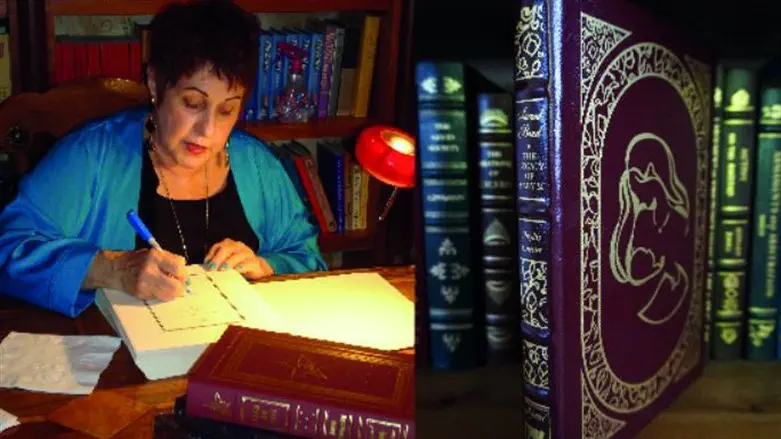
Every single week I receive a letter from God. I'm not kidding. God talks to me--and to each one of us in every chapter of the Torah. God even talks to mighty sinners such as myself. God never gives up.
That's not all. In addition, we have the words of the Prophets, the Writings, the Megillot, (Esther, Ruth, Solomon's the Song of Songs and Kohelet, Eicha, and Judith, in the Apocrypha, etc.); the Mishneh, the Talmud, poetry, psalms, the Zohar, as well as all the amazing commentaries. Preserved here are opposing interpretations of every word, each story. Together, this constitutes a rare treasure which enables intellectual time-travel. Not every genius agrees with one another--chas V'chalilah!--but as a matter of honor, they preserve opposing views. Sometimes, the Great Ones tell us that the matter cannot be settled, ("teku"), that they have quit wrestling with it for now. (Thanks Reb Ben Skydell, a passionate scholar if there ever was one, for teaching me this).
If you use the amazing, online Sefaria, another great gift, sometimes their particular translation of a word is challenging in a rather brilliant way. Take the Book of Job/E'yov. The word Satan, which is contained as such in the actual text, is not translated as Satan, aka Lucifer, that great, fallen angel--not even as the Evil Inclination, (the "Yetzer Hara"), but rather, as "The Adversary". Isn't that wonderful?
So: How does this rebel girl-child long outta Borough Park ever come to study a "bissel Toirah" so much later in her life?
For 25 years, from 1989 to 2014, I was privileged to study with a very special woman, my chevrutah, Rifka Haut (z''l). God actually introduced us at the Kotel in Jerusalem. What a shidduch! Rifka was both a far more religiously traditional and a far more learned woman than I was. She married young, became the mother of two beloved daughters, but she also devoted her life to study. Rifka studied Talmud every night with her husband, Irwin Haut (z"l) who was also a Talmud chacham. She also taught a Talmud class for women-only on Shabbat. Rifka was an activist on behalf of agunot (women whose husbands will not grant them a halakhic divorce).
Rifka loved to go camping; when she and Irwin traveled, they would take heavy suitcases filled with holy books, sforim, and even heavier suitcases packed with kosher food. Rifka loved animals, especially dogs, (I saw her through Kira and Shemesh); she fed the homeless after Shabbos every week. Rifka organized the first women-only prayer services in Flatbush, in Brooklyn, not far from where Jews and synagogues have recently been attacked.
Rifka was a beautiful writer and the co-author of three books and of a woman-friendly bencher (Grace after meals booklet). Rifka's agreeing to study with me was an act of pure chesed, kindness. My passion for study must have been burning very brightly. We talked almost every day, met at least once a week, and observed some holidays, chagim and Shabbatot together.
We rarely engaged in small talk or "girl talk." We walked through the Torah and the Tanach together as well as through some of the Megillot. We attended lectures together. When there were women present who knew of Rifka's work, they stood, as a gesture of respect for her Torah knowledge and for her principled activism.
Ours was the story of a rebel gentled, maybe even refined a bit. Rifka led me along by sharing her learning with me--she fed me Torah in the voice of what seemed to me a pure heavenly voice, a Bat Kol. Perhaps our pairing was well suited to the story of Ruth, and meant to be shared on Shavuot. I am talking about how Ruth fed Naomi on their long walk back to the Holy Land; and how Boaz allowed Ruth to continue feeding Naomi by first feeding Ruth directly and then by allowing her to glean (lelaket) in his fields.
Shavuot is the holiday when we celebrate and again receive the revelation on Sinai--the Torah, the Ten Commandments. The Jews were on our way to a land "flowing with milk and honey." An inheritance, one received as one receives mother's milk. To me, our learning was such a gift.
After about six years, I began to publish Divrai Torah on my own (always with Rivka and sometimes with Irwin looking over my shoulder). And then, Rifka and I began publishing together.
In 2014, Rifka died on me ("meta alai"), which is exactly how Ya'akov described Rochel's death. My late and beloved rabbi, Michael Shmidman (z'l), taught us that Rochel died "all over Ya'akov," that she continued dying "on him" all the days of his life. This led to Ya'akov's favoring his sons with Rochel, Yosef and Binyamin, above all the others, which, in turn, led to Yosef's brothers selling him into slavery, and to Yosef rescuing our people from famine, and subsequently, to our enslavement in the crucible of Egypt. It's a long and divinely pre-ordained story and I'm sure you know it.
"Meta alai." That's how it felt with Rifka. We had been in the midst of writing a D'var Torah about the best fathers of daughters in the Tanach--and I've not had the heart or the stomach or the mind to continue it without her. Unfinished, it waits for us, like Rochel waits for her children, buried at the side of a road, somewhere near Bethlehem. We will work on it in the World to Come.
Midah Keneged Midah. Kindness is highly valued in the Torah. I was finally privileged to put some of our learning into practice.
When Rifka was grieving the death of her husband of 37 years, I had to find a way to keep her here. I suggested that we study Megillat Ruth. After all, Naomi had lost everything--not only her husband but her two sons as well---and yet Naomi, (as well as Ruth), lived to be the progenitors of King David and of a promised Messianic Age. I still have Rifka's copy of Midrash Ruth Rabbah with all her handwritten notes in her very neat Hebrew handwriting. Suffice it to say, we spent more than a year with Ruth and the Rabbis after which Rifka went on to teach midrash, especially the story of Ruth, to eager students everywhere.
Ruth is also the tale of the devotion of one woman to another and an example of how such a union can change their lives as well as the destiny of a people.
I read Megillat Ruth every year but I've never studied it again. Nevertheless, please accept my offering of two previously published Divrai Torah about this beautiful and very mystical story. Here they are.
"Chag Shavuot Sameach."
Pearls Out Of Paradise
Nov 18, 2008, The Jewish Week
By Phyllis Chesler and Rivka Haut
Midrash Ruth Rabbah contains a story about a second-century rabbi's wife who taught Rebbe - Yehudah HaNasi, redactor of the Mishna - a profound lesson about tzedakah, charity being especially pertinent in this week of Chaye Sarah and Thanksgiving.
Our story takes place in Tiberius, on the eve of a chag (festival). Rabbi Shimon Bar Halafta, absorbed in his Torah study, has no money to buy food. Told that all employers have just paid their workers, he goes to a grotto and prays to his "Employer" for his wages. Lo, a hand emerges from Heaven and offers him a magnificent pearl. Shimon immediately brings it to his colleague, Rebbe, an extremely wealthy man, who tells him the jewel is priceless. Rebbe advises him to wait until after the chag, when they can sell it in the marketplace. In the interim, Rebbe lends Shimon money to buy food.
Shimon arrives home with an abundance of food. When he tells his astonished wife where the food came from, she is dismayed and explains that the pearl comes from the canopy that he will sit under in Paradise. Not wanting his canopy to be missing a pearl, she tells her husband he must return the food, the money, and the pearl. Shimon follows her advice and miraculously, the heavenly hand appears and retrieves the jewel.
Angrily, Rebbe summons her and chastises her for causing pain to so holy a man. Rebbe says, "I will give him one of the pearls from my own canopy in Paradise."
She rejects his offer: "Don't you know Resh Lakish's position on this?" She reminds Rebbe that we each earn our heavenly pearls by our deeds in this world. In Paradise, we can no longer give tzedakah. Rebbe's professed munificence in the next world was useless to a hungry pair. Rebbe agrees that she advised her husband correctly.
One might view Shimon's unnamed wife as mainly concerned with her husband's honor and with her own reflected glory in Paradise. However, we believe that she was more interested in this life than in the next one. According to this Midrash, Rebbe did not freely offer Shimon food or a loan. Only when Heaven intervened, and with the pearl as pledge, did Rebbe offer a loan. Rebbe's generosity was confined to the afterlife. However, according to this wise woman, we are supposed to help people in need in this world, tzedakah cannot be delayed.
Since Shimon's wife is unnamed, we would like to name her "Margalit," pearl. Was Margalit a good teacher? Later in Midrash Ruth Rabbah , (perhaps chronologically later as well), we learn that Rebbe used to drop parched corn while walking along the very path that he knew Shimon would take. This suggests that Rebbe had found a way to give Shimon tzedakah anonymously, without causing Shimon embarrassment.
Rebbe had another lesson to learn about tzedakah. In Baba Batra [8a] we're told that in a year of drought, Rebbe opened his storehouses but only for the learned. One scholar entered but, when drilled by Rebbe as to his scholarship, responded that he was unlearned. Rebbe said: How can I then support you? The man replied: "Support me as you would a dog, as a raven," whom God supports.
Rebbe gave food to the man but sadly, believing that the unlearned brought destruction to the world. However, Rebbe's students informed their teacher that this man, Rabbi Yonatan Ben-Amram, was actually Rebbe's own student and certainly a scholar. He denied being a scholar because he refused to use his Torah knowledge for earthly gain. After that, Rebbe opened his storehouses to everyone.
We see that even a great scholar like Rebbe still had something to learn from one of his students and from a poor scholar's wife. Perhaps what made him great was his capacity to learn from everyone. This year, let us learn from them to celebrate God's bounty by sharing sustenance with others without delay.
In Chaye Sarah, Rivka [Rebecca] does just that. Indeed, when Eliezer asks for water she quickly draws water for him and then voluntarily draws water for all his camels. The story is repeated four times, which suggests that such generosity not only characterized our foremother Rivka, but also was important to God.
Let us heed the Torah of Margalit and follow in the footsteps of Rivka. Their lessons can be immediately turned into concrete acts of chesed.
"Ruth in Bethlehem"
Jun 02, 2025 Israel National News
Quite clearly, Ruth is an Abrahamic figure. Her story circles right back to Bereshit (12:1-3). I may have noticed this in the past, but I don't think I ever wrote about it before.
In what way is this possible?
Why do I describe Boaz as Ruth's kinsman, not just her late father-in-law Elimelech's, not only as her beloved mother-in-law Naomi's relative. Wait, I'll tell you. But first: Listen to what Boaz tells Ruth as she gleans in his fields.
In Megillat Ruth (2:11), Ruth's redeemer, future husband, and kinsman, Boaz, tells us so. He says: "It has been fully reported to me all that you have done for your mother-in-law since your husband's death. How you left your father and your mother and the land of your birth and went to a people you had never known before." This is very close to what Abraham has done--except he was instructed to do so by God. Rather mysteriously, Ruth knows exactly the steps to take--and she does so with Naomi's advice but without any God-proclaimed promises; she does so instinctively, riskily, but as if she's done it before, as if she was there at the very beginning when our forefather Avram took his first steps out of paganism.
In Bereshit 12:1-3, God tells Avram to "lech lecha," leave, turn yourself inside out, turn to yourself, and go forth from your native land and from your father's house to the land I will show you. I will make you a great nation and I will bless you and make your name great and you will be a blessing.
But really, how is it possible that Boaz is a kinsman to Ruth?
Easy. She is a Moaviya, a female member of Moav. She is a descendent of Lot, who slept with his two daughters after the destruction of Sdom and Gmorrah. His daughters believed they were the only human beings still alive on earth. They got their father drunk and took the initiative in order to populate the world. The two girls gave birth to Moav and Ammon. Lot was Avram's nephew, and until Ishmael and Yitzhak were born, Avram treated Lot as his son and heir. Their shepherds quarreled over grazing lands for their cattle and Lot chose to separate from his uncle/father figure and to go another way. While Lot had still retained some of Avram's laws of hospitality, Lot chose an evil city in which to live.
Thus, Ruth, Lot's descendant, is also related to Boaz, not only through her late husband, Machlon (which is obvious), but also through both Naomi and her own long-ago ancestor, Lot--who, according to Bereshit 12:4-5, was Avram's brother Haran's son. Ruth's "return" to a land she's never seen to be part of a people she's not known--she married into a lone Jewish family living in exile in Moav. Nevertheless, Ruth's return is not only a "spiritual" return (although it is that too); it is also a return to the very people who first set out on the covenantal journey toward the One True God.
Ruth is not only "feeding" Naomi as a tikkun (to make up for) Moav's long-ago refusal to do so when we were wandering in the desert; Ruth is also repairing the rift between Lot and Abraham. She is surely worthy of becoming King David's great-grandmother.
And no, she is not prohibited to Boaz because she comes from Moav. The rabbis ruled that the prohibition only applies to male members of that nation, who were the ones to refuse bread and water to the Israelites proposing to go through their land on the way to the Jordan River, not to female members.
As I was studying this brief and elegant Megillah, I had a heretical thought. I have always bitterly opposed the fact that father-daughter intimacy* is not mentioned as clearly forbidden in the Torah along with all the other tabooed sexual relationships. I still do--and yet: It has just occurred to me that had Lot's unnamed daughters not slept with their father there would have been no Moav, no Ruth, and no potential Messianic line coming our way courtesy of Ruth's extraordinary deeds.
Editor's note: *The prohibition is spelled out, it is negative commandment 336 in Maimonides. The Torah expressly prohibits relations with one's son's daughter and one's daughter's daughter, although they are more remotely related. It is therefore considered obvious that a daughter is prohibited and in any case, the issur is a derivation, gzeirah shava, from other prohibitions.
Author's note: I want to thank Fern Sidman for talking to me before Shavuot about this and of course, as ever, I thank my late chevrutah, Rivka Haut z"l, with whom I studied this Megillah, long, long ago.