
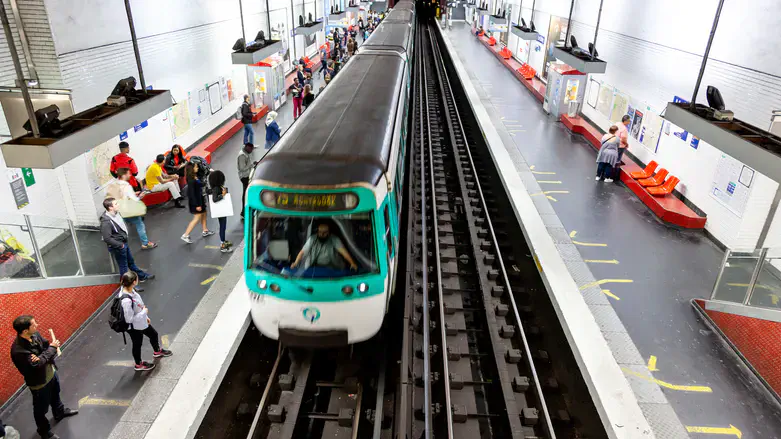
On a recent visit to Paris, I found myself standing on the Metro rail platform in one of the heavily Jewish suburbs of the city. It was an ordinary weekday afternoon. Families, students, commuters, tourists. And then I noticed something that I could not stop staring at.
Orthodox Jewish men - unmistakably Jewish from their beards and peyot - wearing black baseball caps pulled low over their heads in an attempt to disguise their identity. Not to remove it entirely. Just to blur it slightly. Enough perhaps not to be noticed immediately. Enough perhaps not to attract attention. Enough perhaps to survive in Paris in 2026 as a visible Jew.
I watched one man carefully. He was travelling with his young son. The child looked openly Jewish. The father looked like he was trying not to. And I felt suddenly overwhelmed by sadness.
I approached one of the other men on the platform and asked quietly in Hebrew, “Do you speak Hebrew?" Fortunately, he did, because my French is not fluent.
What happened next was probably unfair. I asked him, rather aggressively: “Why are Jews still living in France?" He looked startled.
I continued. “If you have to hide your identity on the Metro, if your children cannot walk openly and proudly as Jews, if Jewish life has become defensive and compromised - why stay? Why not come home to Israel?"
He tried to answer calmly. “You have to understand," he said. “We grew up here. We speak French. We work in French companies. This is our home."
I replied: “I do understand. It’s a choice between money and values."
He pushed back gently. “No, you don’t understand. I’m French. This is what I know."
And so I repeated, perhaps too bluntly: “So ultimately it is money versus values."
He looked at me sheepishly. Not angry. Just cornered. As if perhaps part of him knew I was touching on something true that he did not want examined too closely.
Then the train arrived and he stepped on. I never learned his surname. I only know his first name was Eli. So, Eli, if by some extraordinary chance you are reading this: I’m sorry for accosting you on the Paris Metro. I don’t think you knew what hit you!
Recently I listened to a podcast in which a friend, an American community Rabbi, argued that Religious Zionists should be less forceful in advocating Aliyah. Diaspora Jews, he suggested, are not always ready to hear the message. He proposed a kind of middle category: Jews who emotionally aspire to Aliyah but are “not yet ready."
I understand the pastoral instinct behind this position. But I believe it is profoundly mistaken. When discussing Shabbat observance, religious leaders often avoid pushing too hard because they know the listener may not yet be committed to halachic life. Excessive pressure can backfire.
But Aliyah within the Modern Orthodox world is fundamentally different.
When an Orthodox Jew in Israel speaks to an Orthodox Jew in America, London or Paris, there is already an assumption of shared commitment to Torah, Halakha and Jewish continuity. The debate is not usually about whether Jewish values matter. The debate is about how much comfort we are willing to sacrifice for those values.
And here we arrive at the uncomfortable truth. For many Jews in the Diaspora, the question of Aliyah is not primarily theological. It’s economic. Large homes in New Jersey. Comfortable lives in Florida. Professional status in London. Familiar culture in Paris.
Against this stands a smaller apartment in Jerusalem or Efrat. Higher taxes. Army service for children. Security pressures. Hebrew bureaucracy. Sacrifice.
When asked about their plans, many sophisticated theological arguments suddenly emerge: because Mashiach is not yet here; because Redemption is still unclear; perhaps Jewish destiny can still flourish in exile.
But whatever one believes about the final stages of redemption, one thing is absolutely certain: The Geulah is not happening in New Jersey. It is not happening in Florida. It is not happening in Paris.
Only in Israel does Jewish history move in real time. Only in Israel does Jewish sovereignty, Jewish responsibility, Jewish language, Jewish power, and Jewish destiny unfold before our eyes.
Halakha contains an important principle: when faced with a doubtful possibility and a certain reality, we give greater weight to the certainty.
Perhaps this is the beginning of Redemption. Perhaps not. But it is certainly not unfolding in the Diaspora.
There is another reason why the “neutral middle position" is becoming increasingly unrealistic. Time matters. House prices in Israel continue to rise dramatically. The shekel strengthens. Communities fill up. Opportunities narrow. The cost of waiting is no longer theoretical.
A Jew who delays aliyah today may discover in five years that the move has become financially impossible. Which means the choice is not neutral at all. Every year of hesitation closes doors. That urgency may require stronger language, not softer language.
And so once again, to my new French friend Eli, “Sorry for accosting you on the Paris Metro." But perhaps not entirely…
Rabbi Leo Dee is the author of ‘The Seven Facets of Healing’, a book describing the positive steps that anyone can take following a crisis in their life. It is available to order on Amazon and in Israel from Bookpod.