
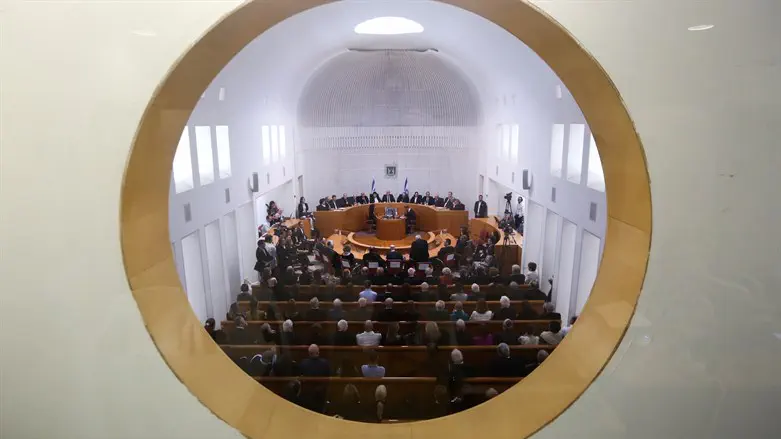
In democracies and republics the people, voting for elected representatives and thereby participating in government are supposed to have the ultimate say over public policy. In some form or fashion, usually an imperfect fashion, the elected representatives are supposed to respond to the will of the people by making laws and policies consistent with the views and desires of a majority of the voters.
There may be exceptions, of course. For instance, in countries that have a constitution, courts are often empowered by that constitution or by long established custom to declare a law unconstitutional and therefore void and unenforceable. The courts that are empowered to act as a check on the legislature and the people by declaring legislation unconstitutional usually have also developed a body of legal doctrine that restrains them from acting as a ‘super-legislature,’ as an organization that thinks itself able to willy-nilly overrule the legislature or casually change the meaning and application of laws.
Constitutional courts also have legal doctrines that restrain the courts from interfering in matters that are supposed to be the province of other branches of government, such as the executive or administrative branches of government.
At its founding in 1948, Israel did not adopt a Constitution because it was in the middle of a war brought by the surrounding Arab nations to wipe Israel off the map and kill all the Jews there. (The religious also saw a Constitution as an attempt to supersede the Torah). That war has been constant since then, although the form and methods of the perpetual Arab war to wipe Israel off the map and kill all the Jews in the Middle East has not prevented the State of Israel from growing, prospering and improving.
Over the first 40 years or so of the Israeli experience statutes enacted by the Knesset, the unicameral representative parliament of Israel, were considered binding and legal, and judicial attacks on those statutes allegedly violative of other basic principles of the state were treated as unusual, to be dealt with cautiously and with restraint.
As Yonatan Green, a graduate of the Hebrew University law faculty and a member of the Israel and New York bar points out in his new book Rogue Justice: The Rise of Judicial Supremacy in Israel, Academica Press, 2025 over a period of years beginning in the 1980s the Israel Supreme Court abandoned the practice of self-restraint and instead adopted a policy of aggressively interfering with legislation by ruling that statutes were void, that statutes did not mean what they plainly said, that the courts had the right to interfere with and direct aspects of the functioning of the bureaucracy, and even in who could be appointed to the cabinet or other high level posts by elected representatives without the courts having any statutory or other well-grounded authority for doing so.
In short, the Israel Supreme Court appointed itself a super-legislature whose opinions and policy goals are more important than those of the people as expressed through their elected representatives.
A runaway court would not be so bad if members of the court were appointed by elected officials and were therefore accountable to someone outside the courts for the courts’ composition. If elected representatives, like the Knesset or a committee of the Knesset or the Prime Minister on the recommendation of a Knesset committee, for instance, appointed Israeli judges, then the courts would be at least indirectly responsible to the people.
But in Israel the Judges of the Supreme Court are chosen by a committee consisting of three current judges, the current chief justice and two other Supreme Court judges, two members of the bar who are almost always from the same social and intellectual milieu as the judges and invariably vote with them (also because they have to appear before them in court, ed.) , two cabinet ministers and two members of the Knesset. To appoint a judge or supreme court justice seven votes are needed. The justices and their allies in the bar therefore have veto power over appointments and can prevent those who disagree from attaining a judgeship and force their own candidates into office. As a result, the judges and their allies in the bar control the process of who is appointed to the Court and in effect have the power to choose their successors and replacements.
For all practical purposes, the Court chooses its own members.
Even that self-selection process would not be so bad if the Israel Supreme Court had not abandoned the rules of judicial self-restraint common in other democratic countries. For instance, in the United States in order for someone to bring a case challenging a law the litigant has to show that he has a direct and personal interest in the matter, that he is a ‘real party in interest’ and that he has a stake in the outcome beyond the stake of the general public so that there is a ‘real case or controversy.’
Typically, in the United States, a case cannot be brought by a foreign Non-Governmental Organization or even a domestic NGO, unless it can show that it is directly affected by the law or the government action in an important way, sometimes called ‘standing’ and an aspect of what is referred to as ‘justiciability.’
Typically, if a decision is committed by law or by long-standing custom to another branch of government like the legislature or the executive/administrative branch of government, the courts will not interfere in it because it is a ‘political question.’
These doctrines of judicial restraint prevent the American courts, for instance, and other courts of nations with a constitution from issuing advisory opinions and also prevent a tidal wave of senseless litigation based on the fact that a political minority wants to challenge a law the majority passed. But in the Israel Supreme Court there are essentially no limits on who can file a case against the government or what kind of personal interest they have to show in the litigation.
Almost any legislation or government action can be challenged. That Court also usually does not demand a full factual record. There are typically no evidentiary hearings, although the court may consider affidavits from various people. Without a full and fair record of the facts being developed, including cross-examination of witnesses, the court is often left to assume what the facts are, consistent with the judges’ pre-existing prejudices.
Green and many others connect the change from a doctrine of restraint to a doctrine of Judicial Supremacy to the presence on the court, beginning in the 1980s of Aharon Barak. Barak announced and developed doctrines that elevated the importance of the Court and frustrated the will of the people. Those included:
-Barak’s doctrine of reading statutes to say what he thought they ought to say instead of what they actually said, a doctrine he called ‘objective purposive interpretation.’ He and his disciples would read a statute to have an ‘objective purpose’ consistent with ‘fundamental modern societal views’ meaning their views, of course, and thereby change the clear meaning of a statute beyond recognition so that the statute was interpreted to mean something the Knesset clearly did not intend.
-Barak developed a doctrine that was generally adopted by a majority of the Court, that if they believed that a statute or a governmental action was ‘unreasonable’ because it did not comport with their ideas of how things ought to be, they could declare it null and void as unconstitutional- a very peculiar position to take in a country with no constitution.
-Barak and his followers decided that the ‘basic laws’ which are statements of policy about the structure and effect of the government, but carry no more weight than any other law passed by the Knesset, had magically become parts of an unfinished Constitution of Israel and therefore enjoyed special status and controlled other laws. They then read those basic laws as they pleased, according to their loose rules of interpretation,
-Barak and his disciples also decided that they could apply their opinion of reasonableness to any governmental action at all based on their judicial view of how things ought to be including such executive decisions as the appointment of ministers and cabinet members.
One American judge, writing about Barak’s judicial philosophy called it ‘despotism.’ Another said that the Israeli Supreme Court had turned the country from a democracy into a ‘juristocracy’ meaning government by the judges.
Green explains all this in a calm and detailed, highly readable prose that makes the important ideas and the cases he discusses come alive. He shows the ‘What?’ and the ‘How?’ of judicial supremacy and leaves it to the reader to fill in the ‘Why?’ He gives multiple examples of cases which seem like deliberate abuses and instances of a Court run wild with judicial supremacism. Here are just a few examples out of the many, many that Green presents to prove his case:
-The Knesset passed a law that provided that if a minor was convicted of certain terrorism offenses, that so long as the minor was incarcerated or detained by the government that minor’s family would not receive the Israeli government payments that often go to the families of Israeli minors. Of course, this law applied to Arab teenagers who threw rocks at passing Israeli motorists and occasionally firebombs at buildings or were involved in other attacks.
The law makes perfect sense on two levels: it is meant to cause the parents to discourage that kind of behavior on pain of losing some government support-just for the guilty child, not all government support- and also, while the minor was incarcerated or detained his family did not have to meet his basic needs such as food and shelter. The State had to provide those while the minor was incarcerated or detained.
Nonetheless, the Israel Supreme Court struck down the law as ‘unreasonable.’
-In another case, anti-Israel activists, involved in the Boycott, Divest and Sanction movement, an Israel-hating movement that seeks to wreck Israel’s economy, sought entry to Israel, probably so that they could either claim to have personal knowledge of the facts of life in Israel or to spread their bile. The governmental official in charge of issuing visas denied them entry to Israel. They sued in the Supreme Court, which ordered the official to issue the visas and let the anti-Israel activists into Israel. The Court held the official’s actions ‘unreasonable’ because it might dampen the ‘free speech rights’ of the anti-Israel activists.
There was no statutory or other basis for the decision at all. It was just a decision based on the world view of the judges and their willingness to overrule a government official who was doing his job lawfully.
-In perhaps the most notorious and outlandish case of all, the Knesset passed an amendment to the Basic Law on the Judiciary, a law which the Court claimed was part of a nascent constitution. The amendment stated, in essence, that the Court could not overrule governmental action solely on the basis of its notions of ‘reasonableness.’ You would think a Court would not find the Basic Law which it had claimed was the equivalent of a Constitution to be void. But the amendment was immediately challenged, and in a disgraceful show of judicial arrogance and some would say intellectual dishonesty, the Court found that the amendment was void.
The Court produced multiple opinions on the subject, totaling hundreds of pages and almost all of it legalistic gibberish. The result was that the Court confirmed its own power to overrule the people’s elected representatives on a regular basis.
Yonatan Green’s Rogue Justice: the Rise of Judicial Supremacy in Israel is a detailed, thoughtful, well-written and convincing book. It suffers only one small defect. It is over 600 pages long and therefore perhaps more than some readers can bear. Yet the reader who takes the time and makes the effort will come away from this book far more knowledgeable about an important issue in Israel domestic public law and policy, an issue which still remains to be resolved.