

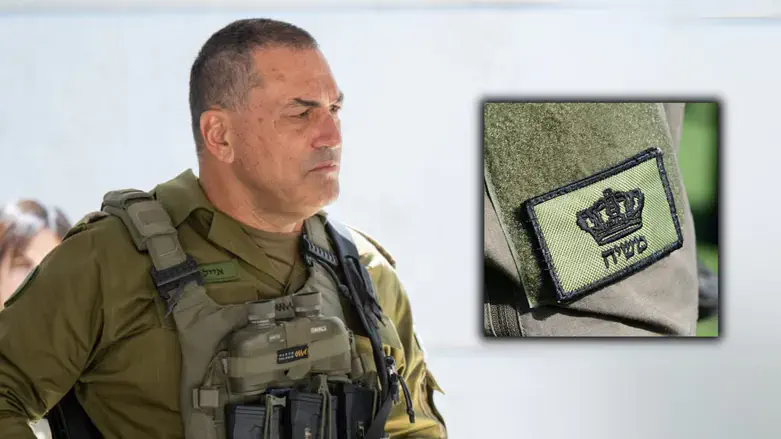
It is hard to dispute that the punishment of thirty days’ army imprisonment meted out to a Nachal soldier for wearing a “Mashiach" patch is outrageous, even Draconian, so much so that it is likely to be reduced if not eliminated altogether.
Thirty days? Bear in mind that the Chief of Staff has many accomplishments on his ledger for which we owe him a debt of gratitude but also as then Deputy Chief of Staff shares primary responsibility for the catastrophic Hamas invasion and carnage of October 7. For that he received not thirty days incarceration but a promotion.
The tatzpaniyot (female outlook scouts) repeatedly warned their superiors of dangerous Hamas activity and many paid with their lives because their superiors ignored their warnings. Yet, these superiors have never, to our knowledge, been identified, vilified, prosecuted, or incarcerated.
But thirty days in jail for wearing a patch?!
Indeed, the IDF changed its regulations just over a year ago banning such personal patches depicting “Mashiach" or the the Holy Temple, “Bet HaMikdash," which on some level is sensible. An army must be uniform, individual expressions must be limited. Such was the reasoning of the US Supreme Court when it ruled, in Goldman v. Caspar Weinberger (1986), that US Air Force Captain Simcha Goldman was not allowed to wear his kippah while on duty. His personal religious garb, innocuous as it was, was held by a slim 5-4 majority to be an affront to the need to "foster instinctive obedience, unity, commitment, and esprit de corps." Yet, Congress in 1988 passed a law permitting members of the US Armed Forces to “wear an item of religious apparel" while on duty. Somehow, the US military survived, with kippah-wearing Jews and turban-donning Sikhs.
Would a future IDF Chief of Staff prohibit soldiers from wearing kippot? One should be aghast at the thought but who knows? A kippah also distinguishes one soldier from another - as the US Supreme Court implied - and in a profound way. (Conversely, would a future Chief of Staff order every soldier to wear a kippah? Ah, but that would never be sanctioned by Israel’s rogue Supreme Court.) A kippah signifies reverence for Heaven and deference to a higher power, attitudes not always welcome in the military.
For sure, a Mashiach or Mikdash patch is not a kippah; yet, I can hear a dyed-in-the-wool secular Chief of Staff opine that a kippah is barely mentioned in the Talmud or Shulchan Aruch, should not be defined as essential Jewish wear, and certainly not when it can diminish a soldier’s “instinctive obedience" or the cherished “esprit de corps."
As parents, numerous reservists and other Israelis have opined, these patches are instrumental in motivating our troops to make the necessary (and even, G-d forbid, ultimate) sacrifice and therein lies the difference in approaches and why this Nachal soldier’s summary prosecution and sentence is so disgraceful. For what are we fighting? For what purpose are we losing the finest of our youth and seeing many others maimed for life?
One approach is that we are fighting for our land and our State and that too is true enough - but not the whole truth. Poles, Germans, and Spaniards also fight for their land. Russia and Ukraine are fighting over land. We too struggle for our land, our independence, our physical survival - but our endless wars are not simply over territory. Those who believe that - and many do - are generally secular and are seduced by such fantasies as Oslo or the two-state delusion, the illusion that ultimately, we are in the middle of a real estate dispute that can be resolved if we just compromise enough.
It is hard to fathom but even after October 7, really, even after a century of conflict, there are people who still believe that.
There is a second approach, apparently lost on the Chief of Staff. Many of our brave soldiers - even those who don’t wear patches - instinctively realize that there is much more to our enemies’ hatred of Israel than our possession of a certain parcel of land. It is hatred of the Jewish people, such is now again sweeping the world, which itself is really hatred of the G-d of Israel. As our sages expressed it (Sifrei, Beha’alotcha, 84), “he who hates Israel it is as if he hates the One who brought the world into existence." Moreover, “whoever touches Israel it is as if he is touching the apple of His eye" (Gittin 57a, based on Zecharia 2:12).
The Torah conflated the census of our military with the desire to have the divine presence dwell among us (Rashi Bamidbar 1:1). Our army serves a greater purpose than merely defense of land. It is the instrument through which the Jewish idea is able to proliferate. The land of Israel is holy and a divine gift - but the wars of Israel have a far more profound basis than simply territory. We fight for something far deeper.
Our enemies realize this, even if our Chief of Staff does not. Our enemies focus their evil on conquest of Yerushalayim. Hamas called its invasion the “Flood of Al Aksa." Pictures of the Dome of the Rock adorned numerous Gaza homes thankfully destroyed. Jewish sovereignty anywhere in the land of Israel, but especially in Yerushalayim, enrages them and gives them no rest. Their evil is limitless, self-destructive, and suicidal - but at least they are clear about that they are fighting for.
We are less clear and so pay a steep price in life and limb, and the endless pursuit of panaceas and chimeras. Some fight for the homeland, some fight for democracy, and some fight for individual rights. But many also fight to protect Jewish life, preserve the holy land of Israel despite the whimsy of politicians and diplomats, bring the divine presence to earth, establish a model Torah state, bring Mashiach closer, hasten the Redemption, and rebuild the Bet HaMikdash.
We need not all share the same motivation to fight successfully, but we will rue the day when the latter motivations are disdained and those who believe in them are prosecuted. Truth be told, they are the most motivated of all our soldiers. Disproportionately, they have borne the heaviest burden of war in terms of casualties and repeated reserve duty. We disparage them and their inspiration at our peril.
For sure, there are certain patches that should be banned - those that repudiate our national purpose, weaken morale, or dispirit our troops. But King David stated (Tehillim 122:2) that “Our feet were standing in your gates, O Jerusalem," to which Rashi comments, “our feet were standing in battle everywhere because of the gates of Jerusalem, where they were engaged in Torah."
Jerusalem - both spiritual and physical - is the focal point of this and every war. Mashiach will appear in Jerusalem and the Bet Hamikdash will be rebuilt in Jerusalem (or vice versa, as conflicting Rabbinic sources suggest). The order is less important than the realization of the centrality of Yerushalayim to our lives, our soul, and our esprit de corps.
We should be encouraging our soldiers to fight for what they believe in, not disheartening them. In this latest contretemps, let cooler heads prevail - heads that are also saner, holier, and more imbued with the eternal spirit of Israel, the key to victory.
Rabbi Steven Pruzansky, Esq., a former pulpit rabbi and attorney, serves as the Senior Research Associate for the Jerusalem Center for Applied Policy (JCAP.ngo), the Israel Region Vice-President of the Coalition for Jewish Values, and is the author of six books including “The Jewish Ethic of Personal Responsibility" (Gefen Publishing).