

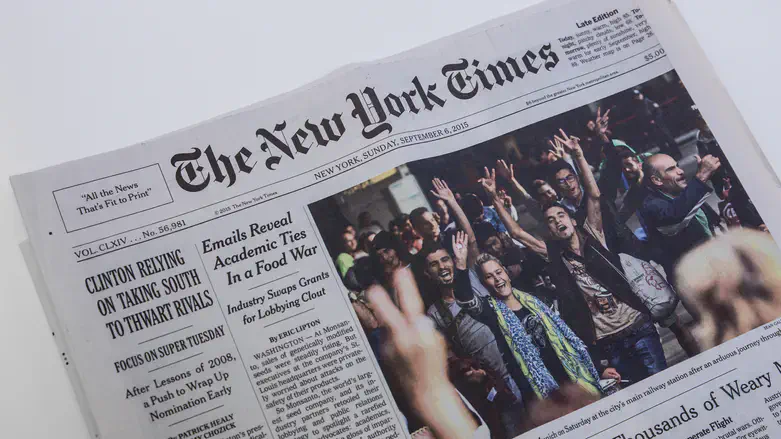
As soon as you think it’s over, they pull you back in.
Is there any way to write this column, in which Times columnist Nicholas Kristof accuses Israelis of rape against Palestinian Arabs, while keeping the prose cool and detached?
A column like Kristof’s deserves a SCREAM.
No doubt this blood libel was written to counter and even the score against a news item, heavily sourced, which documents the rape culture among Palestinian Arabs.
Quickly, Kristof went to press as damage control.
Kristof would serve as publicity agent for, say, Hamas and the Palestinian Authority.
I go back to a conversation I had with Abe Rosenthal, [May, 1922-May 10, 2006] formerly executive editor at the Times until he left that spot to writing a column for the paper.
As Exec Editor, he was the most powerful newspaperman in the newsroom, or in any newsroom throughout the world.
His word was law. His style was rough, gruff, and tyrannical…as it was in those days when Clark Gable played types like him in “Teacher’s Pet."
Abe Rosenthal was drama, last of the cigar-chomping editors that you feared, publicly hated, but privately respected and loved.
I reached out to him when he was settled in to writing his columns, in which I sensed a man, column by column, doing his version of the scream.
Only he called it the Howl, from the hipsters howl against mind-numbing conformity as written and performed by Allen Ginsberg.
Rosenthal’s columns touched on many topics, of course, but the one he kept getting back to was about Israel, and listen to him howl between the lines for all the injustices being done against the Jewish State, and there it is, the man discovering his Jewishness, prompting his Cry in the Wilderness.
He approached Israel with reverence, indulgence and respect, and as a nation that, sharing as it does our Judeo/Christian values, warrants our support.
I wrote him a long letter expressing my own frustrations per Israel, which can count on no fairness, nor from the Nations, or from the media.
Or…even from his own paper, The New York Times.
I accepted it as fact, that there was no chance of hearing back, but I had to let him know that he was not alone.
There were others operating as Miss Lonely Hearts.
Besides, the top newsman in the land…for sure he has more important business than me.
But, incredibly, he did respond, on Times letterhead, and the letter was entirely and emphatically personal.
He opened by saying his paper was shamefully at fault for downplaying the Holocaust, that coverage that belonged front page was instead given the back pages.
Unforgivable.
Would there be a change in the paper’s attitude? He would try, but his powers were awfully limited.
He may be a giant in the newsroom, but there were other factors and concerns, which we shared during our exchanges.
For example, the culture of the paper was established early on, in 1896, when the Ochs and Sulzberger families took control.
They were Jewish, but only as German Jews were Jewish.
Which means keep it to a whisper.
They were horrified by those Jews “who just got off the boat," and they declined to offer editorial support for the fledgling State of Israel.
Their coverage of the death camps was shoddy, journalism at its worst.
From all this, and more, grew Nicholas Kristof.
Back to Abe Rosenthal…we became friends…especially from our shared concerns upon Israel. He wrote to me, saying,
“Dear Jack, I understand your broken heart because it reflects my own."
Imagine what he would say today, if someone like Kristof were to hand in such blood libel for his approval.
Not a chance.
But they do not make editors like that anymore. Rosenthal, rough, tough, cigar-smoking, as I imagine, but honest to the core, was last of a kind
As meanwhile clean-living but crooked journalists flourish.
Novelist Jack Engelhardwrites a regular column for Arutz Sheva, Israelnationalnews.com A CANNES award winner for his post-Holocaust/Montreal memoir, “Escape from Mount Moriah," he wrote the international bestselling novel, “Indecent Proposal," which was turned into a major movie success by Paramount Pictures. His fact-based novel about the 1960s, “The Days of the Bitter End," has been cited as the absolute finest work of that tumultuous era. His website: www. Jackengelhard.com