
There are few places in the world more beautiful than Greece. Athens radiates ancient grandeur. The islands shimmer like jewels in the Mediterranean. The country gave humanity philosophy, democracy, drama, and some of civilization’s foundational ideas.
But Greece also carries one of the darkest Holocaust records in all of Europe.
Between 82 and 92 percent of Greek Jewry was exterminated by the Nazis and their collaborators during World War II - among the highest destruction rates on the continent.
And today, as anti-Israel fury sweeps parts of Europe, Greece is once again becoming a troubling epicenter of anti-Jewish hostility.
The ghosts of history are stirring.
More than 90 percent of Greek Jewry was annihilated. Europe must never forget that.
Before the Holocaust, Greece was home to one of the oldest and most magnificent Jewish civilizations on earth. Jews had lived in Greece for over 2,000 years. The Romaniote Jews traced their roots back to antiquity. Later, Sephardic Jews expelled from Spain in 1492 transformed cities like Thessaloniki - then known as Salonika - into thriving centers of Jewish life.
Salonika was once called the “Jerusalem of the Balkans."
By the early 20th century, Jews made up a massive portion of the city’s population. Ladino filled the streets. Jewish dockworkers shut down the port on Shabbat. Rabbis, merchants, printers, scholars, and musicians built one of the great Jewish communities in the world.
Then came the Nazis.
In 1941, Germany occupied Greece. What followed was among the most devastating destructions of a Jewish population anywhere in Europe.
Nearly 50,000 Jews from Thessaloniki alone were deported to Auschwitz. Around 96 percent of the city’s Jews were murdered.
Across Greece, roughly 60,000 to 70,000 Jews were exterminated. Entire ancient communities vanished almost overnight.
The deportations began in March 1943. Jews were rounded up into ghettos, humiliated publicly, stripped of property, and loaded onto trains bound for Auschwitz-Birkenau.
Why was the destruction rate in Greece so catastrophic?
Partly because Thessaloniki’s Jewish community was so concentrated and identifiable. The Nazis could isolate the population with terrifying efficiency. The German occupation authorities also received cooperation from local collaborators and bureaucratic structures that facilitated deportations.
There were heroes too. Archbishop Damaskinos courageously protested Nazi policies and some Greeks risked their lives to save Jews. Thousands of Greek Christians hid Jewish neighbors.
But the numbers remain horrifying.
A civilization centuries old was almost erased from existence.
The Holocaust did not merely kill Greek Jews. It erased a universe.
And yet, for decades after the war, Greece often struggled to fully confront this history.
In Thessaloniki, Jewish cemeteries desecrated by the Nazis were never fully restored. Universities and public buildings were built atop destroyed Jewish burial grounds. Survivors frequently faced enormous obstacles reclaiming stolen property.
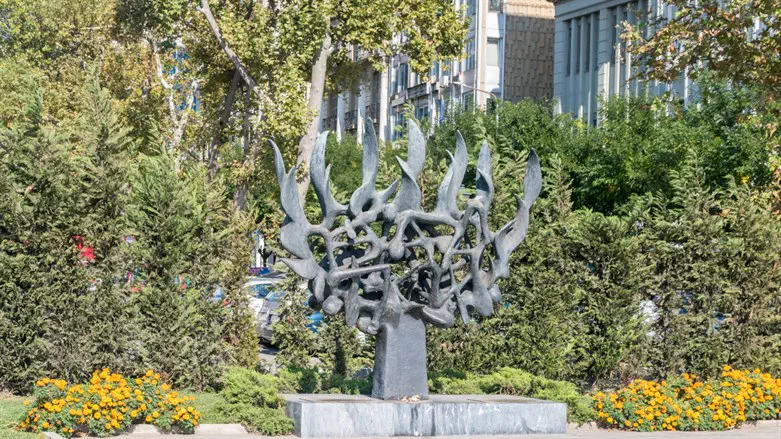
Only in recent years has Greece begun more serious Holocaust remembrance efforts, including the construction of a Holocaust museum in Thessaloniki near the very railway station from which Jews were deported to Auschwitz.
But remembrance alone is not enough. Because Europe is once again experiencing an explosion of antisemitism. And Greece is not immune.
Since Hamas’s October 7 massacre, anti-Israel protests across Greece have increasingly crossed the line from political criticism into open hostility toward Jews and Israelis. Israeli tourists have faced harassment. Kosher establishments and Jewish-linked businesses have been vandalized. Graffiti targeting “Zionists" has spread in Athens.
One especially chilling incident occurred in Athens in 2025 when anti-Israel activists vandalized an Israeli-owned kosher restaurant while threatening “Zionists."
Elsewhere, coordinated “days of action" targeted Israeli tourists vacationing in Greece.
Imagine the insanity of that sentence.
Israeli tourists. Families on vacation.
People whose grandparents may have been deported from Greece to Auschwitz. Now once again being singled out in Greece because they are Jews from the Jewish state.
Europe never learns the lesson.
The language changes slightly. The slogans evolve. But the obsession with Jews remains remarkably constant.
Once Jews were accused of poisoning wells.
Today Israel is accused of poisoning humanity.
Once Jews were portrayed as demonic global conspirators.
Today Zionists are depicted as uniquely evil monsters among the nations.
The emotional structure is exactly the same.
Of course criticism of Israeli policy is legitimate. Israelis themselves criticize their governments ferociously. That is democracy.
But when protests become obsessed with excluding Israeli visitors, vandalizing kosher restaurants, threatening Jews, or painting Stars of David as symbols of evil, this is no longer political discourse.
It is antisemitism. Pure and simple.
When Israelis alone become unwelcome among the nations, history begins repeating itself.
The tragedy is especially painful in Greece because Jewish history there is so profound.
Few modern tourists walking through Thessaloniki realize they are traversing what was once one of the greatest Sephardic Jewish capitals on earth. Few know that Jewish life there stretched back centuries before many modern European states even existed.
The Nazis did not only murder people. They murdered memory. And when societies lose historical memory, hatred returns.
That is why Holocaust remembrance matters.Not as ritual. Not as empty ceremony. But as moral warning.
The Holocaust did not begin with gas chambers. It began with words. With exclusion. With demonization. With propaganda portraying Jews as uniquely malevolent.
Europe told itself repeatedly that anti-Jewish hatred was justified because Jews supposedly represented some cosmic evil.
Today, far too many people say the same about Israel.
The target changed from “the Jew" to “the Jewish state." The psychological mechanism remains frighteningly similar.
And Greece - with its haunting Holocaust history - should understand this better than most nations.
There are signs of hope. Some Greek leaders have courageously embraced Holocaust remembrance. Educational programs have expanded. Memorial marches now commemorate deported Jews from Thessaloniki to Auschwitz. Many ordinary Greeks reject antisemitism and support coexistence.
But Greece now faces a choice.
Will it become a nation that remembers the annihilation of its Jews with honesty and moral clarity?
Or will it allow anti-Israel extremism to become a socially acceptable gateway for renewed anti-Jewish hatred?
Because history shows that antisemitism never remains confined to Jews alone. It poisons entire societies. It destroys moral judgment. It corrupts nations from within.
The Holocaust in Greece should stand as an eternal warning to the world.
A vibrant Jewish civilization was almost completely exterminated in full view of Europe. And now, less than a century later, Jews again hear chants that they are unwelcome.
That should terrify every decent human being.
Especially in Greece.
A nation that watched its Jews disappear should never tolerate the return of anti-Jewish hatred.
Rabbi Shmuley Boteach is widely known as “America’s Rabbi" and is one of the world’s most recognized and influential Jewish voices. A bestselling author, award-winning columnist, global human rights advocate, and dynamic public speaker, he has dedicated his life to spreading Jewish values, defending the Jewish people, and championing universal human dignity.