
There are moments in civic life when participation in a public event ceases to be ceremonial and becomes something far more consequential. In such moments, attendance is no longer merely attendance-it is interpretation. It is validation. It is, whether intended or not, a statement.
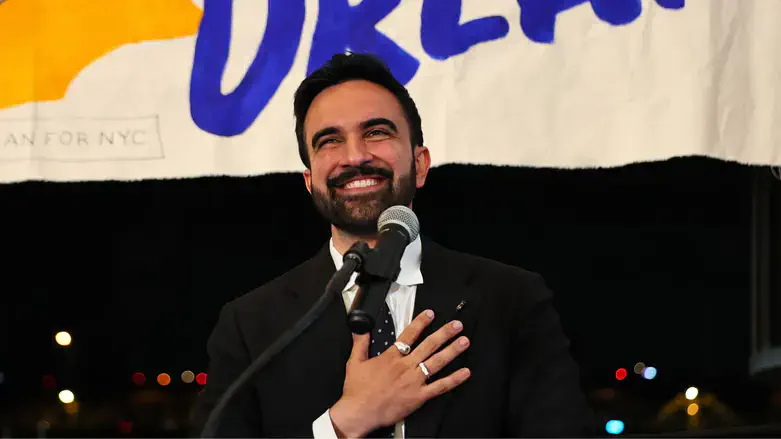
New York City now finds itself at precisely such a juncture, as the controversy surrounding Mayor Zohran Mamdani and his planned May 18 event “Shavuot Celebration in Honor of Jewish Heritage Month" at Gracie Mansion has evolved into a profound test of leadership, integrity, and communal resolve.
What might otherwise have been a routine acknowledgment of Jewish Heritage Month has instead crystallized into a flashpoint, exposing a widening chasm between City Hall and significant segments of the Jewish community. As The New York Post reported, the dispute is not rooted in the event itself, but in the broader context of rhetoric, policy, and perception that has come to define the mayor’s relationship with Jewish New Yorkers. And read this on Yeshiva World.
At the forefront of this unfolding debate stands longtime Jewish activist and former Democratic member of the New York State Assembly, Dov Hikind, whose intervention has injected a sense of urgency-and moral gravity-into the conversation. Hikind’s words were neither measured nor ambiguous. “Things are out of control in this city. Attacks upon Jews. Fear in the Jewish community," he declared, articulating what many believe to be an undeniable reality.
More striking, however, was his call to action. “I am calling on Jewish leaders not to attend this event. I plead with you to take a stand. Show pride. Have self-respect." These are not the words of quiet diplomacy; they are the language of intrepidness-of a man who knows that the stakes have risen beyond the point where polite engagement can suffice.
Moments of symbolic significance demand clarity of principle. The central question is no longer whether the mayor’s event is well-intentioned, but whether participation in it can be disentangled from the broader concerns that have fueled this controversy.
Those concerns are neither trivial nor abstract. They are rooted in a pattern of statements and positions that have crossed the line from criticism of policy into something more corrosive. In a break with longstanding practice, the mayor does not plan to join the Israel on Fifth parade this year. This, added to his vocal support for the boycott, divestment, and sanctions movement, coupled with his repeated accusations against Israel in the aftermath of the October 7th massacre, have rightly generated deep unease. Does the mayor believe that the State of Israel has the right to exist?
His statement that Israeli Prime Minister Benjamin Netanyahu could face arrest if he were to visit New York is an extraordinary escalation-one that transforms political disagreement into outright hostility. For a community already grappling with a surge in antisemitic incidents, such rhetoric is not perceived as theoretical; it is experienced as deeply consequential.
In this context, the symbolism of a celebratory gathering at Gracie Mansion becomes inescapable. To attend is not merely to partake in a cultural observance; it is to engage with an administration whose words and positions are antagonistic. That reality cannot be wished away, nor can it be neutralized by the presence of a kosher menu or the invocation of tradition.
And yet, there are those within the Jewish community who argue that engagement remains essential-that to absent oneself is to forfeit the opportunity for dialogue, to relinquish the chance to speak truth directly to power. This perspective is not without merit. History offers ample evidence that meaningful change often requires engagement, even under uncomfortable circumstances.
But engagement, to retain its integrity, must be purposeful. It must be accompanied by candor, by a willingness to confront rather than to accommodate. Absent that, it risks devolving into mere optics-a performance of inclusion that leaves underlying tensions unaddressed.
The present moment demands a higher standard. If Jewish leaders choose to attend, they must do so with a clear and unambiguous commitment to raising the issues that have brought them to this crossroads. They must ensure that their presence is not interpreted as acquiescence, but as an assertion of dignity and concern.
Conversely, if they choose not to attend, that decision must also be framed with clarity- as a principled stance rooted in the belief that thresholds have been crossed.
In either case, ambiguity is the enemy. Silence, in a moment such as this, is not neutral; it is read, interpreted, and often misunderstood.
The broader implications extend beyond a single event. They speak to the evolving relationship between political leadership and Jewish communities in a city that has long prided itself on pluralism and coexistence. Trust, once eroded, is not easily restored. It requires more than gestures; it requires consistency, accountability, and a demonstrated willingness to listen.
For Mayor Mamdani, this moment presents an opportunity as much as a challenge. If his administration is sincere in its desire to build bridges with Jewish New Yorkers, it must grapple honestly with the concerns that have been raised. It must recognize that outreach is not measured by invitations, but by the substance of engagement and the tone of discourse.
For Jewish leaders, the moment is equally consequential. Leadership is not tested in times of comfort, but in moments of tension-when the path forward is neither obvious nor easy. The decision they make in response to this controversy will resonate beyond Gracie Mansion, shaping perceptions of communal unity, resolve, and purpose.
Ultimately, the debate unfolding in New York is emblematic of a larger struggle-one that transcends local politics. It is a struggle over the boundaries of acceptable discourse on Jews and Israel, over the responsibilities of Jewish leadership, and over the meaning of Jewish solidarity in an age of polarization.
There are no easy answers. But one principle should remain paramount: that dignity, security, and respect for the Jewish community are not negotiable. They are the foundation upon which all meaningful engagement must be built.
In the end, this is not merely about whether to attend an event. It is about what that decision signifies-and whether, in a moment that demands clarity, those entrusted with leadership are prepared to meet the gravity of the hour.