

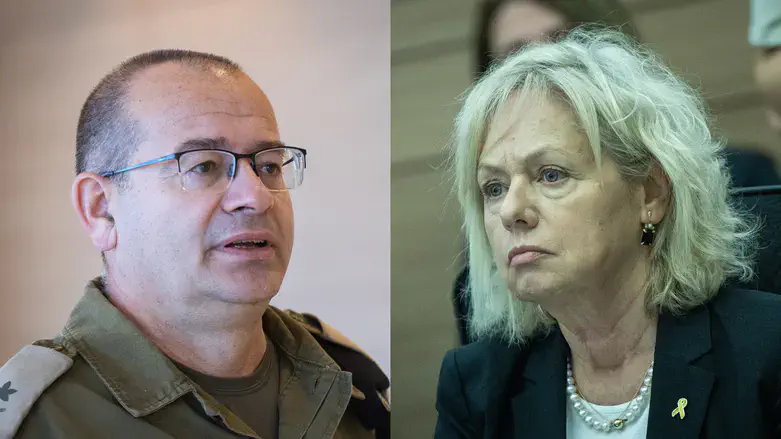
Maj. Gen. Roman Gofman, who is slated to serve as the next Mossad chief, on Friday submitted a sharp response to the Supreme Court against the confidential update filed by Attorney General Gali Baharav-Miara.
Gofman argued in his response that the Attorney General’s conduct in her attempt to cast doubt on his integrity is “very grave" and was carried out in bad faith against an officer holding the rank of major general.
According to Gofman, Baharav-Miara’s claims regarding the transition meetings he held at the Mossad are irrelevant to the petitions and do not include any moral flaw.
He clarified that he began the transition process immediately after the Prime Minister signed his appointment, in order to prepare for his planned entry into the position on June 2, and that discussions regarding the organization’s employees are an integral part of that process.
In his response, Gofman detailed that when the issue of Brig. Gen. G.’s continued service at the Mossad came up, he made clear that he would be able to make decisions on the matter only after officially assuming office.
Gofman stressed that he instructed those involved not to approach Brig. Gen. G. on matters related to his professional future until a ruling is issued on the petitions, in order to preserve the integrity of the legal process and not “contaminate" it.
He accused the Attorney General of omitting material facts from her notice to the court, and argued that her statements regarding the conversation between him and the Mossad’s legal counsel “are not true." According to Gofman, Baharav-Miara was updated on his request to freeze the handling of Brig. Gen. G.’s matter, but chose not to mention this in the information she defined as “confidential and sensitive."
Concluding his statement, Gofman called on the court to reject the petitions against him as soon as possible, ahead of his entry into office in about two weeks.
He also expressed regret over the conduct of the Attorney General’s office in the case, and argued that the speed with which the confidential information was leaked to the media raises concern of an attempt to influence the content of Brig. Gen. G.’s affidavit.