
In 1937, Rav Tzvi Yehudah Kook published an article entitled “Behind our Wall." The title cites a verse from Song of Songs that describes God’s constant presence at the Kotel: "Behold, [my Beloved] is standing behind our wall, looking from the windows, peering from the lattice." (Song of Songs 2:9)
Rav Tzvi Yehudah objected to the term “Wailing Wall." To him, this is a shallow description of the Kotel, as a place of mourning and inconsolable grief. Even worse, this name suggests the helplessness of a weak and stateless people.
More fitting, he argued, is the name Kotel HaMa’aravi, the “Western Wall." This title describes the Kotel as a holy remnant of the Second Temple, the Temple Mount wall closest to the Holy of Holies. It recalls the ancient tradition that “the Shekhinah has never departed from the Western Wall."
This name presents the Kotel as a symbol of Israel eternal nature, despite centuries of exile and persecution. Its unmoving stones are testimony that the Jewish people will return to their land and their lofty heritage.
When originally published, the article was mistakenly attributed to his father. It was later included in a collection of Rav Tzvi Yehudah Kook’s writings entitled LeNetivotYisrael. Below are translated excerpts from the article, as well as the popular song it inspired forty years later.
“Behind our Wall," by Rav Tzvi Yehudah Kook
Secure and invincible in its Divine strength, the Kotel holds its own - throughout times of upheaval, transformations and vicissitudes, the horrors and disasters that visited the Land of Israel and its inhabitants. The Kotel is in them and with them.
Even if the disgrace of ruin conceals its beauty; even if signs of destruction are prominently displayed upon it, and clouds of desolation cast shadows over its radiance; even if it lies hidden behind a thicket of dark and squalid alleyways, as it is shoved aside in the cruelty of its neighbors, surrounding it from all sides, who try to invade its borders, to suppress and erase its legacy.[1]
Nonetheless, like a stone fortress, it stands guard, unwavering, not allowing its inner dignity to be sullied. It remains pure and exalted, in the strength of its essence...
For it is a remnant of the holy and precious, of the Divine abode. By the wonderful quality of its very existence, it bears witness to world events and millennia of human history.
יֵשׁ לְבָבוֹת וְיֵשׁ לְבָבוֹת. יֵשׁ לִבּוֹת אָדָם, וְיֵשׁ לִבּוֹת אֲבָנִים.
וְיֵשׁ אֲבָנִים וְיֵשׁ אֲבָנִים. יֵשׁ אַבְנֵי דּוֹמֶה, וְיֵשׁ אֲבָנִים-לְבָבוֹת.
There are hearts and there are hearts.
There are human hearts, and there are hearts of stone.
There are stones and there are stones.
There are silent stones, and there are stones that are hearts.
These stones, remnants of our dwelling on high, “retain their holiness even in desolation" (Mishna Megillah 3:3), for “the Shekhinah has never departed from the Western Wall" (Shemot Rabbah 2:2).
These stones are our hearts.
Each of us knows that this Wall, despite its somber simplicity and marks of ruin and exile, is not, for us, a “Wailing Wall," as strangers and foreigners call it. To us it is a richness of life, a hidden treasure of light and strength, safeguarded and preserved by our tears.
The healthy Jewish eye does not see in the Kotel a symbol of our nation’s ruin, devastation, and decay. On the contrary, we see the Wall, in its hidden strength and resilience, still standing. Even after they fell and as they fell, it rises up and reaches out with Divine strength to eternal redemption.
Yossi Gamzu’s song: “The Kotel"
After the liberation of the Kotel during the Six-Day War, Israeli lyricist Yossi Gamzu composed a song that quickly became an Israeli classic: HaKotel. Gamzu drew directly upon imagery from Rav Tzvi Yehudah Kook’s 1937 essay. One stanza is even devoted to Rav Tzvi Yehudah himself, capturing both the rabbi’s exaltation at the historic moment and his deep affection for the soldiers who fought in the war.
The Kotel
The Kotel, moss and sadness;
The Kotel, lead and blood.
There are people with a heart of stone;
And there are stones with a human heart.
Together with us, facing the Kotel,
Stands an elderly rabbi in prayer.
He said, “Fortunate are we, that we merited this!"
But then he remembered: “But not everyone."
He stood there with glistening tears,
Alone among the dozens of soldiers.
He said, “Beneath your khaki uniforms, in truth,
You are all holy priests and Levites."
(Stories from the Land of Israel. LeNetivot Yisrael, vol. I, pp. 22-25)
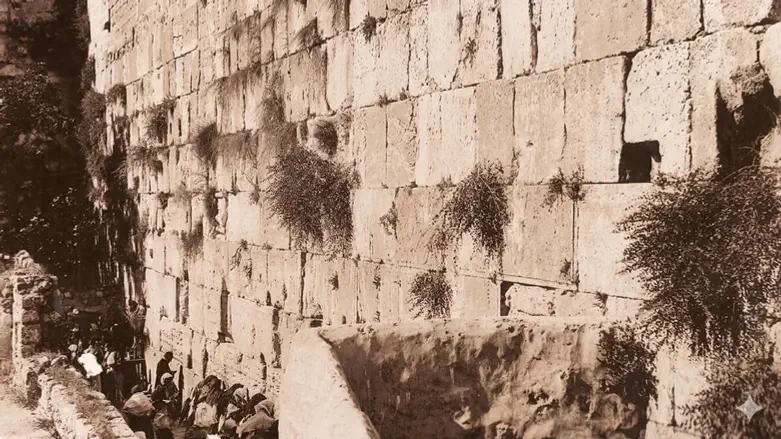
Image: "The Western Wall" (PikiWiki). Photographed in the 1870s by 19th-century French photographer Félix Bonfils. In the 19th century, Jews were required to pay the Ottoman authorities for the right to pray and lament at the Kotel. The American consul Albert Rhodes reported that the annual payment amounted to $1,500.
[1] When Rav Tzvi Yehudah wrote this in 1937, the Kotel was accessible only through the narrow, overcrowded alleyways of the Mughrabi Quarter. The area surrounding the Kotel was neglected and impoverished, and Jewish access and worship were frequently restricted by the British authorities and local Arab opposition. His words reflect both the physical condition of the site at that time and the ongoing attempts to deny the Jewish people’s historic connection to the Kotel and the Temple Mount.