
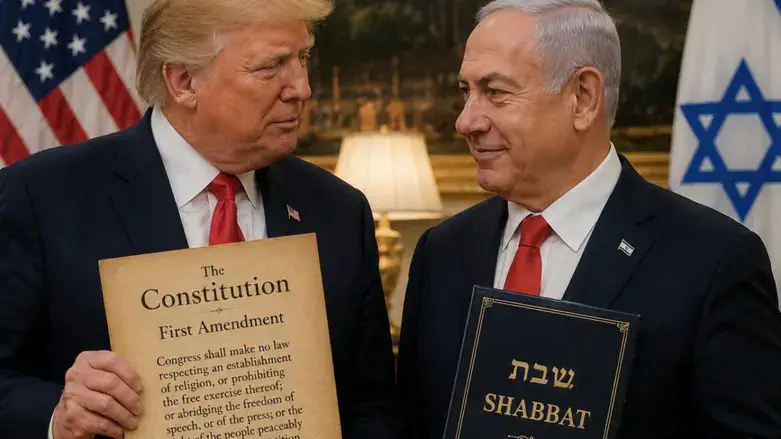
On May 4, 2026, as part of Jewish American Heritage Month and in honor of the 250th anniversary of independence, Donald Trump took an initiative no one had taken before: he proclaimed the period from sundown on Friday, May 15, through nightfall on Saturday, May 16, as a national Shabbat. He called it "Shabbat 250" and invited all Americans -Jews and non-Jews alike- to observe it not as a religious ritual, but as a recognition of coexistence and historical gratitude, each keeping their own faith.
The reaction was immediate and predictable.
The Jewish world celebrated.
The media characterized it as a political gesture. The average citizen understood it only partially.
The enemies of the Jewish people rejected it. The guardians of history applauded. Those who love the free world rejoiced.
Most people, surely, were unaware of the depth of the bond between the most powerful nation on earth -celebrating 250 years- and a people with more than three thousand years of tradition.
Trump’s proclamation is, however, far more significant than it appears.
It reflects the spirit of Washington, Madison, and Jefferson- founders who etched into the very DNA of the republic something that time has been unable to erase, even as political interests remain bent on destroying it-and which the commemoration of Shabbat 250 is destined to protect.
What Trump Understood
There is something deeper in this proclamation than politics or diplomatic courtesy. The Shabbat is not merely a ritual. It is the first declaration of human dignity in the history of civilization, and it is closely bound to the founding values of the Declaration of Independence of 1776.
The Shabbat is commonly taught as the Jewish “day of rest" - and that definition, while correct, is almost an injustice.
In the Fourth Commandment, the Creator does not rest because He is tired -that would be an anthropomorphism that the Jewish tradition expressly rejects. The Torah speaks in human language so that man may comprehend the divine, not to describe it literally.
What the Creator wishes to demonstrate is that rest is not a concession: it is a right. And that this right belongs to everyone -to the master and the servant, to the citizen and the stranger, even to the animal.
Rest is a time of complete freedom for both body and soul- not only for the individual, but also for the family environment.
A Foundational Bond
The Declaration of Independence of the United States establishes:
“We hold these truths to be self-evident, that all men are created equal, that they are endowed by their Creator with certain unalienable Rights, that among these are Life, Liberty and the pursuit of Happiness; that to secure these rights, Governments are instituted among Men, deriving their just powers from the consent of the governed."
The Shabbat reflects the spirit of the First Amendment of the American Constitution. The confluence of religious freedom and freedom of expression is the foundation of the pluralism that is the recipe for peace.
A Second Foundational Bond
In his proclamation, Trump recalled the historic letter that George Washington wrote in 1790 to the Hebrew Congregation of Newport, promising that the United States would give no
“sanction to bigotry nor assistance to persecution."
It was not an isolated gesture: it was the expression of the spirit of the founding fathers, rendered with precision in the First Amendment:
“Congress shall make no law respecting an establishment of religion, or prohibiting the free exercise thereof; or abridging the freedom of speech, or of the press; or the right of the people peaceably to assemble, and to petition the Government for a redress of grievances."
First Amendment to the United States Constitution, 1791
The order does not seem accidental. Religious freedom comes first. Freedom of expression comes second.
The founding fathers understood something essential: freedom of expression could not be allowed to become an instrument for destroying coexistence, persecuting minorities, or justifying hatred.
For decades, the United States managed to sustain that balance. In recent years, however, a reinterpretation began spreading through important academic and cultural sectors -one in which, in the name of free speech, openly antisemitic discourse became part of political activism, not only in words but accompanied by physical discrimination and aggression.
The Shabbat 250 proclamation is not merely a gesture: it is a response that recovers the original spirit of the Constitution.
The Jew Who Financed Freedom
There is something deeply moving in that historical arc: the most powerful republic of the modern era was founded, in part, with the critical financial support of a Jewish immigrant who gave everything for his adopted country.
His name was Haym Salomon. At the darkest moment of the Revolution, when the Continental Congress was bankrupt and troops threatened to mutiny for lack of pay, Washington instructed his superintendent of finance, Robert Morris, with a single order:
“Send for Haym Salomon."
Salomon raised 20,000 dollars in a matter of days -an enormous sum for the time- and between 1781 and 1784 lent or raised more than 650,000 dollars to sustain the American cause. He also extended personal interest-free loans to James Madison, Thomas Jefferson, and James Monroe, so they could devote themselves to building the new nation.
Haym Salomon died in poverty, at age 44, in 1785. But he gained eternity.
In Heald Square, Chicago, a monument stands today depicting Haym Salomon alongside Washington and Morris. It bears the same words Trump chose to recall -and that choice was not accidental.
An Answer That Needs No Words
The Shabbat does not need to answer antisemitism of any era or latitude. It simply exists. And that existence -week after week, from Sinai to Shabbat 250- is the most eloquent answer the Jewish people can give to those who dream of their disappearance.
On May 15, 2026, millions of American families of all traditions will symbolically light the candles of Shabbat 250.
They will not know, perhaps, that Haym Salomon died in poverty so that republic could be born. They will not know that Washington’s letter to Newport is more than two centuries old and remains in force. They will not know that the Shabbat they observe that night is the oldest labor law in human history. And few will recognize that the president who convened that moment understood something many modern leaders have ignored: that the greatness of a nation is also measured by its memory.
But they will observe it. And that is enough.
This article was published in Iton Gadol (Argentina) in Spanish and translated into English. Leon J. Halac is an accountant and businessman. He is also a great-grandfather, Argentine, and Zionist who has been publishing opinion pieces in Iton Gadol and AJN since 2025.