

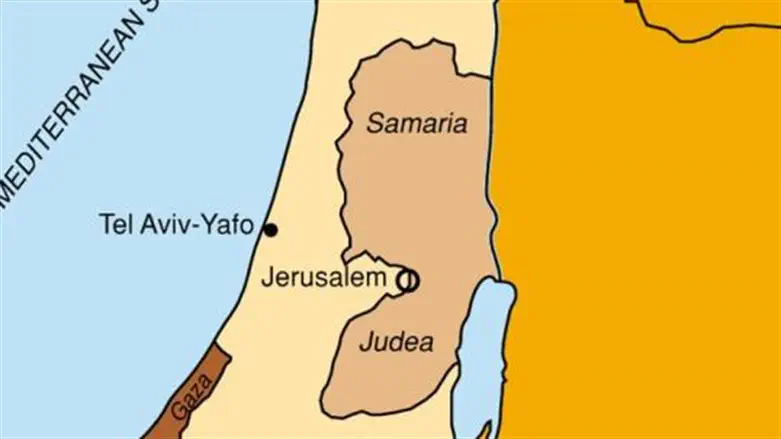
Last week, the Sovereignty (Ribonut) Movement which advocates for the application of Israeli sovereignty to Judea, Samaria and the Jordan Valley, founded in 2011 and co-chaired by Women in Green leaders Nadia Matar and Yehudit Katsover, hosted an evening on the Prospects for Sovereignty.
The event took place at Oz VeGaon in Gush Etzion, the nature preserve established by the Women in Green organization together wih residents of Judea, and the Gush Etzion Regional Council, after the murder of three Israeli teens by Hamas terrorists in 2014. Its name is an acronym of Eyal Yifrach, Naftali Fraenkel and Gilad Shaer HY"D, the young terror victims’ names. An audience of 200 attended the program which got off to an exciting start with the launching of best-selling author Tuvia Tenenbom’s latest book, “Excuse me, is this yours?" - “this" being Judea and Samaria and written after he lived in the region for eight months.
The irrepressible and intrepid author was interviewed by well-known Israeli journalist Yifat Ehrlich and said that if "Judea and Samaria really belong to the Jewish people, Israel must assert sovereignty there. If not, Israelis should leave! It is the cradle of the Jewish people, and it makes no difference if you’re religious or not. It’s the land of the Bible. It’s the foundation of the Jewish nation. More than 80% of the stories in the Tanach [the Bible] happened here, not in Tel Aviv."
A panel discussion after the launching turned heated as panel members Lt. Col. (res.) Maurice Hirsch, JCFA; Omer Rahamim, CEO Yesha Council; Michael Sperber, Channel 14 commentator; Dovi Sheffler, Efrat mayor; and myself (as senior consultant at Arutz 7), and moderator Gabriel Asulin all agreed on the pressing need to declare sovereignty, but differed in perceptions of the reasons it has not yet occurred, how to achieve it and what the aftermath might be.
That evening was the catalyst for writing this article, which will hopefully add to understanding, awaken interest and encourage involvement in an issue that has a powerful effect on the present and future of our beloved homeland, Israel.
The phrase ‘Sovereignty over Judea and Samaria’ sounds weighty. The word “sovereignty" resonates with solemnity. All it means, however, is the official application of Israeli law to the area - that is, asserting the right to govern Judea and Samaria instead of its continuing to be held in an ongoing jurisdictional limbo.
Judea and Samaria are, after all, an integral part of the land reserved for a Jewish homeland by the 1920 San Remo conference whose decisions were later ratified by the League of Nations. The British, to whom that conference granted the Mandate for Palestine, lopped off a portion of the land meant for the Jews when they created Transjordan, later renamed Jordan, in 1921, for their own political reasons, but Jews had purchased land in Judea, notably in Gush Etzion for example, way before 1948.
Israel’s fledgling army was not able to retain control of Judea and Samaria nor the Old City of Jerusalem during the 1948 War of Independence and Jordan overran the region, occupying it until the Six Day War. Gush Etzion’s pioneers, who had built four thriving kibbutzim, surrendered after evacuating women (some refused to leave) and children, but almost all were murdered in cold blood by the Jordanian Legion. The Old City’s Jews were evacuated after a siege.
Nineteen years later, at the start of the Six Day War, the Hashemite Kingdom of Jordan ignored Israel’s secretly relayed request promising not to attack Jordan if it stayed out of the conflict, joined the fighting and was roundly defeated, retreating from Judea and Samaria (Note: the area called Judea and Samaria is located entirely on the west bank of the Jordan River, and called "West Bank" by those who wish to obscure Israel's biblical conection to it, while Jordan proper runs along the river's east bank) as well as from eastern Jerusalem. Jews then returned to Judea and Samaria, and to the Old City in eastern Jerusalem where they had lived continuously and had been the majority since 1844.
That defensive war took place in June 1967, some 60 years ago.
A short time later, Israelis began to build communities in Judea and Samaria, encouraged by the government, and leading to flourishing cities, towns, villages and more recently, farms and sheep-raising homesteads. Jordan ceded its rights to the area in 1988, but Israel stopped short of formally declaring sovereignty over the region, in another instance of the ‘let sleeping dogs lie’ conceptzia. This inaction encouraged the Israeli Left and most of the world’s claim that Judea and Samaria were "occupied territory", Israelis were colonizers, and that a Palestinian Arab state established in the region was all that was needed to bring peace.(Terrorists, meanwhile, tried unsuccessfully to make the area judenrein by more barbaric means)
Efforts to achieve peace culminated in the 1993 Oslo Accords which divided Judea and Samaria into three sections (A, B, C), of which Area C, where all the Israelis of the region live, was under full Israeli jurisdiction, B under Israeli security jurisdiction alone, and A entirely under a newly created Palestinian Authority jurisdiction. The Palestinian Authority (PA) was to govern A and B, allowing those areas a limited police force to enforce order.
The Oslo Accords, which supporters claimed would lead gradually to regional peace and a viable final status for Judea and Samaria, were an abysmal failure marked by constant terror, bloody intifadas and the PA’s blatant pay-for-slay. And the Israelis continued to build.
The October 7 massacre, cheered by most Arab residents of Judea and Samaria, killed any hopes for peaceful Palestinian Arab state bordering Israel. Some Israelis may still believe in it, but the vast majority have realized that the neighboring Arabs want to destroy Israel and that a two state “solution" is suicidal - slogans at Western college campuses and hate marches helped make that point clear, also proving that exporting Qatari money and Iranian planning yield results.
There is, in fact, a movement to cancel the failed Oslo Accords along with other related agreements, and a bill to that effect has been presented to the Knesset, though it will probably not be advanced in the near future. Still, it is hard to find an Israeli today who thinks Israel can ever withdraw from Judea and Samaria. And that makes the question of applying Israeli law relevant - and crucial.
Does Israel have the right to declare Israeli law binding over Judea and Samaria, to decide that Judea and Samaria are part of the Jewish state, as it did in the Golan Heights and the eastern neighborhoods of Jerusalem?
A. In Judea and Samaria, Israel has historical rights as well as legal rights:
1.Historical rights:
The Kingdoms of Israel and Judea ruled for over half a millennium in Judea and Samaria during the Iron Age, this after the centuries-long period of Joshua and the Israelite Judges. Judea and Samaria are the biblical heartland of Israel, as archaeological findings have shown, and its place names appear throughout the Bible. Other tribes that inhabited the area are long disappeared, (despite absurd claims by some Palestinian Arabs that they descend from the biblical Jebusites, or alternatively the Canaanites who sacrificed their sons to the god Moloch).
Jews are the extant indigenous people who preserved the same language, religion and credo (Torah) for thousands of years, and held on to a continuous presence in the Holy Land, even when it was invaded and ruled by foreign forces. The Arabs invaded it in the 7th century C.E.
2. Legal rights:
The 1920 San Remo Agreement included Judea and Samaria in the parameters of the Jewish homeland, was ratified by the League of Nations and has never been rescinded.
The Jews and the Jordanians are the only nations who once ruled Judea and Samaria and can therefore lay claim to it. As cited above, Jordan rescinded its claim. Abe Greenberg wrote in Commentary that Zohran Mamdani's claim that Gush Etzion is on Palestine's land is patently false. There may be individual Arabs who own land there, he agreed, but there was never a Palestinian national entity that governed the region.
B. But why change the current reality?
1. Psychological realpolitik:
It does not matter how many soldiers, tanks and airplanes Israel deploys in Judea and Samaria if it does not define itself as the sovereign government there. Sixty years may seem like time enough for the world and the Palestinian Arabs to realize Israel is there to stay, but sixty years of military administration instead of regular civilian governance signals non-permanence to the local Arab population and the world, signals that we feel that it is not really ours, although we cannot possibly give it up. Even the English words the world uses to describe our presence sound temporary: “settlement," and “settlers" instead of communities and residents.
2. Democracy for all Israelis:
The Jews living in Judea and Samaria do not really live under Israel’s vibrant democracy - in fact, one could say there is a form of apartheid dividing them, not from Arabs, but from the Jews living in the rest of Israel.
The over half a million Israelis in Judea and Samaria are governed by an unelected IDF civil administration headed by theHead of the IDF Central Command. The only legislative framework in existence is the primitive Jordanian system stuck in 1966. Civil laws passed in the Knesset have no standing (criminal law and traffic laws do) unless the Head of Central Command signs them individually, government ministries lack the purview to deal with Judea and Samaria, although they try to help. That leads to inequality, even in minor matters such as library subsidies that are not automatic or permits to open private day care centers. When there are land disputes between Jews, who decides what law prevails?
Even if they mean well, the military staff in charge have no voters to answer to, little knowledge and often even less interest in the mundane problems of mayors and their constituents. There are no local planning and building committees - the Head of Central Command decides. There is no eminent domain for state use - if, for example, a road needs to be built, or a sewage system expanded, the land cannot be expropriated; there must be proof each change serves both the Jewish and Arab population, whether or not they are in need of it.
Finance Minister Bezalel Smotrich’s position as Deputy Defense Minister for Civic Affairs brought about a tangible change for the better in this regard, not only in authorizing new communities, but in the treatment of veteran ones. Instead of months going by without progress solving any civic problem, there is somewhere to turn nowadays and an office that listens and expedites processes. That makes it even more unnerving to think about what could happen after the next elections.
How can Israel allow over half a million citizens who pay taxes and serve in the IDF (without going into their heroic roles on October 7 and its aftermath) to live in legal limbo, unsure how their civic needs will be met by a new government? It must declare that Israeli law is the governing legal framework in Judea and Samaria so as to extend democracy to all its citizens.
C. What about demography?
Area C is majority Israeli (550,000 Jews to 100,000 Arabs) so that declaring sovereignty there as a first step is justified demographically, not just historically and legally. When Areas A and B are factored in, the 1.5m. Arabs become the majority and can affect the entire country's population ratio of Jews and Arabs (See Yoram Ettinger, co-founder of the America-Israel Demographic Research Group, who shows why the Arab population of Judea and Samaria is 1.5 million and not the 3.25 million claimed by the Palestinian Authority.) That, however, is solvable.
D. Why not assert Israeli law in Area C and stop there?
That is possible on all counts, but it is not enough. Israel needs to be sovereign in all of Judea and Samaria to ensure its security.
The PA Army:
Israeli Ideological motives and historical attachment to Areas A and B aside, the Palestinian Authority has blatantly violated the Oslo Accords which allowed it a minimal police force for internal security in Areas A and B, and now has a 60,000+ man well-armed and well-trained army. Areas A and B are a ticking time bomb waiting to explode. Israel must be sovereign in all of Judea and Samaria in order to neutralize that danger and prevent another October 7 style invasion.
E. What to do about the danger of adding 1.5 m. Arabs to Israel’s population?
The only problem might be the change in the proportion of Arab votes for the Knesset. The way Israel can absorb the additional Arab population without paying a dangerous electoral price is twofold:
1. Tuvia Tennenboim’s suggests Israel demand an oath of loyalty to the state as a condition for citizenship, just as the USA does from anyone seeking naturalization. That may not be acceptable to many Palestinian Arabs, but Israel has every right to condition citizenship on pledging allegiance.
2. A concerted effort to bring new immigrants (there is a good chance of their numbers skyrocketing in the near future) to live in the rapidly growing Judea and Samaria cities of Ariel, Efrat and Maale Adumim as well as in the new communities authorized by the current government can change the demographics of Judea and Samaria - and make the issue of citizenship for resident Arabs who swear loyalty less of an electoral influence countrywide.
Why now? Why look for more trouble?
Israel is condemned for its presence in Judea and Samaria anyway. It will be condemned for asserting Israeli law there as well. But with Donald Trump in the White House, there is hope of convincing this most openminded president of the reasons the move is necessary. And with Mike Huckabee, who believes in the Jewish People’s inalienable biblical rights to Judea and Samaria, as ambassador, we have the best friend we can imagine to help us.
Israel is a democratic state. Except when it comes to Israelis in Judea and Samaria. Jerusalem and the Golan were declared to be under Israeli law and the world disapproved but has learned to live with it. It is high time that Judea and Samaria become a legally equal, not just a geographic and historical, contiguous part of the Jewish state.