
Exactly a Week Before
Hashem orchestrated the liberation of Yerushalayim so that Yom Yerushalayim falls on the 28th of Iyar, precisely one week before Shavuot.
Similarly, Yom Haatzma’ut aligns with Pesach, occurring exactly two weeks after Pesach. This alignment is significant because all three days commemorate themes of freedom and redemption.
But what is the relationship between Yom Yerushalayim and Shavuot? What is the significance of Yom Yerushalayim falling exactly one week before Shavuot? Are they similar in some way? Is the former meant to prepare us for the latter?
The Condition for Matan Torah
To address these questions, we must examine the prerequisites for Matan Torah.
The Torah can only be received when the Jewish people are worthy. The Zohar explains that this requirement of worthiness accounts for the seven-week interval between Yetziat Mitzrayim and Matan Torah. Just as a niddah requires seven days to achieve purity, the Jewish people required seven weeks of self-purification and improvement to become ready to receive the Torah.
In what ways did the Jewish people need to improve themselves?
There are many answers to this question. One appears in the Torah’s description of the arrival at Har Sinai: “Vayichan sham Yisrael neged ha’har - Israel encamped there, opposite the mountain." The use of the singular vayichan, rather than the plural vayachanu, indicates that the nation encamped in unity, “as one person, with one heart."
Hashem gifts the Torah only to a unified Jewish people. This is further demonstrated by the Torah’s description of the nation’s consent at Har Sinai: “Vaya’an kol ha’am kol echad - The whole people answered with one voice." Hashem gave the Torah to the Jewish people as one people, only when we stood unified before Him.
Unity is essential for Matan Torah because Hashem intends the Torah for Klal Yisrael - the ontological communal entity of the Jewish people - rather than for individuals. Although each person possesses a unique connection and understanding, the Torah fundamentally belongs to Klal Yisrael as a unified whole. No individual or subgroup can receive it independently.
The City that Brings Us Together
Unity is likewise a prerequisite for our relationship with Yerushalayim. Our merit in receiving and maintaining a presence in the city depends upon our achdut.
1967 Versus 1948
Rav Moshe Zvi Nerya applied this principle to explain the contrast between the unsuccessful and successful efforts to liberate Yerushalayim in the twentieth century.
In 1948, we lost the Old City of Yerushalayim because the fighters fought as separate entities rather than as a unified force. The Palmach attacked Sha’ar Tziyon; the Haganah and Irgun fought for Sha’ar Yafo; and the Lechi and Irgun approached Sha’ar HaChadash - each group attacking a different gate at different times, and each therefore unsuccessful.
In 1967, the situation was dramatically different. Facing existential threats, Israel established its first Unity Government. A unified IDF, supported by a united populace, succeeded in retaking the Old City and reunifying Yerushalayim. Hashem returns His city to us only when we fight for it together, as a unified people.
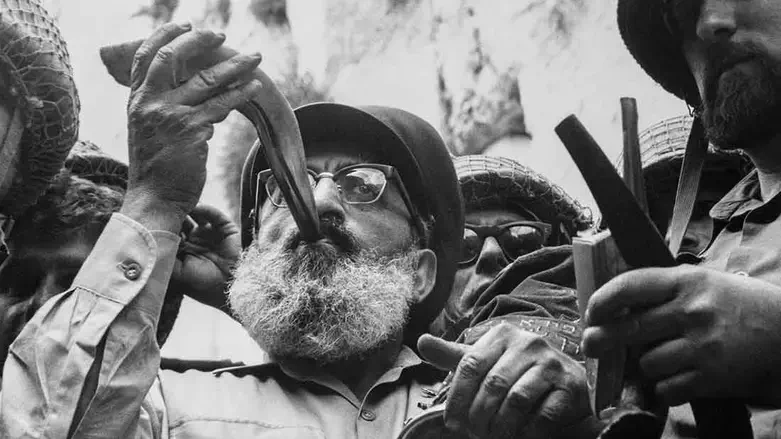
The unity is symbolized by the iconic photograph of three paratroopers at the Kotel. Each soldier represented a distinct background within Israeli society: Tziyon Karasenti, born in Morocco to a religious Mizrachi family; Yitzchak Yifat, an Ashkenazic secular Sabra; and Chaim Oshri, from a traditional Eastern European Balkan family.
Despite their differences, they stood together, shoulder to shoulder in the same frame, celebrating the reunification of Yerushalayim at the Kotel.
Yerushalayim’s Yachdav Roots
The requirement of achdut as a condition for receiving Yerushalayim is rooted in our earliest relationship with the city. The Torah highlights this in its first narrative concerning Yerushalayim: Akeidat Yitzchak. Twice within three pesukim, the Torah describes Avraham and Yitzchak proceeding “yachdav - together" to Har Hamoriah, the pinnacle of Yerushalayim." Rashi explains that the repetition teaches us that this togetherness persisted even after Yitzchak understood that Avraham intended to sacrifice him. Yitzchak remained unified with Avraham, even when Avraham’s intention might have driven them apart.
Appropriately, the first Jewish king of Yerushalayim, Dovid HaMelech, likewise used the word yachdav when describing Yerushalayim as the “ir she’chubrah lah yachdav - city that connects together." Chazal explain this phrase to mean that Yerushalayim connects Jews to one another.
Yerushalayim is intended to unite the Jewish people. This unity is integral to the goal of aliyah l’regel, the Yom Tov pilgrimage to Yerushalayim. The mitzvah is not solely for individuals to visit Yerushalayim, but for the Jewish people to ascend collectively. Just as we stood unified before Hashem at Har Sinai to accept the Torah, so too are we meant to stand three times a year before Hashem at Har Hamoriah as one people.
The central role of unity in our relationship with Yerushalayim also explains why sinatchinam (baseless hatred) led to its destruction. The city was merited through unity and lost through division.
Yom Yerushalayim Preparing Us for Shavuot
Two millennia after sinat chinam led to our exile, Hashem returned Yerushalayim to us during a moment of profound Jewish unity in 1967. Unfortunately, we were unable to sustain this unity in the years that followed, and our disunity intensified before October 7th. The attacks by Hamas served as a stark reminder of the importance of Jewish unity.
Yom Yerushalayim celebrates the city's reunification under Jewish sovereignty. Yet, despite official declarations, Yerushalayim remains deeply divided - not only between Jews and Arabs but also within the Jewish community itself. The ultimate redemption and genuine unification of Yerushalayim depend upon achdut among the Jewish people.
May our Yom Yerushalayim celebration strengthen our bonds with our Jewish brethren and foster the unity that enables the Kabbalat HaTorah of Shavuot, the ultimate reunification of Yerushalayim, and our closeness with Hashem.
To actualize this message of unity, let’s all take a practical step: reach out to fellow Jews or invite a group of friends to study together in honor of Yom Yerushalayim and Shavuot. By actively building these connections within the community, we strengthen the achdut that lies at the heart of both Yerushalayim and Matan Torah.
Rav Reuven Taraginis the Dean of Overseas Students at Yeshivat Hakotel and the Educational Director of World Mizrachi and the RZA.
His new book, Essentials of Judaism, can be purchased at rabbireuventaragin.com