
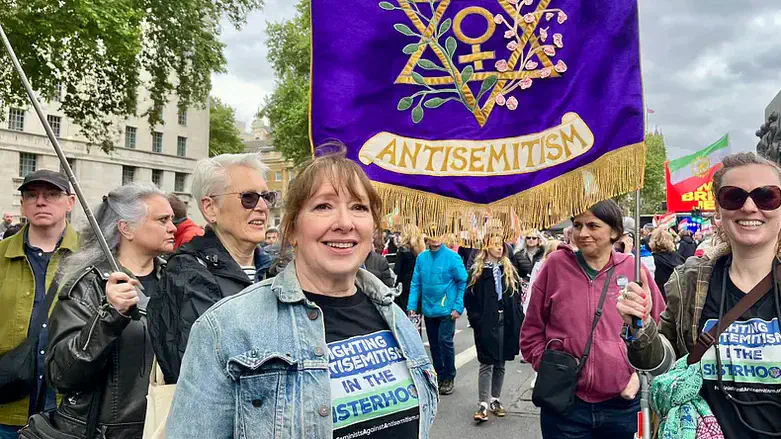
Ed. Note: At the "Standing Strong" rally against antisemitism several days ago at Downing Street, Jews and non-Jews gathered to demand action against the rising tide of hate against UK Jews. Feminists against Antisemitism were there. Anti-racist feminists were not.
Susan McDonnell, a member of Feminists Against Antisemitism, wrote this response.
Dear anti-racist sisters,
I was so sorry not to see you on Sunday. The event slogan read “Britain stands with Britain’s Jews". It was explicitly anti‑racist: a demonstration against Jew‑hatred. I hoped to see you because anti‑racism is supposed to mean showing up when a minority is under threat.
So I’ve been wondering why you weren’t there?
Maybe you were just scared?
Jewish events now require serious security because the hate marches are normalising violence, and that violence is no longer theoretical. The sight of Jews queuing within barriers to surrender their belongings for searches to take place had hideous, humiliating echoes. And it had to be a fortified static rally, not a march, almost certainly because it was easier to secure. That alone says something disturbing and the fear is grounded in unprecedented reality. Antisemitic incidents in the UK are at their second‑highest levels ever recorded. For the first time in modern history, Britain has seen fatal antisemitic terrorism on its own soil. Jews are now the most targeted religious group per capita in the country.
I was scared, too - but I know my Jewish friends’ children go to school through double airlock security, their teenagers are shunned and face death threats at university, and their synagogues are guarded by professionals and by volunteers - friends of mine - for whom rotating security duty in stab‑proof vests has become routine. If I don’t stand up for my Jewish sisters, who will? Maybe next time I can help you find the courage. Solidarity has to mean something.
Did you know Jewish people in the UK feel completely alone?
I talked to a couple of hundred people, mainly women, at the event. Almost all of them were Jewish. I don’t know how to describe the welcome: one 84-year-old gave me her phone number and invited me to stay at her house. People were absurdly, embarrassingly grateful to me for being there, because they are a tiny community under physical attack by a state power in their own country, and they feel terribly alone.
Why does anti‑racism stop when the victims are Jewish?
They are hurt, and I am astonished that people who were perfectly willing only a few weeks ago to stand, in the name of anti-racism, with Islamists who support the murderous Iranian regime weren’t willing to stand with Jews to demand Jewish safety. I suppose you’d say that the Jews are not victims of racism, that they’re ‘white oppressors.’ But that’s an ancient conspiracy theory in progressive drag. If you fall for something this stale and this dishonest, you’re not qualified to call yourself an anti‑racist at all.
Why do Iranians under Islamist tyranny see more clearly than the British left?
I wore a small pre-regime Iranian flag badge, and the Iranian supporters there wanted to talk. They were incredibly well informed about the history of the region - even a nine-year-old that I met! - and see Jews, and Israel, as their historic allies, not as enemies. The Iranians who showed up are some of the most passionate people to support the Jews because they understand exactly what is going on. They understand Islamist extremism. They understand complexity. That clarity stood in contrast to much of the British left.
There were chants from this group - who skewed younger - of ‘Long live Iran, Long live Israel’. That ought to give my progressive sisters pause for thought. By the way, there were plenty of Iranian women in this group, loud and proud. These women are truly brave, and have far more to lose than most. Be braver every day.
What does it tell you that this wasn’t an activist crowd?
Those gathered were of all ages, with a wide range of skin colours and from all classes. But I didn’t meet a single activist; ‘I’ve never done this sort of thing before,’ more than one person told me. There were no mantras; there was no ‘call-and-response’ chanting. Everyone I met expressed sadness that this was necessary, but was resigned to the inevitable fact: it is.
The phrase that came to mind was ‘an atmosphere of quiet disquiet.’ It is in marked contrast to the jubilation I have seen at the pro-Palestinian marches.
The crowd demanded Deeds, Not Words.
Representatives of the three traditional political parties in England were there. Two were jeered, the Labour minister Pat McFadden so loudly that his speech could not be heard. I spoke to many people about this. Lots were Labour voters, angry at years of government inaction on explicit parades of Jew-hate, whether the rhetoric on the Saturday marches, or the casually accepted vandalism of Jewish-owned property, which has culminated in stabbings and murder. It wasn’t that they hated the left: it was that they hated the government’s inertia in the face of normalisation of Jew-hate.
‘We want action,’ I heard one woman yell. I spoke to her afterwards and asked her what she wanted. She was very clear; it had to start with naming and evicting the elephant in the room: Islamist extremism, and the IRGC. Again, a phrase popped into my head - the suffragettes’ demand of Deeds, Not Words. No one wanted warm words or lip service.
Why must Jews be perfect victims to deserve your support?
Lots of people have commented about a controversial politician, Richard Tice, who was invited. No, it wouldn’t have been my choice. But why must Jews be the perfect victims, only accepting the right sort of allies, before ‘anti-racists’ will offer their help? Do they make similar demands of other vulnerable groups? And what of the fact that left-wing progressives - and far too many others - don’t offer allyship at all? Similarly, I know people who stayed away or hid their presence because they were afraid of being labelled ‘far right’, ‘Islamophobic’ or ‘hateful’. Or perhaps because standing with Jews now carries a social cost? It ran through my mind, too. But this is a self-fulfilling fear. I am not willing to cede the ground of fighting against Jew-hate to those who are simply exploiting it for their own ends.
Where were your institutions when Jews were threatened and killed?
On a different, but again related, note: one reason for the political nature of this gathering was that so few of our institutions are willing to stand up for, or even with, Jews. Where were the unions, the NGOs, the universities? The silence after October 7th hasn’t been much broken by institutional outcry over the murder of Jews in this country.
This abandonment extends into workplaces, health care, unions, and civil society where many British Jews now report experiencing antisemitism in universities and at work. Many experience it within trade unions themselves and of course diversity and inclusion frameworks routinely exclude antisemitism, signalling that Jews do not count. Perhaps some of this silence is driven by a misplaced fear that naming antisemitism means banning criticism of Israel. It doesn’t. Israel is a normal country and can be criticised like any other. If you doubt that, try asking a few Jewish friends (if you’re lucky enough to have them - they are only 0.5% of the population) what they think about Israel and get ready for love and critique, attachment and frustration, pride and hope, because Jews are very used to holding two thoughts at once. What is not normal is singling out the world’s only Jewish state and arguing that it alone does not deserve to exist.
My progressive sisters: believing yourselves immune to antisemitism has made you blind to it. There is a long and familiar pattern to that blindness, and it never ends where people expect. If you think you are striking a blow for the underdog by ignoring Jewish pain, you are wrong: you are part of an anti-Jewish establishment that never really went away.
Why does your anti‑Israel politics stop at Jewish safety?
Finally, of course, there was Israel. There always is, and long may Israel thrive. Many Jews at the rally expressed support for Israel because Israel is a symbol of peoplehood, continuity, and survival. So if you insist that you are anti‑Israel rather than anti‑Jew, answer this plainly: why do Israel’s actions suddenly become relevant when Jews here are threatened or attacked? We do not ask other minorities to answer for states or peoples elsewhere before deciding whether they deserve safety. No one is required to disavow their collective belonging as a condition of basic protection - except Jews.
Do you not see that the double standard is not accidental? Antizionist slogans are easy because they recycle thousands of years of antisemitic ideas - blood libels, accusations of deviousness, deviancy, and greed - that already sit comfortably in people’s heads, just as modern misogyny recycles millennia of woman-hate.
Anti‑racist movements have always been judged most harshly not by who they defended when it was popular, but by who they protected when it wasn’t. And reflecting afterwards, I realised that at this rally, almost everyone fell into one of two categories: Jews (and Jewish institutions) defending their own right to exist safely, and non‑Jewish individuals attending privately, cautiously, often without organisational backing. What was striking by its absence were non‑Jewish, values‑driven organisations willing to say publicly and without hesitation that antisemitism is their fight too.
So no, we at Feminists Against Antisemitism are not simply ‘showing solidarity’ with Jews. We are saying that institutional antisemitism is identical to the institutional failure to liberate women. A feminism that cannot recognise antisemitism in its own spaces, that withholds support from Jewish women until political conditions are met, is failing its own principles and that is a feminist issue.
My anti‑racist sisters: you belong in this fight. You don’t need to have all the answers, or perfect language, or a fixed position on every geopolitical question. You just need the willingness to listen and to stand alongside Jewish women without conditions.
Arutz Sheva thanks Prof. Phyllis Chesler for forwarding this letter.