

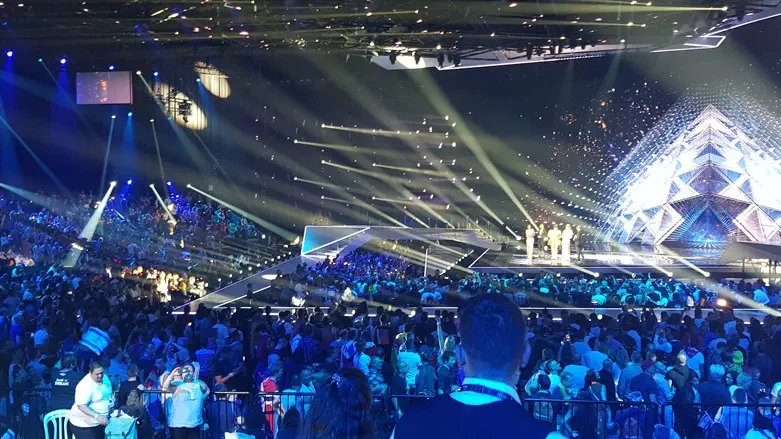
The Ministry of Diaspora Affairs and Combating Antisemitism on Monday warned of a rise in antisemitic incidents and incitement ahead of the Eurovision Song Contest 2026 in Vienna, Austria, and announced that it is ramping up operations to monitor and address threats surrounding the event.
The Ministry released a special report titled “Antisemitic Discourse in the Mirror of Eurovision 2026," which details online incitement, boycott campaigns, political pressure on broadcasters and artists, and planned protests linked to Israel’s participation in the competition.
According to the report, approximately 39,500 antisemitic posts were identified on the X platform in Austria between January 1 and April 16, 2026.
The Eurovision final is scheduled to coincide with “Nakba Day" on May 15, a date associated with pro-Palestinian demonstrations worldwide.
Diaspora Affairs and Combating Antisemitism Minister Amichai Chikli said the Ministry’s National Command Center (NCC) had identified “a sharp and coordinated surge in antisemitic and anti-Israel discourse surrounding Eurovision 2026."
“This online incitement attempts, among other things, to brand the Eurovision as ‘Genovision’-an event allegedly concealing a fabricated Israeli ‘genocide,’" Chikli stated.
He added that the overlap with “the false ‘Nakba Day’" increases risks and reflects what he described as “the dire state of Europe."
“In light of these developments, I have instructed to step up the NCC’s activities, expand real-time monitoring and alerts, and work alongside relevant authorities and our global partners to protect Israeli citizens and Jewish communities," Chikli said.
“The melody of our people, the People of Israel, cannot be stopped."
Eurovision 2026 will take place at the Wiener Stadthalle in Vienna between May 12 and May 16.
According to the report, more than 1,100 artists and cultural figures, including Roger Waters, Peter Gabriel, and Macklemore, signed an open letter calling for a boycott of the competition as long as Israel participates.
The report also stated that Ireland, Spain, the Netherlands, Slovenia, and Iceland withdrew from the competition following the decision to allow Israel’s participation.
Spain, Slovenia, and Ireland announced they would not broadcast Eurovision 2026 in protest of Israel’s involvement. Slovenia stated that it would instead air special programming titled “Voice of Palestine."
The Flemish public broadcaster in Belgium, VRT, announced it would air a special segment before each Eurovision broadcast discussing controversy surrounding Israel’s participation.
In contrast, Austria’s ORF broadcaster stated that Eurovision would not take place in Austria if Israel’s participation were banned. Broadcasters in Switzerland, Greece, Cyprus, Bulgaria, Azerbaijan, Albania, Ukraine, France, and Belgium support Israel’s participation.
Director General of the Ministry of Diaspora Affairs and Combating Antisemitism Avi Cohen-Scali described the campaign as “coordinated and extensive."
“This is a coordinated and extensive campaign involving digital activity, targeted pressure on artists, and protests on the ground," Cohen-Scali stated.
“The phenomenon is worsening due to recent events in Europe, and we will continue to monitor, alert, and provide accurate real-time information to the relevant authorities."
The report stated that alternative events, including “United for Palestine" in Brussels and “No Stage for Genocide" in Vienna, are being organized as platforms opposing Eurovision and calling for Israel’s exclusion.
The Ministry added that large-scale demonstrations are expected in Vienna during the Eurovision final, alongside protests planned in several European countries, including Malta and Greece.
According to the report, Austrian authorities and ORF are expected to implement enhanced security measures at key locations, including the Wiener Stadthalle, Praterdom, and Vienna City Hall.
The measures are set to include comprehensive background checks for staff members, increased police presence, deployment of special units, and airport-style security screenings.
The Ministry noted that only approved flags purchased through official channels will be permitted inside the arena, including flags of the 197 countries and territories recognized by the UN.
Although the report stated that no concrete threat has been identified at this stage, authorities are continuing risk assessments and preparations for possible disruptions and protests during the event.