
Leo Pearlman is a London based producer and a loud and proud Zionist. His most recent film about the Oct 7 Nova Music Festival massacre, ‘We Will Dance Again’ has won the
On Thursday, Britain voted, by Friday morning, the story was Reform, by Saturday, the story was Labour’s collapse. But by this morning, if we are paying proper attention, the story should be something far darker.
The Greens.
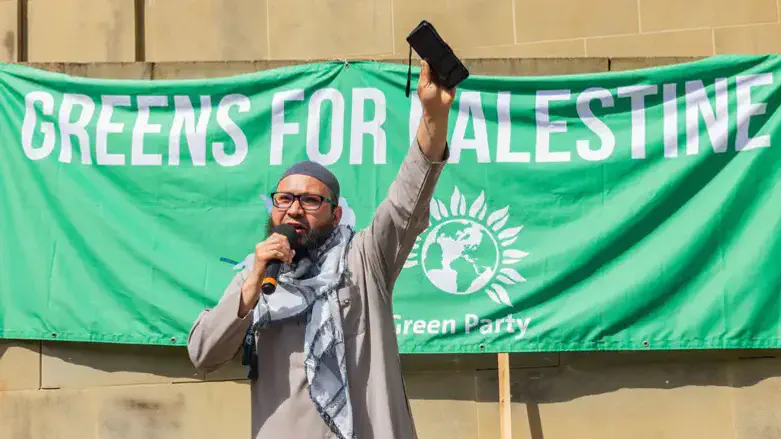
Somewhere along the way, the Green Party of England and Wales stopped being primarily concerned with cleaning up our rivers and seas, and became obsessed with ensuring that the Jewish state no longer exists between a very specific river and a very specific sea, two bodies of water that many of their most performative supporters could not even name.
The local election results were not merely a protest vote, they were a warning flare.
Reform’s rise will dominate the commentary, and understandably so, they won big. They now have to prove they are more than slogans, more than Nigel Farage, more than opposition. They have councils to run, services to deliver, budgets to manage, promises to keep. That is the test of having actual power, rather than simply claiming to deserve it.
But there is a difference between a party being tested by responsibility and a party being rewarded for irresponsibility and the Greens have been rewarded.
This is the uncomfortable truth the Left refuses to confront. For years, it has shrieked that anyone who votes Reform is, by definition, flirting with fascism. Yet Reform, however imperfectly, has been trying to clean up its act. People with undeniably ugly views still get through the gaps. That matters, but when exposed, they are more often dealt with swiftly and publicly. Reform is now full of former Conservatives and is careful to distinguish itself from harder-right outfits.
Whether that effort succeeds, time will tell, but Reform is not leading hate marches through Britain’s streets. The Greens, on the other hand, increasingly look like the parliamentary wing of those hate marches.
Look at Croydon where Mark Adderley was elected as a Green councillor despite being suspended by the national party over alleged antisemitic comments. Yet he remained on the ballot, and the local party continued to back him. This is not fringe, this is elected office.
Across the country, the Greens made significant gains, taking control of councils and embedding themselves in local government at scale. This is no longer a protest movement, it is real power.
For many Greens, this election was effectively a referendum on Gaza. There is a bitter irony in that, since the Palestinian Arabs themselves have not had free and fair elections for two decades. Since Israel’s withdrawal from Gaza in 2005, and the subsequent takeover by Hamas, democracy there has been extinguished. Yet in Britain, comfortable progressives turn Palestinian Arab suffering (whose real cause is Hamas) into an identity badge, a chant, a campaign slogan.
This is certainly no longer about environmentalism. It is a combustible mix: identity politics at its core, foreign conflicts elevated above domestic reality, and a sectarian edge that is increasingly explicit.
The environmentalism now feels like a veneer. Mothin Ali offers a telling illustration: a deputy leader who publicly leans into the imagery of gardening and green enterprise, sharing videos of soil, growth and cultivation, while also framing the events of October 7th through the false language of “indigenous resistance." (The Jews are indigenous to Israel, not the Arabs, ed.)
Not so much green fingers, then, as a politics that, at times, feels closer to a green headband. The contrast is stark and it is revealing.
This has been the direction of travel for the Left for quite some time. An inclusive insistence that the victim, any victim, has the right to self-define racism without fear of challenge or debate. As we now know, this inclusivity does not include the Jew.
When Jewish communities report fear, abuse, intimidation and assault, suddenly the language changes. Suddenly Jews are not experiencing hatred, they are “perceiving" it. As if British Jews have collectively imagined the marches, the chants, the ripped-down hostage posters, the security at schools, the decisions to hide identity in public, the arson attacks, the stabbings and the murders. As if fear itself has become political dissent.
And now we look ahead to the Nakba march next week. How many of those newly elected Green councillors will be there? How many of those marching will have put a cross next to the Green Party on Thursday? How many will stand near the front, wrapped in the language of human rights while surrounded by people who long ago stopped pretending that their rage is aimed only at a government?
This is, after all, the party that now dominates among 18-24 year olds, the same cohort that fills these marches, sets their tone, and floods social media with their messaging. The overlap is no longer incidental, it is structural.
These are not marches for peace, not anymore. They are stages upon which something older is being performed, with newer language but familiar intent. The banners change, the slogans evolve, but the direction of blame remains eerily consistent.
The politics of the march and the politics of the party do not simply intersect; they reinforce one another, one legitimises the other. So let’s not pretend this is a fringe phenomenon, let’s not pretend this is coincidence.
This is a pipeline, from placard to polling booth, and back again.
Britain keeps pretending not to recognise it and that is the true story of these elections. Not simply that Labour failed, though it did. Not simply that Reform rose, though it has. But that a party now gaining serious local power across this country has become a vehicle for a politics that treats Jewish safety as negotiable and Jewish sovereignty as uniquely illegitimate.
So yes, scrutinise Reform. Demand seriousness, demand policies, demand competence. Demand that Farage and his party prove they can govern, not just complain and that they continue to rid racists from their ranks.
But do not choose to look only Right for danger. Because while Britain’s commentariat stares obsessively at one end of the horseshoe, the other end is wrapping itself in green, chanting about liberation, and marching towards something very old indeed.
The Greens have found their river, it isn’t the Thames - and the sea they care about most is not the one they once promised to clean.