
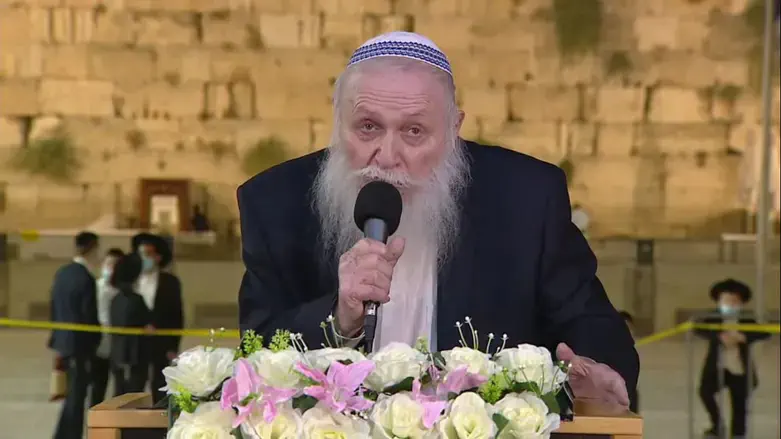
This article is an extract from Rabbi Chaim Druckman’s book, “Step by Step," an enlightening discussion of the process of redemption that is taking place in our generation. (Adapted and translated by Moshe Goldberg)
Showing Appreciation
The joy and the praises of Hallel on Yom Ha’atzmaut and Yom Yerushalayim are a way of giving thanks to God, not only for rescuing us but also for the tremendous heavenly gift He gave us - the State of Israel. The fact we are independent and no longer subordinate to others obligates us to give thanks and not to show a lack of appreciation, despite many problems that exist in the country.
What can this be compared to? Think of a man who receives a gift of a beautiful vase from a friend, but a member of his household fills it with mud instead of flowers. Would anybody think the recipient of the vase should not thank the benefactor? A member of his own household soiled the vase. Why should this detract from the thanks due to the one who gave the gift?
God gave us the State of Israel, the most precious gift possible. We were privileged to acquire something no previous generation had merited. However, some problems have arisen, things we created ourselves. Why should these problems prevent us from thanking God for this gift? Quite the contrary! Our appreciation of the good should awaken a desire in us to make sure everything functions properly. Of course, we must continue to thank God for all the good He has done for us.
For thousands of years, we have continued to celebrate Pesach in memory of the Exodus. Does Bnei Yisrael’s sin with the Golden Calf prevent us from celebrating?
We celebrate Chanukah because of the miracles performed for us by “heavenly chassidim" - the Chashmona’im. When their dynasty was taken over by Tzedukim, did we stop celebrating Chanukah?
The same reasoning is valid today. Are the problems we ourselves caused a reason to stop us thanking God for the great miracles He performed, for the release from oppression He granted us, and for saving us from certain death and giving us life? All these elements are expressed on Yom Ha’atzmaut and Yom Yerushalayim by joy, Hallel, and thanksgiving!
Sadness and Joy in Eretz Yisrael
The following appears in the Shulchan Aruch:
If one’s father dies, he should recite the blessing “dayan ha’emet." If he inherited money from his father... he should also recite the blessing “shehechiyanu." - Orach Chaim 223:2.
We cannot begin to describe the great pain and sadness at a father’s death. Even if he left a huge sum of money or all the wealth in the world, the pain at the loss is deep, with terrible sadness. But in the above quote the Shulchan Aruch rules that if the father left an inheritance the son must recite not only dayan ha’emet but also shehechiyanu. Does this second blessing in any way diminish the pain and the sorrow? Of course not! A great lesson can be learned from this law:
When both happiness and sadness are mingled together - each side is taken into account; neither one is cancelled.
The joy for the inheritance does not dull the sadness for the death, and the sadness does not repress the feeling of thanks that the father left an inheritance and not a debt.
The rabbis discuss whether shehechiyanu should be recited at a circumcision:
The father recites the shehechiyanu if he performs the circumcision himself, but if another person does it some say it is not recited...
Comment (by the Rama): In our lands, the blessing is not recited even when the father himself does the circumcision - unless he is circumcising his firstborn son, whom he must also redeem from a Kohen. Then he says shehechiyanu at the circumcision but not when he redeems his son. However, this blessing is not recited if the son does not have to be redeemed.
Yoreh Dei’ah 265:7
According to the Shulchan Aruch, only the father recites shehechiyanu, and only if he performs the circumcision himself. On the other hand, the Rama writes that the blessing is not said even if the father performs the circumcision himself, unless this is a firstborn son, who must also be redeemed by a Kohen. And then the blessing should be recited at the circumcision and not at the redemption ceremony.
One of the reasons given for not reciting shehechiyanu at a circumcision is because of “the baby’s pain."
On the other hand, the Shulchan Aruch quotes the Rambam:
The father recites this blessing for every circumcision. And this is the custom in the entire Kingdom of Eretz Yisrael, and Syria and its surroundings, and in the Kingdom of Egypt.
The Shulchan Aruch emphasizes that the people accepted the Rambam’s custom in Eretz Yisrael and nearby lands, and the shehechiyanu is recited for every circumcision. Why was there no concern for “the baby’s pain" - don’t the babies of Eretz Yisrael feel pain? The answer teaches us an important lesson: In Eretz Yisrael, the pain of a circumcision is not great enough to suppress the great joy of being in the Land! When happiness and pain are both present in Eretz Yisrael, neither one cancels the other! Even great pain does not diminish the happiness, and it is therefore necessary to recite the shehechiyanu: “He who gave us life, supported us, and helped us reach this moment!"
Kiddush Hashem is Greater than Chillul Hashem
Rabbi Abba Bar Zamina says in the name of Rabbi Hoshaya: Kiddush Hashem is greater than Chillul Hashem.
Talmud Yerushalmi Kiddushin 4:1
My mentor Rav Tzvi Yehuda Kook asks: What is novel about this statement? Do we need the Yerushalmi to teach us to sanctify the Name rather than desecrate it? Rav Tzvi Yehuda replies that the passage is referring to a case in which there is both desecration and sanctification of the holy Name. The situation has positive and negative elements, and the dilemma is how we should relate to such a case.
The Talmud Yerushalmi teaches us that we should not refuse to act in this case, but that the positive side takes precedence. That is what is meant by, “Sanctification of the Name is greater than its desecration." The holy side in such a case must take precedence for us. This principle applies to our current situation. Despite its negative aspects, we must certainly celebrate the holiday and thank God, because the aspect of sanctification takes priority.
God’s Counsel Stands Forever
One who recognizes God’s guidance as the moving force behind the process of our rejuvenation can be confident that everything we see that seems to oppose this plan is nothing more than what we read in the verse, there are many thoughts in the heart of man (Mishlei 19:21). As Rav A.Y. Kook wrote, it makes no difference whether the thoughts stem from within us or from foreign sources:
With respect to God’s decision to begin shining the light of Redemption hidden in mystical hiding places, as we see with our eyes, but surrounded by many blemishes of those who have feeble thoughts and suffer from a spiritual disorder -clearly none of these human thoughts will come to anything, since human thought is null and void as compared to God’s counsel. He spoke well of Yisrael and plans to establish the light of Redemption and a path of life for the remnant of His people, who will all repent their sins in the future. Igrot Ha’reiyah vol. 2 p. 37
Difficulties and delays, and even questions that sometimes appear on the path of Redemption, cannot in any way dim our confidence in the continued progress Divine Plan. After all, God’s counsel stands forever, the thoughts in His heart from generation to generation (Tehillim 33:11). For He said and it took form, He commanded and it stood up (ibid. 33:9). For God will not abandon His nation and He will not leave His heritage (ibid. 94:14).
The difficulties and setbacks in our lives must not prevent us from singing songs of praise. They are painful for us and we try to mend whatever we can, but we understand that “sanctifying God’s Name is greater than desecrating it," and we must recite the shehechiyanu even as we feel sadness and give vent to a sigh. We try to mend whatever we ourselves have spoiled, but we do not forget to give thanks to the One who gave us His great gift of a sovereign state.