

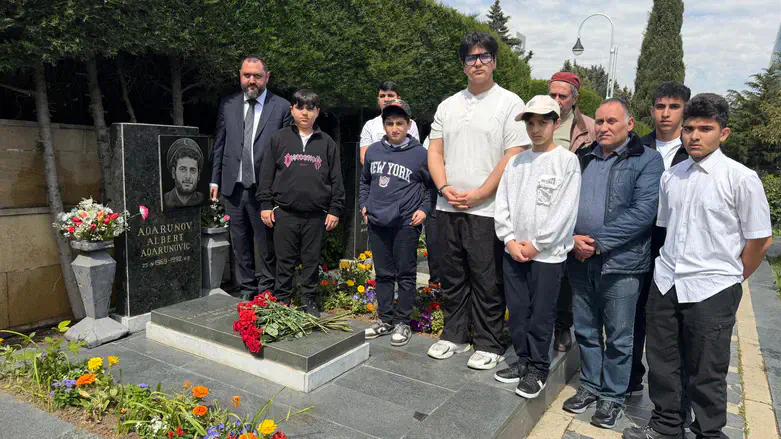
Thirty-four years after he was killed in the battles of Karabakh, the Muslim-majority state of Azerbaijan continues to honor the memory of Albert Agarunov, the Jewish soldier who became a national hero and a symbol of unity between Jews and Azerbaijanis.
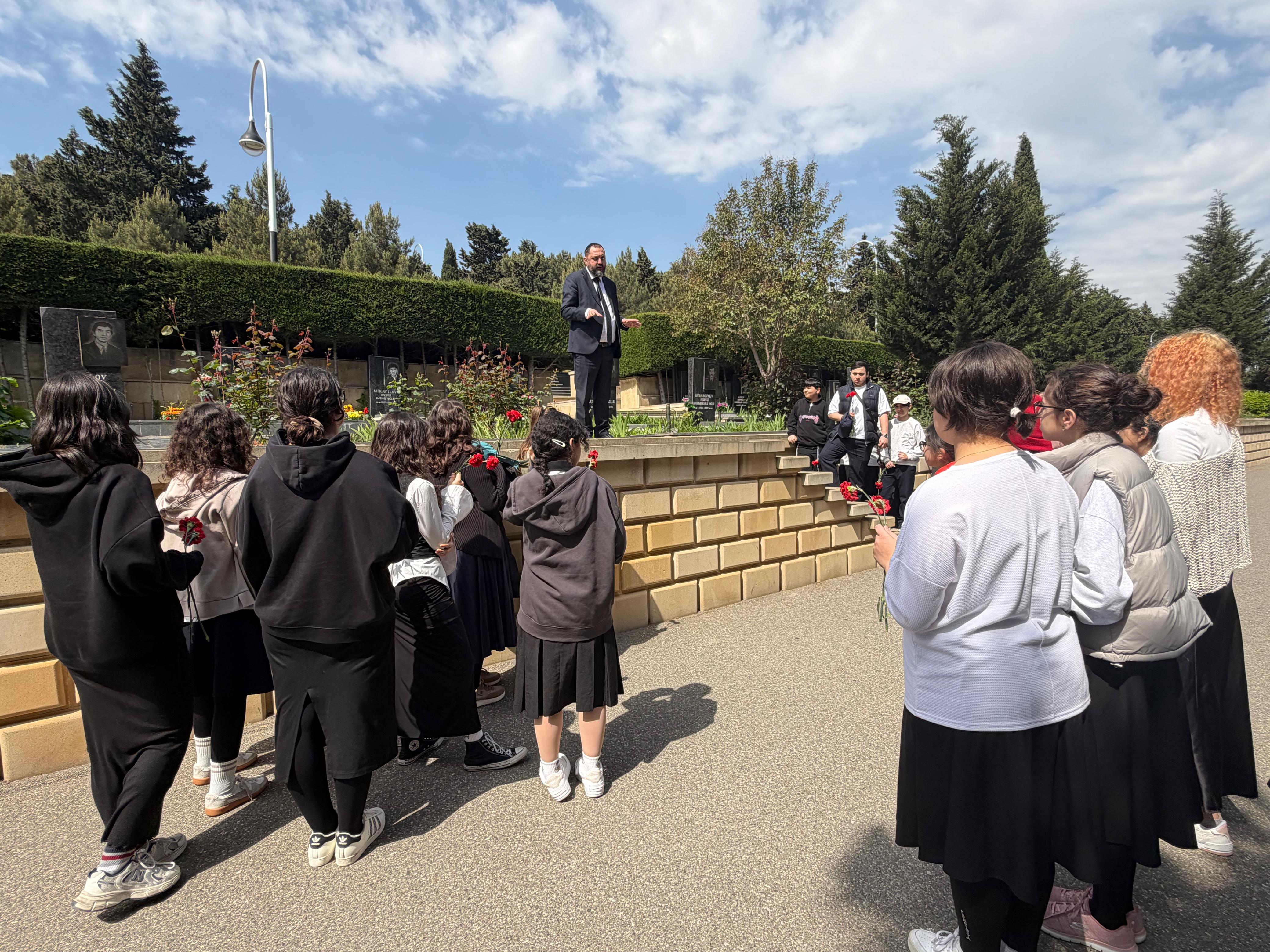
As part of the memorial events held this week, the rabbi of Baku’s Sephardic Jewish community, Zamir Isayev, arrived together with students from the Jewish school and young members of the Jewish community to pray near Agarunov’s grave in central Baku. Agarunov is buried beneath the flags of Israel and Azerbaijan at the central site known as the Alley of Martyrs, alongside other national heroes. During the visit, the students heard the life story of the Jewish fighter who became one of the country’s symbols of national heroism.
“His legacy is a lesson in courage, responsibility, and love of homeland," Rabbi Isayev said during the event. “Albert Agarunov proved that it is possible to be a proud Jew and a loyal citizen who loves his country and is willing to sacrifice for it."
For many Azerbaijanis, Agarunov’s name is associated not only with a heroic battle from the First Karabakh War, but also with values of loyalty, sacrifice, and civic partnership. The story of the Jewish fighter, who was killed while attempting to evacuate the bodies of his comrades from the battlefield, continues to resonate far beyond the local Jewish community.
Agarunov fought in May 1992 in the battle for the defense of the city of Shusha, one of the central and most difficult battles of the First Karabakh War. He was already known as a master tank commander. During the fighting, he took part in numerous tank battles against Armenian separatist forces and the Russian army, and according to reports succeeded in destroying a large number of enemy armored vehicles. Armenian forces reportedly placed a substantial bounty on his head.
According to testimonies from Azerbaijani officers who fought alongside him, during the battle Agarunov left his tank in order to evacuate the bodies of Azerbaijani soldiers who had fallen and remained in the streets of the city. While attempting to recover the dead, he was shot and killed by a sniper on the Shusha-Lachin road on May 8, 1992.
After his death, he was awarded the title “National Hero of Azerbaijan," the country’s highest honor. His funeral became a symbol of interfaith respect, with Jewish rabbis and Muslim imams participating together.
Over the years, Agarunov became a well-known figure in Azerbaijan’s public consciousness. The school where he studied was named after him, and later a memorial plaque was placed on his family home in the Amirjan district of Baku. In 2020, a large monument in his memory was also inaugurated in the city.
In Azerbaijan, Agarunov’s story is viewed as proof that Jewish identity and Azerbaijani patriotism are not contradictory. In a rare recording made just days before his death, Agarunov told a journalist that he was Jewish and was fighting for the place where he was born together with his Azerbaijani brothers. For many in the country, he represents a civic worldview according to which a person’s worth is measured by courage, service, and devotion to the state, rather than by ethnicity or religion.
The attitude toward Agarunov also reflects the long-standing status of Jewish communities in Azerbaijan, primarily in Baku and Quba, where Jewish communities have lived for centuries with relatively high public visibility and a sense of security.
More than three decades after he was killed in battle, Albert Agarunov continues to be regarded in Azerbaijan not merely as a soldier who fell in war, but as one of the country’s national symbols.