
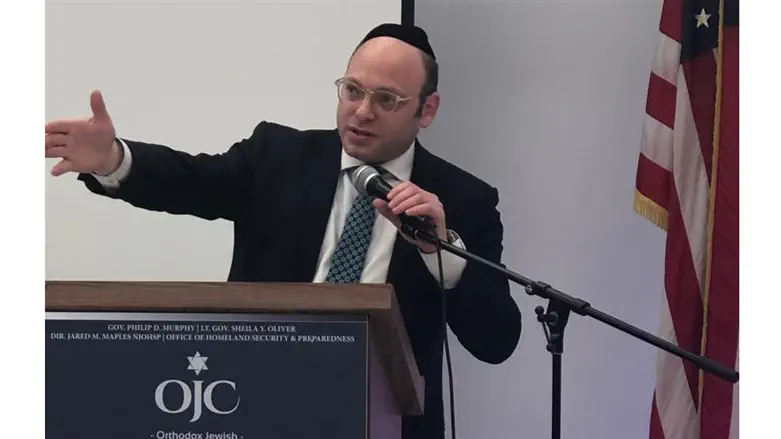
Duvi Honig is Founder & CEO of the Orthodox Jewish Chamber of Commerce and Secretary & Co-Founder of the Multicultural Business Coalition
As this article is being written, nobody truly knows what tomorrow will look like.
Will the war with Iran expand further? Will the Middle East spiral into a broader regional conflict? Will more countries become directly involved? Will civilians once again find themselves searching for safety, bomb shelters, or ways to flee danger zones?
The uncertainty itself is the story.
For decades, much of the modern world operated with the assumption that stability was permanent. The Western world convinced itself that technology, military alliances, democratic institutions, and scientific advancement had created a predictable future. Flights operated normally. Financial markets expanded. Borders remained open. Most people built their lives believing tomorrow would look very similar to today.
Then COVID-19 shattered that illusion overnight.
The entire world stopped at once. Airports closed. Businesses collapsed. Families were separated. Governments imposed restrictions that would have sounded unimaginable only weeks earlier. Humanity suddenly realized how fragile modern civilization truly was.
Before the world could fully process that shock, October 7 arrived.
Israel - one of the world’s strongest and most advanced democracies - experienced one of the deadliest terror attacks in its modern history. Entire communities were devastated. Families were massacred. Children were kidnapped. The illusion that advanced intelligence systems, military power, and modern infrastructure could guarantee complete safety was broken in a single day.
Now the growing confrontation with Iran has taken that uncertainty to an even deeper level.
For Israelis, the reality of uncertainty is no longer theoretical. Parents put children to sleep not knowing what sirens may sound during the night. Families discuss where the nearest shelter is located. Flights are canceled. Daily routines are interrupted. Every headline carries the possibility of escalation.
But this moment is not only an Israeli story.
It is a global wake-up call.
What many people once believed could never happen is now unfolding in real time across the Western world. Nations that proudly spoke about democracy, freedom, and shared Western values increasingly appear divided, hesitant, and politically paralyzed in the face of radical extremism.
Across Europe especially, demographic and ideological shifts are dramatically reshaping political systems. Countries that once stood firmly beside the United States and Israel now face growing pressure from political movements and extremist voices openly hostile toward Western alliances and values.
History itself seems to be turning upside down.
Countries that once persecuted Jews for refusing to abandon their faith are now struggling with threats from entirely different forms of extremism within their own societies. Governments that once projected confidence and moral clarity now often appear fearful of confronting radical ideologies directly because of political pressure, electoral concerns, or social unrest.
Who would have imagined ten years ago that some Western nations would hesitate to fully support efforts to confront Iran’s nuclear ambitions and terror networks?
Who would have believed that democratic societies would increasingly punish moral clarity while rewarding political weakness?
And who could have imagined how quickly the world order that many assumed was permanent could begin to crack?
But perhaps the deepest lesson of all is not political.
It is spiritual.
Humanity spent decades placing enormous faith in governments, economies, institutions, technology, and science. Society increasingly viewed human achievement as the ultimate source of security and certainty.
Recent years have exposed how fragile all of those systems truly are.
-A virus disrupted the entire planet.
-A barbaric terror attack changed the Middle East overnight.
-A regional war now threatens global stability.
Financial markets fluctuate wildly based on a single military strike or diplomatic statement. Entire nations alter policy overnight. Flights stop. Economies shift. Supply chains break. Fear spreads instantly across continents.
Everything people believed was stable suddenly appears temporary.
That realization is deeply uncomfortable - but perhaps also necessary.
The uncertainty we are living through is forcing humanity to confront an uncomfortable truth: we are not fully in control.
For religious people, this is not a new idea. Judaism has always taught that no human system is absolute and that ultimate control belongs only to the Almighty. Throughout history, Jews repeatedly experienced how quickly stable societies can change, how rapidly governments can turn, and how dangerous it becomes when people place blind faith in political systems alone.
The Orthodox Jewish Chamber of Commerce has long worked to build bridges between communities, government, and business leaders while advocating for religious freedom, stability, and moral clarity in public life. But moments like these remind all of us that economic success, political influence, and technological advancement alone cannot guarantee security or peace.
This message is not only for Jews.
It is a message for humanity.
The modern world became intoxicated with the belief that human progress alone could eliminate insecurity, suffering, or instability. Many began viewing faith itself as outdated - something unnecessary in an age of artificial intelligence, scientific breakthroughs, and global institutions.
Yet the events of recent years have reminded the world that no amount of technological advancement can eliminate human vulnerability.
The illusion of total certainty has been shattered.
And perhaps that is exactly the wake-up call humanity needed.
Not to live in fear - but to live with humility.
To appreciate freedom instead of assuming it is guaranteed.
To value moral clarity instead of sacrificing it for political convenience.
To understand that peace and stability are blessings, not permanent entitlements.
And to remember that while governments, economies, alliances, and military powers all matter, none of them are ultimate.
As Israelis once again live through sleepless nights and an uncertain future, the lesson reaches far beyond the Middle East.
This moment is reminding the entire world that civilization itself is more fragile than many were willing to admit.
Perhaps the uncertainty of this era is forcing humanity to rediscover something essential that comfort and prosperity caused many to forget:
That true security does not come only from human power.
It also comes from faith, humility, morality, and recognizing that ultimately, there is a higher power guiding history beyond anything mankind can fully control.