
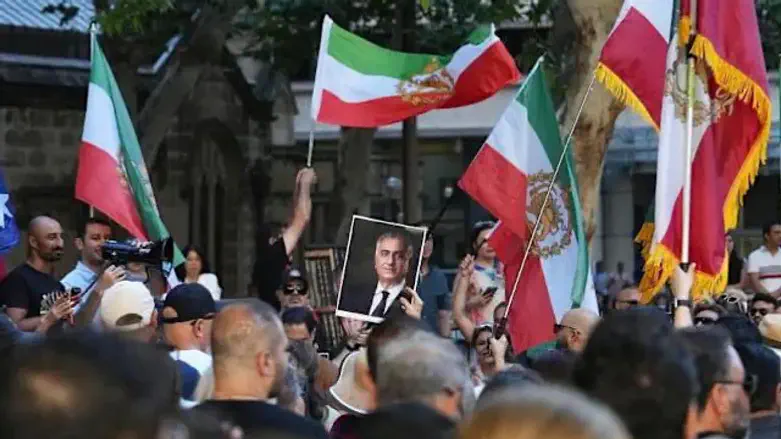
This Sunday, Iranians across the world will gather in major cities including Los Angeles, Berlin, Toronto, Paris, Stockholm, Dallas, Amsterdam, Geneva, Vienna, Brussels, Tokyo, Dublin, and Seoul to raise their voices for a nation that has been silenced within its own borders. These gatherings are not ceremonial demonstrations or symbolic acts detached from reality. They are the political and moral continuation of a national struggle taking place inside Iran itself a struggle between a brutal religious dictatorship and a wounded nation seeking survival, dignity, and freedom.
At a time when the Islamic Republic has transformed Iran into one of the most heavily repressed societies in the world, these demonstrations carry extraordinary significance. For nearly three months, the regime has ruled the country like a dark prison. Internet access has been severely restricted, journalists have been silenced, political dissidents have disappeared into prisons, and executions continue with terrifying speed. The ruling establishment does not govern through legitimacy, national confidence, or public consent. It governs through fear, intimidation, torture, censorship, and violence.
The world must understand an essential reality: millions of Iranians inside the country can no longer freely express themselves. Speaking openly against the regime leads to arrest, torture, or execution. Families whisper inside their own homes. Mothers fear phone calls in the middle of the night. Young people live under constant surveillance by a paranoid state that views every independent mind as a potential enemy. Under such conditions, the responsibility of speaking for Iran has increasingly fallen upon Iranians living abroad.
This is why the global demonstrations matter so profoundly. Every Iranian marching peacefully in Berlin, Paris, or Washington represents countless others in Tehran, Shiraz, Mashhad, Tabriz, and Isfahan who are unable to protest without risking death. The rallies abroad are not separate from the resistance inside Iran; they are its international voice.
The events of January 2026 exposed the true nature of the Islamic Republic more clearly than at any moment in recent history. Peaceful demonstrations demanding basic human dignity were answered with bullets, mass arrests, and systematic slaughter. Tens of thousands of innocent civilians were reportedly killed by security forces and armed gangs loyal to Ali Khamenei.
Streets turned into battlefields. Universities became militarized zones. Hospitals were monitored by intelligence officers searching for wounded protesters. The regime behaved not as a government confronting civil unrest, but as an occupying force waging war against its own people.
This national trauma has fundamentally transformed Iranian society. Across the country, many citizens have reached a psychological point of exhaustion and despair unprecedented in modern Iranian history. One of the most painful realities emerging from private conversations and social media is that many Iranians openly say they would rather endure instability, conflict, and uncertainty than continue living under the rule of the Islamic Republic. Such a sentiment reveals the catastrophic collapse of legitimacy facing the ruling establishment.
No normal society reaches such a conclusion unless it has suffered unbearable humiliation, repression, corruption, poverty, and hopelessness for decades. Millions of Iranians now see the regime not merely as an ineffective government, but as the central source of national destruction. A ruling system that forces its own people to pray for its collapse at any cost has already lost its moral foundation.
The Islamic Republic has spent more than four decades exporting extremism abroad while systematically destroying the social, economic, and cultural foundations of Iran itself. Billions of dollars have been wasted on proxy militias, ideological expansionism, nuclear ambitions, and terrorist networks across the Middle East while ordinary Iranians struggle with inflation, unemployment, addiction, collapsing infrastructure, and despair. Entire generations have watched their futures disappear under the rule of a corrupt religious oligarchy that speaks endlessly about morality while governing through violence and fear.
The tragedy unfolding in Iran today is not only political; it is civilizational. One of the world’s oldest and richest cultures has been reduced to a suffocating security state controlled by aging ideologues terrified of their own population. The regime fears women refusing compulsory hijab, students demanding freedom, workers demanding unpaid salaries, journalists carrying cameras, and grieving parents asking why their children were murdered in the streets.
That fear explains the executions. That fear explains the internet shutdowns. That fear explains the endless arrests. And that fear explains why the regime responds to peaceful demonstrations with bullets instead of dialogue.
At the same time, the growing unity among Iranians abroad has begun to create a new political momentum centered around national solidarity and the rejection of ideological extremism. In recent years, Crown Prince Reza Pahlavi has increasingly emerged as a unifying figure for many Iranians seeking a democratic and secular future beyond the Islamic Republic. Whether inside Iran or across the diaspora, many citizens now view him not simply as a political personality, but as a symbol of national continuity, stability, and transition beyond the current system.
The significance of these global demonstrations therefore extends far beyond ordinary political protest. They represent the collective voice of a nation demanding to be heard after decades of repression and silence. They also expose the complete moral bankruptcy of a regime that has lost not only international credibility, but increasingly its own society.
The free world must recognize that the Iranian people are not asking for charity or symbolic statements. They are demanding recognition of a simple truth: an entire nation has effectively been taken hostage by a violent ideological regime that survives through repression alone.
History will remember these demonstrations. It will remember the Iranians who marched peacefully across the world while their compatriots suffered under executions and censorship at home. And it will also remember which governments chose to stand with the Iranian people and which continued offering legitimacy, negotiations, and political oxygen to one of the most repressive regimes of the modern era.
Despite censorship, prisons, executions, and violence, the voice of the Iranian nation continues to rise. From Tehran to Toronto, from Shiraz to Stockholm, from Isfahan to Los Angeles, millions of Iranians are sending the same message to the world:
Iran does not belong to the Islamic Republic. Iran belongs to its people.