
Randy Settenbrino is a writer, artist, and public intellectual whose work bridges theology, philosophy, and psychology. He is a passionate advocate for Israel and Jewish-Christian solidarity, and the founder of the Historic Blue Moon Hotel-recognized by National Geographic as one of the 150 most unique projects in the Western Hemisphere. A father of IDF soldiers, Torah scholars, and holy daughters, his work is devoted to truth, faith, and cultural restoration.
Mine is a voice formed through lived experience, grounded in confrontation rather than speculation. My voice was removed from a panel meant to address that reality. I survived the SJP cancellation effort only to be removed by the ADL, which is supposed to defend Jews from experiences like mine, from another panel meant to discuss those realities. In that irony, I found myself in company with Kahane. No informants necessary.
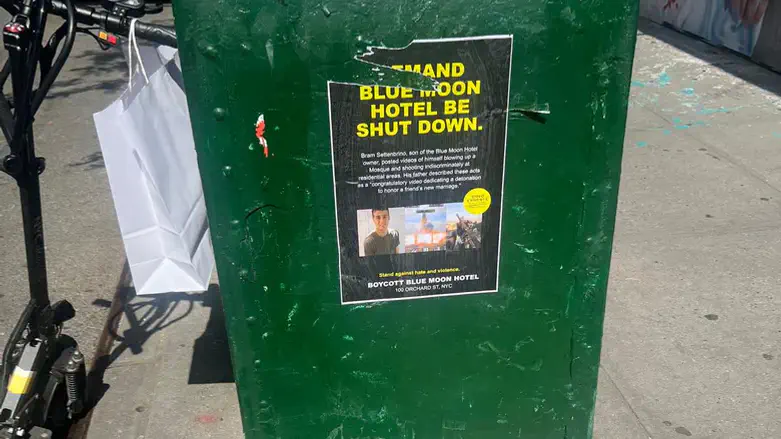
The Historic Blue Moon Hotel after anti-Israel agitators marked the property during a coordinated harassment campaign. What institutions discussed in conference halls, some of us lived at our own front doors.
The Federation and the ADL continue to act in dissonance with reality. For decades, they mistook access, prestige, and political proximity for communal responsibility. They opposed Rabbi Meir Kahane while he confronted threats at personal peril and expense.
Meanwhile, highly paid Jewish institutional leadership presided over religious decline and treated growing dangers as public-relations problems, responding with passivity instead of resolve and force. They aligned themselves with ideology over covenant, politics over faith, and institutional acceptance over Jewish continuity.
Conferences are convened, panels assembled, statements issued. Yet when hostility arrives, the most visible and vulnerable Jews stand alone. The Jew in the arena, confronting threats, is opposed not only by adversaries, but by the institutions claiming to represent him. Organizations built on diplomacy and consensus are uncomfortable with messages rooted in Jewish pride, self-defense, and confrontation.
We have reached a point where consensus should demand change in our institutions, party affiliations, and in my opinion, willingness to engage in civil disobedience when necessary.
Yet stagnation remains, and voices disturbing institutional comfort are removed.
Elise Stefanik, a Christian Zionist and political figure I admire, was scheduled to speak at Temple Emanu-El. Her appearance was canceled, and whether from pressure, fear, or avoidance of controversy, the message was unmistakable.
Comfort, accommodation, and the need for approval eroded the confidence that once sustained Jewish identity.
Silencing voices or retreating when new strategies are required invites shame, emboldens predators, and alienates the next generation.
Compare that with seventy years under America’s most powerful Jewish institutions. With vast resources and influence, one might have expected a renaissance of Jewish identity.
Intermarriage soared. Jewish literacy collapsed. Entire generations grew distant from their identity. Some now support movements hostile to Israel.
Where oppression failed, institutional complacency succeeded.
For me, being the child of an inner-city mixed marriage left me far from the illusions of suburban Jews. My radar detected antisemitism crouching beneath the surface, whether through confidences or direct confrontation. Experience strips away illusion. I learned early that failure to push back becomes complicity and invites aggression.
My grandmother, Ida Turkenich Smiloff, was one of only two survivors of a pogrom. My grandfather, Abe Smiloff, came from the pogrom-ravaged town of Chern Jenya. Their world taught them what happens when hatred is normalized and Jews stand alone.
I knew my Jewish grandparents, pogrom refugees who escaped with little or nothing. There was distance between us. We lived in southeast Brooklyn, they in the western reaches of the borough. Not far, yet far enough. Life intervened, and we were seldom together. We sensed their character and goodness from a distance, more felt than lived. Born in the late 1800s under the Russian Empire, they carried the weight of a world where violence against Jews was normalized by populace and state.
That pattern has not disappeared. It has changed form.
Across the Atlantic, it is emerging again, and it does not bode well for North American Jewry.
The seeds of genocide are no longer sown by czars or Nazis alone, but by new forces that an institutional Judaism is unwilling to face with the strength of a threatened people.
When the ADL, the Federation, and elements of the Reform movement align with policies antithetical to Torah and Jewish continuity, it becomes a Purim spiel.
When Jewish law is bent to serve progressive goals, it becomes a Passover farce, with self-loathing Jews reciting from a Haggadah glorifying Egypt and condemning Israel.
Arthur Szyk’s depiction of the Wicked and Simple Sons from the Four Sons of the Haggadah.
The American Exodus began in the aspirations of the Ivy League halls, where we grew polished yet naked and bare. We ourselves became the Pharaoh who does not know Joseph and the four sons, fractured in spirit: one wise, one wicked, one simple, and one who no longer knows how to ask.
Who cultivated the wicked son, writhing in self-contempt and standing with our enemies?
Who raised the simpleton, emptied of spiritual literacy, no longer able to formulate a question?
Why be Jewish?
Where are we in America if we no longer know, or no longer care, why we are Jewish at all? What have we gained from our golden calf universities? Our degrees, positions, and status drift toward the abyss, not only because of hatred, but because we have become a people rich in knowledge yet impoverished in spirit, literate in the world and illiterate in our own inheritance, failing to pass on the spiritual gold our ancestors placed at our feet.
“My people are destroyed for lack of knowledge." - Hosea 4:6
Material success is exalted. Assimilation is mistaken for safety. Identity is cast aside, while those who endure do so only by standing unapologetic, unbowed, and proudly Jewish.
If 14 percent of young adults are anti-Zionist and another 18 percent remain undecided, even as we are under siege, we are not drifting, we are inviting catastrophe.
“I spoke to you persistently… but you did not listen." - Jeremiah 7:13
There are Jews within institutions, and Jews on the front lines.
You learn the difference when a yarmulke makes you a target, your business becomes a symbol, and threats arrive in the middle of the night.
Following an FBI investigation, Donovan Hall was arrested and later convicted for sending hundreds of threats to the Historic Blue Moon Hotel and the Settenbrino family, including antisemitic messages and threats of violence.
Institutional Jewish leadership failed to resist the erosion of Judaic values, leaving many Jews with little worth defending and bringing us to this defining moment. The ADL moved in lockstep with Democratic Party activism, including support for Kamala Harris, a danger to both Israel and American Jewry, while disparaging figures like Charlie Kirk and refusing to attend an EU conference on Antisemitism because of the attendance by AFD - Alternative for Germany despite their stance of removing Islamist threats and support for a Judeo-Christian alliance and Israel.
The ADL seems to forget that German Jews were more German than we are American. The Nazis were National Socialists, socialist being the operative word. The Munich massacre and the Entebbe hijacking likewise revealed that antisemitism and anti-Israel fanaticism also emerged from revolutionary far-left ideologies. Sound familiar?
The ADL, ancillary to the DNC, aligned itself with the SPLC, Southern Poverty Law Center, and the ACLU, organizations defined by political bias, selective outrage, and tolerance toward anti-Israel activism while aggressively targeting ideological opponents on the Right. Who does this serve?
Abortion rights, transgender ideology, gender politics, climate absolutism, mass illegal immigration, open borders, détente with Iran, and forced vaccinations may be defining priorities for some, but they become secondary when your people face an existential threat and Israel remains the historic fortress and sanctuary of the Jewish people.
Christian Zionists have proven to be reliable allies. Our shared convictions are rooted in patriarchs and prophets, not in the erosion of identity into a liberal creed. A confident Jew does not fear alliances with faith-based communities, but welcomes those whose values strengthen belief, continuity, and civilization itself.
Political leadership cultivated a generation more fluent in grievance than civilization. Billions in taxpayer funds were funneled to activist networks and infrastructures that helped create and coordinate the mayhem across America: Antifa-style disruption, Black Lives Matter and the explosion of Free Palestine chaos blurred the line between protest and open hostility and violence.
These funding pipelines extended beyond the United States through agencies such as USAID and massive EPA-linked disbursements, increasingly portraying Israel as a pariah state and normalizing Jew hatred across the West.
What emerged was an interconnected activist infrastructure rooted in social destabilization and the normalization of antisemitism. The Biden administration’s last-minute diversion of roughly $20 billion through EPA-linked channels into activist organizations was a bureaucratic putsch, funneling public money through eight entities into divisive causes destructive to American cohesion.
Should this be the party of American Jewry, of the ADL and the Federation? The last two Democratic administrations helped cultivate a climate that targeted Jews and demonized Israel. The bitter irony is that many Jews voted for the very governments under which being openly Jewish became a liability.
Western institutions, media, and political elites treated Israel as a burden rather than a frontline ally. The result is unmistakable: Judaism is increasingly viewed as an affliction, Jewish communities are openly targeted, and many are losing confidence in their security and continuity as American citizens.
These conditions are the consequence of entrusting our future to feckless institutions and political movements that cultivated the forces burdening Jewish life with harassment, intimidation, unrest, and terrorist attacks. The same institutions that sidelined the Trump administration, viewed by many Jews as restoring stability and deterrence, instead favored the Obama and Biden administrations, whose policies empowered Islamist actors, pursued détente with Iran’s theocratic regime, and accelerated funding toward organizations radically subversive to American values and bent on dismantling the U.S.-Israel alliance.
Jews who cannot distinguish between a democracy defending itself and movements openly aligned with fanaticism have already drifted into the enemy encampment. Historically cultures that lose the ability to counter mounting threats, anarchy follows.
Canada, once regarded as among the gentlest and most orderly societies in the West, now leads North America in antisemitic threats and violent incidents, a collapse made possible by Justin Trudeau’s socialist political agenda, unimaginable under Stephen Harper’s conservative government.
Biden’s indulgence of the agitators and refusal to confront them accelerated the radicalization seen across universities and violent activism. The new theaters of revolution survive only through institutional indulgence and would not endure under a Trump administration. In 2019, President Trump signed an executive order applying Title VI of the 1964 Civil Rights Act to antisemitic discrimination, extending federal protections to Jewish students facing harassment on campus. His administration also pursued investigations and legal pressure against universities accused of tolerating or enabling antisemitic activity. More recently, investigations into New York City’s Department of Education revealed antisemitic ideological influence within schools and growing ideological indoctrination
The truth is beginning to emerge, like light breaking through the shadows of Plato’s cave.
Canadian Jew hatred signals a contagion crossing borders, moving left from Canada into the American Left and, ultimately, into the next DNC administration in the United States; American Jewry will face grave repercussions. Let history be our guide: we are moving toward a fanaticism that threatens the stability of the United States itself and will leave us in a more vulnerable position than most could imagine.
If it is not self-evident by now that parts of the Democratic establishment are struggling with a serious and growing antisemitism problem within activist, academic, and ideological factions aligned around it, then many Jews have become dangerously desensitized to what is unfolding around them.
The hour is too late for vanity alliances, reflexive partisanship, and tribal political loyalty. Jews must move in a more unified direction, willing to reassess old affiliations with honesty and sobriety.
Many Christians on the Right have shown greater willingness to confront antisemitism, Islamist extremism, and to combat the abandonment of Israel than institutions created for Jewish defense. Survival has always demanded collective responsibility and the courage to act before history repeats itself.
We are past “Never Again."
Now it is “Now or Never.
Randy Yisroel Settenbrino is a writer, artist, and public intellectual whose work bridges theology, philosophy, and psychology. He is a passionate advocate for Israel and Jewish-Christian solidarity, and the founder of the Historic Blue Moon Hotel, recognized by National Geographic as one of the 150 most unique projects in the Western Hemisphere. Founder of Ohr Chodosh L’Zion, a cultural and spiritual initiative dedicated to restoring Jewish identity, courage, and moral clarity through the fusion of art, history, and living faith. His newest release on Amazon is Between the Altar and the Sanctuary: The Life, Faith, and Fire of Rabbi Meir Kahane.