
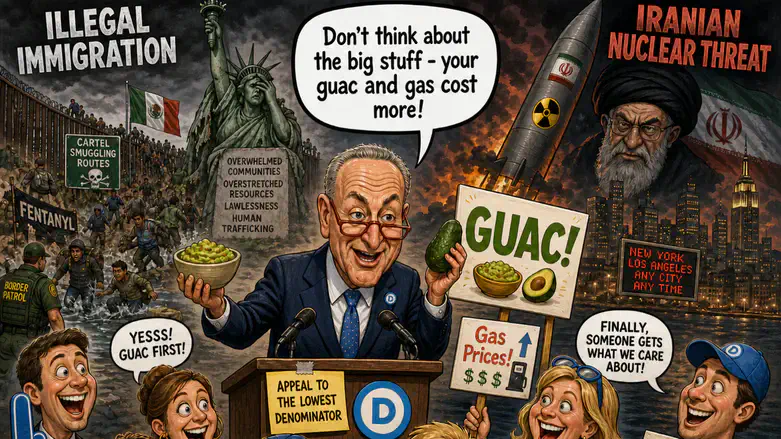
That is not just a joke about Chuck Schumer’s awkward Super Bowl guac routine. It is a window into an entire political method. Faced with large questions - sovereignty, border security, national leverage, energy independence, Iran’s nuclear ambitions, and the long-term survival of American deterrence - Democrats increasingly respond by shrinking the moral universe. They take issues of national consequence and miniaturize them into consumer irritations.
Economic leverage over Mexico shrinks to the price of guacamole. Nuclear blackmail shrinks to the price of gasoline. Forty-seven years of Iranian aggression shrinks to a lawyerly debate over whether the latest threat was “imminent" enough.
This is not policy. It is demagoguery by infantilization.
Schumer’s now-infamous guac routine was a perfect artifact of the genre. In February 2025, he warned that Trump’s tariffs would raise the price of beer and guacamole for Super Bowl parties because avocados, limes, and Corona come from Mexico. “It’s going to affect your guac," he said, as if he had discovered the Rosetta Stone of working-class pain.
But what did that performance actually communicate? Not seriousness. Not concern. Not leadership. It communicated contempt. It assumed that Americans could not be asked to think about tariffs as tools of national leverage, or about why a president might use economic pressure against Mexico over border security, fentanyl trafficking, cartel power, illegal migration, trade dependence, industrial policy, and the terms of American economic independence. No, the issue had to be brought down to the lowest possible emotional denominator: your dip may cost more this weekend.
That is not speaking to citizens. That is speaking to appetites.
There is something deeply patronizing in this style of politics. Democrats often present themselves as the party of sophistication, compassion, expertise, and moral nuance. Yet their actual appeal to voters is frequently childish and short-sighted: What hurts right now? What costs more this minute? What can we blame on Trump before anyone asks a larger question? There is no delayed gratification. No call to sacrifice. No invitation to think beyond the immediate sting. No appeal to adult citizenship. The voter is treated less as an adult member of a republic than as a consumer standing in front of a supermarket shelf, irritated that the avocado is pricier than last week.
The contrast with real leadership could not be sharper. In Britain’s darkest hour, Churchill did not tell his countrymen that war would be easy, cheap, emotionally validating, or good for household convenience. On May 13, 1940, he told Parliament that he had “nothing to offer but blood, toil, tears and sweat." He spoke of “many, many months of struggle and suffering." A month later, with France falling and Britain nearly alone, he spoke again not to their panic but to their resolve, calling them to make that hour their finest.
Churchill did not infantilize his people by capitulating to the tyranny of the least common denominator. He summoned them. He spoke to the best in them, and they responded with the best in themselves.
That is what serious leadership does. It does not flatter the public’s immediate discomfort. It disciplines it. It tells people the truth about danger, cost, endurance, and consequence. It says: yes, this will be hard. Yes, you will feel it. Yes, the price may be real. But there are things worse than cost. There are humiliations worse than sacrifice. There are futures far darker than temporary hardship.
Democrats increasingly do the opposite. They do not ask Americans to rise above the moment. They trap them inside it.
The Iran debate shows the same pathology in a more dangerous form. Gas prices are painful. Nobody serious should pretend otherwise. But when the United States is in an existential confrontation to prevent Iran from acquiring nuclear weapons, the first question cannot be whether the average American is paying more at the pump this week.
As of May 3, 2026, AAA put the national average for regular gas at $4.446 per gallon. That is high, but still below the Biden-era record of $5.016 reached on June 14, 2022. Yet during the Biden years, when administration policy was broadly hostile to fossil-fuel production, pipelines, drilling confidence, and energy abundance, Democrats and their media allies treated high prices as complicated, global, unavoidable, or unworthy of sustained moral outrage. Now, a mere eight weeks into a war whose purpose is to prevent a terror regime from gaining nuclear leverage, they have suddenly rediscovered the suffering of the motorist.
How convenient. How pathetic.
Gas prices matter. But they do not matter more than nuclear blackmail. They do not matter more than the possibility of a bomb in New York or Los Angeles. They do not matter more than the collapse of American deterrence. They do not matter more than teaching every terror regime on earth that if it can make Americans pay another dollar at the pump, the Democratic Party will race to the nearest microphone to declare American failure and demand retreat.
That is the real issue. Not whether gas hurts. It does. The issue is whether Democrats believe any national objective is worth enduring discomfort for. Increasingly, their answer seems to be no - unless, of course, the discomfort is being imposed by their own climate agenda, their own regulatory state, their own spending, their own border ideology, or their own moral experiments. Then sacrifice is noble. Then the costs are investments. Then the pain is the price of progress. But when the cost is attached to stopping Iran from becoming a nuclear terror empire, suddenly every gallon of gas becomes a moral emergency.
There are moments when opposition parties should oppose. That is healthy. But there are also moments when a serious opposition understands that it is still part of the country. Preventing Iran from obtaining nuclear weapons should not be a government-versus-opposition issue. It should not be Trump’s issue, or the Republicans’ issue, or Israel’s issue alone. It should be an American issue. It should be a civilizational issue. It should be one of the few remaining questions on which a sane political class can say: we can fight about taxes, judges, spending, and elections tomorrow. Today our different fingers forge into one fist to make sure the world’s leading terror regime does not get the bomb.
But Democrats find that increasingly difficult because Trump hatred has become the solvent that dissolves every larger thought. If Trump supports a policy, the policy must be recoded as reckless, fascistic, corrupt, stupid, or dangerous. If Trump uses tariffs as leverage against Mexico, the question becomes guacamole. If Trump acts against Iran, then Iran’s nuclear program somehow becomes less alarming than Trump’s personality. If Trump tightens the border, the border crisis becomes theater. If Trump takes military action, the big question becomes the gas pump. The hatred does the work that a policy vision once might have done.
This is how a party becomes small. It does not merely lose elections or misread polls. It loses the ability to speak in large terms about large things. It loses the ability to call citizens to adulthood. It forgets how to say: endure this now so that all of our children inherit something better. It forgets, or ignores, how to distinguish between inconvenience and catastrophe.
So it reaches for guac.
It reaches for the cheap image, the childish hook, the consumer complaint, the momentary irritation. It tells Americans that the price of avocados is the real measure of whether the United States should use its economic power to pressure Mexico, and that the price of gasoline is the real measure of whether Iran should be allowed to hold the civilized world hostage.
Churchill spoke to a frightened people as adults, and they became larger under the summons. Schumer speaks to Americans as if they are children at a Super Bowl party, worried that the dip might run short.
That is the difference between leadership and demagoguery. One calls a nation upward. The other hands it an avocado and hopes it forgets the future.