
In aftermath of the stabbing attack in Golders Green, Jewish leaders in England, both secular and religious, appeared throughout the media with a similar response - the hitherto silent Jews of Great Britain must speak out to the British Government in protest against the lack of security for England’s Jewish population.
Appealing to the British Government to safeguard the country’s Jews against the increasing anti-Semitic violence is like a mother rabbit imploring a fox to guard her baby bunnies.
Let’s take a brief historic look at England’s interaction with the Jews.
Medieval Era
Beginning in 1095, the English Church, as part of the Roman Catholic Church at that time, was actively involved in the Crusades, both spiritually, practically, and financially. English bishops and abbots preached crusading and killing Jews as a holy duty. Sermons across England helped recruit crusaders. English clergy and nobles like Richard the Lionhearted participated in the mass murder of Jews. During the coronation of Richard I of England (Richard the Lionhearted), violence broke out against Jews in London. Jewish homes were burned; people were killed and forcibly baptized. Following this, the York Massacre claimed the lives of hundreds of Jews in 1190. In 1290, Edward I of England ordered the expulsion of all Jews from England. This ended organized Jewish life in England for centuries until readmission in the 1650s under Oliver Cromwell.
Modern Times
Before World War I, Palestine was still under Ottoman rule, but Zionist immigration had already begun. After Britain conquered Palestine during the war, it issued the Balfour Declaration in 1917, supporting “a national home for the Jewish people" in Palestine. While Lord Balfour and Prime Minister David Lloyd George were true friends to the Jewish People, opposition to the Declaration was widespread. The Declaration was not the result of a full parliamentary vote. It was a government policy statement, approved by a small War Cabinet during World War I. Interestingly, in a final debate on the issue a letter was read from the Chief Rabbi of “Palestine," Rabbi Avraham Yitzhak HaKohen Kook who was in London at that time. His words boomed out like a thunderous call from Sinai:
“We publically protest against those who rend the Jewish soul, against all those who want to dissolve the wonderful wholeness of Jews and Judaism. With the sacred power of Jewish wholeness, we protest against the traitors, informers, and purveyors of empty talk of all types. We demand all that is ours, from all of our brothers, and from all of the civilized world.
“We demand all that has been robbed from us. The injustice that cries to Heaven must be completed righted. Our holy, precious, splendid Land, our pride, our human rights, and our human dignity, our civil and national rights in all countries must be returned to us entirely - without compromises - without flatteries - entirely!
“The time has come when all those who have disrupted, or whose ancestors have taken part in the disruption of our Nation and Land will have to turn back from their terrible ways, and as redress for their horrible delinquency, they will have to provide us, in every possible way, with all of the means to return and rebuild the destroyed House of Jacob, and to established its ruined dwelling in its full splendor.
“We must explain to all of the warring mankind their obligation towards us. We have given so much to humanity. We have given life to human morality. Our spiritual possession lives in the essence of civilized religions. We have saved civilized man, on the one hand, from dark enslaving paganism, and on the other hand, from a weak, anemic, dead abandonment of God. Our wonderful and purely Divine history was and will remain the basis for the purest in man’s spirit, out of which all of mankind’s refinement developed.
“And the nations paid us back very handsomely - by robbing our Land, by expelling us from it, by burning and destroying our sanctuaries, by massacres, by cruelty, by searing us, by burning us at the stake, by yellow badges, by calling Hep! Hep! after us on the streets, by banging nails into our heads, and by a great many more good deeds like these, and by all types of false and inhuman libels and plots, all at the same time that their entire spirituality is founded in our living, holy, fountain of life, and they enjoy wholeheartedly our glorious accomplishments.
“And now that we apparently are finally at the end of the war, after the terrible injustices of the nations have ruined all that was good and peaceful, at a time when the earth is shaking and trembling from its weighty sins, at a time, when national ideologies and the thrones of kings are destroyed, at a time when mankind is hoping to be redeemed with eternal salvation through the blood of this present horrible war, at a time when the cruel human suffering has ignited a holy spark in peoples’ hearts, and they dream that the future after the war will bring a new and much better life than what was before; a life of honesty and justice, so exemplary, that it will be worth all the rivers of blood spilt for it.
“Do we not then, in this awesome, wondrous, holy time, have the great obligation to inform all of mankind, and, above all, the civilized warring nations, that if the wrong of all wrongs remains on their heads, if they do not purge themselves of the murder and robbery they committed against us, then they are bringing greater wretchedness upon themselves than the misfortune they inflict on us?! The cry to heaven of the robbery of our Land will negate all of mankind’s aspiration and will bring even worse upheavals in its wake.
“But, on the other hand, if the results of the war will bring, together with all righteous corrections, our return, and if the nations will set right this horrible crime and help us organize our full lives, give us back our Land, allow and help us to develop our kingdom, let us renew and develop in peace our ancient, tranquil, heroic, peaceful, material, holy, and regular lives, then will the disgrace of the world be removed from the society of mankind.
“The pettiness of those who want to split the completeness of our splendid life into pieces, tearing off a part here and there, is not only treachery to Jews but also to all of mankind.
“Our hope is great that our holy and just cause will be understood by all foreigners, and by our own People, and may all of us together, all the ‘exiled of Israel’ actively and forcefully demand all that is ours; and may our voice be heard in all circles, to the joy and honor of the nations, and to our own exaltation and joy, for the speedy rebuilding of our Holy Land, our Nation, and our exalted holy spirit, which will become a beacon unto the nations, and a salvation for all the earth."
The Balfour Declaration was later incorporated into the international framework of the San Remo Conference of 1920 and the League of Nations Mandate for Palestine in 1922, giving Britain responsibility to facilitate Jewish national development while also protecting the civil and religious rights of non-Jewish communities.
In practice, however, Britain increasingly retreated from its pro-Zionist commitments. Under Arab pressure and imperial concerns, Britain began limiting Jewish immigration and land purchase. Originally, the Mandate territory included both sides of the Jordan River. However, in 1921-1922, Britain separated Transjordan (today’s Jordan) from the Mandate area designated for Jewish settlement: roughly 80% of the original territory was removed from Jewish settlement.
Arab Violence and British Response
Even with these sweeping concessions to the Arab cause, violence broke out against the Jews. The 1929 riots, including the massacre of Jews in Hebron and violence in Safed and Jerusalem, exposed the weakness and unwillingness of British protection. In Hebron, dozens of Jews were murdered, Jewish homes and synagogues were attacked. Conveniently, in most places, British reinforcements arrived too late to prevent the massacre.
Again, it is interesting to note the reaction of Rabbi Kook to this British betrayal. Learning about the Hevron massacre he fainted and collapsed to the floor. When he recovered he hurried off to confront the acting High Commissioner, Harry Charles Luke at the Government Palace, repeated the verse of Tehillim: “He will avenge the blood of His servants; and He will take revenge on His adversaries; and he will placate His Land and His People."
“I will not shake a hand which is stained with Jewish blood," Rabbi Kook bluntly told him. “I hold you responsible for this rampage of murder. The honor that the British nation had in helping the Jews is now sanguine with treachery and disgrace. I demand that you shoot the murderers!" Rabbi Kook exclaimed, glaring at the Jewish convert to Christianity.
“I have not received any orders to do so," Luke replied.
“I order you!" Rabbi Kook told him, raising his voice.
British commissions after the riots often treated Jewish immigration and land purchase as causes of Arab unrest, rather than focusing only on Arab violence. This pattern encouraged the Arab side to believe that violence could produce political concessions. The Arab Revolt of 1936-1939 was aimed against British rule and against Zionism, especially Jewish immigration and land acquisition. Britain suppressed the revolt militarily, but politically it responded by moving sharply away from the Mandate’s original Zionist purpose.
British Policy at the Western Wall
Under the British Mandate, the Western Wall became a focal point of tension between Jews and Muslims. While Jews had long prayed there, Britain adopted a policy of maintaining the Ottoman-era “status quo", which recognized Muslim ownership (as part of the Waqf of the Haram al-Sharif) and limited Jewish rights to access and prayer only, not sovereignty.
British authorities enforced rules that: prohibited bringing benches, chairs, or partitions (mechitzot) to the Wall; forbade blowing the shofar, especially on Yom Kippur; and limited Jewish prayer. These restrictions were meant to avoid provoking Muslim opposition, but were widely seen by the Jewish community as curtailing religious expression and denying national rights at Judaism’s holiest accessible site.
When Rabbi Kook appeared as a witness before the judges of the International Western Wall Commission he stated:
“What do you mean, ‘The International Commission will decide to whom the Kotel belongs?’ Does this committee, or the League of Nations, own the Kotel? The entire world belongs to the Creator - Blessed be He - and He proportioned the lands of the Earth to all peoples, bequeathing ownership of the entire Land of Israel, including the Kotel, to the Jewish People. No power in the world, not the League of Nations, nor the Empire of England, and not this Commission, can take this God-given right away from the Jewish People…
“Days will come when all nations will recognize our legitimate rights to the site of our Holy Temple," he proclaimed, raising his voice. “And everyone will know that the prophecy concerning this holy place - 'For My house will be called a house of prayer for all peoples’ - meaning the Third Temple, will be fulfilled only when that great and holy edifice stands once again in its rightful place, on the Temple Mount, in the possession of its original and rightful owners, the Nation of Israel, God’s eternal People, and not in the hands of any other nation - may it be soon!"
Peel Commission and Retreat from Partition
The Peel Commission of 1937 concluded that the Mandate had become unworkable and recommended partition into Jewish and Arab states. The Arab leadership rejected partition and demanded an end to Jewish immigration. Britain went along with the Arabs. This retreat signaled that Britain was increasingly unwilling to confront Arab opposition and increasingly ready to sacrifice Jewish immigration for imperial quiet. Instead of a small state, Britain moved toward no Jewish State at all.
The 1939 White Paper
The decisive blow came with the White Paper of 1939. Issued just before World War II, it limited Jewish immigration to 75,000 over five years, after which further immigration would require Arab consent. It also severely restricted Jewish land purchase in most of Palestine and rejected the idea that Palestine should become a Jewish state. This policy came at the very moment European Jewry was facing destruction by the Nazis.
Britain prevented many Jews from reaching Palestine before and during the Holocaust. Zionist groups therefore organized Aliyah Bet, illegal immigration by sea, to bring refugees despite British restrictions.
Wartime and Postwar Blockade
During and after World War II, Britain continued enforcing immigration restrictions. Holocaust survivors trying to reach Palestine were intercepted by the Royal Navy and often sent to detention camps, including camps in Cyprus. The most famous case was the Exodus 1947, carrying more than 4,500 Jewish refugees. British forces intercepted the ship near Haifa, removed the passengers, and sent them back toward Europe, creating worldwide outrage. Other ships capsized (or were sunk) and many Jewish lives were lost.
Britain repeatedly restricted Jewish immigration, limited Jewish land purchase, and abandoned earlier Zionist commitments. It seemed that Arab violence was rewarded while Jewish rights under the Mandate were weakened.
Crackdown on the Jewish Underground
As Jewish frustration grew, underground groups such as the Haganah, Irgun, and Lehi fought British rule and immigration restrictions. Britain responded with arrests, curfews, searches, executions, expulsion from the country, and major security operations. In Operation “Black Sabbath," in June 1946, British forces arrested Jewish leaders and searched Jewish institutions.
By 1947, Britain could no longer manage the conflict. It referred the Palestine question to the United Nations. The UN voted for partition in November 1947. Britain withdrew in May 1948, and the State of Israel was declared.
Failure to Rescue Jews During World War II
During World War II and the Holocaust, Britain was one of the principal Allied powers fighting Nazi Germany. While it helped defeat the Nazis, its efforts specifically aimed at rescuing Jews from the extermination camps were very limited.
Most damning, despite clear evidence of mass murder, Britain did not open the gates to Palestine as a refuge. It continued enforcing the White Paper of 1939. Even during the Holocaust, ships carrying Jewish refugees were turned away or detained. This policy closed off one of the only realistic escape destinations for European Jews.
Britain did allow some refugees into its own territory (the Kindertransport, which saved about 10,000 children), but there was no large-scale effort to evacuate Jews from Nazi-controlled Europe. Proposals to negotiate releases, expand visas, or create safe havens were largely rejected or delayed.
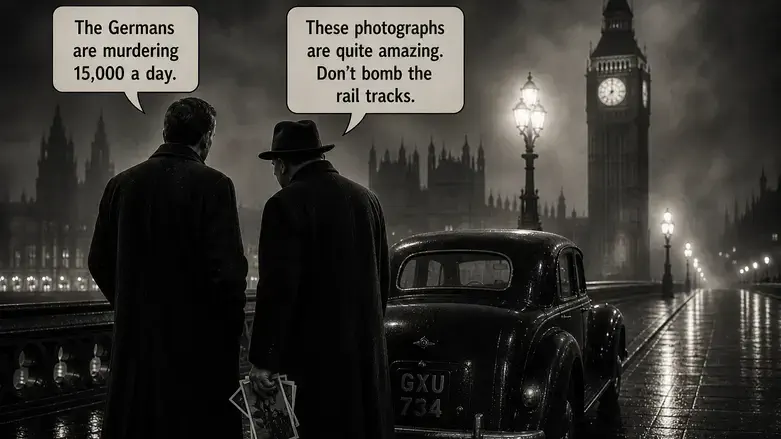
By 1944, the Allies had reliable information about extermination camps like Auschwitz. Jewish organizations urged Britain and the U.S. to bomb railway lines or gas chambers. Britain declined, arguing that military resources should focus on defeating Germany, and that such operations were not strategically justified or feasible.
Even late in the war, Britain intercepted “illegal" Jewish immigrants trying to reach Palestine. Many survivors were placed in detention camps including Cyprus after the war.
Additional Areas of British Policy
Beyond the Mandate period, critics point to several areas where the United Kingdom has taken positions viewed as unfavorable to Israel. In more recent times, Britain has frequently supported or abstained on UN resolutions critical of Israel, especially in the United Nations General Assembly and UN Human Rights Council.
Successive British governments have strongly opposed Israeli settlement activity, sometimes supporting labeling requirements or trade distinctions for goods produced beyond the 1967 lines. At times, Britain has restricted or reviewed arms exports to Israel during conflicts, citing legal or humanitarian concerns.
Furthermore, elements within British politics have supported recognition of a Palestinian state (e.g., the symbolic 2014 House of Commons vote), often framed as pressure on Israel in negotiations. While these actions are usually justified by Britain as part of international law or diplomatic balance, critics interpret them as disproportionately critical of Israel. Within civil society, movements such as Boycott, Divestment and Sanctions have had notable presence on university campuses, unions, and activist circles.
In light of England’s historical animosity toward the Jewish People and Israel, we must make it obvious to British Jewry that the good times in England have ended and that there is no future for Jews there.
In the immediate wake of the Holocaust, the world was embarrassed by the extent of the evil it allowed against the Jews. As if in repentance, Western countries left Israel alone to prosper, and most hid their antisemitism from view. That time of reprieve has passed, a new generation has arisen which doesn’t remember the Holocaust and to their progressive minds, antisemitism is the norm and the Jew is today’s evil white colonizer.
Hashem is calling us home. Several years before the outbreak of World War II, Rabbi Kook warned that if the Jews of Europe refused to hear the shofar of Redemption which calls out from the Torah and our Prophets of old, they would be compelled to hear the shofar of an impure beast. That shofar is once again blowing loudly in our ears. This time we must heed the call.