

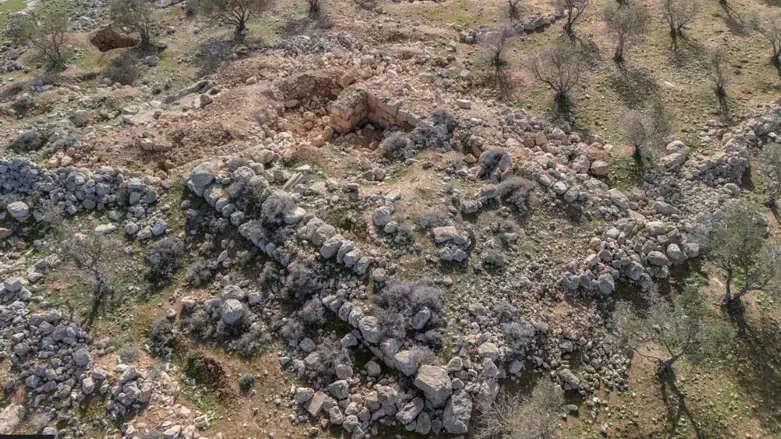
For hundreds of years, the location of the Jewish prophet Amos's burial has been a mystery.
Although the tomb was a significant pilgrimage site for Jews and Christians from the 4th century, security instability in the 17th century led to its abandonment, and its exact location was forgotten.
Now, a new study by archaeologist Michael Chernin and Israel Antiquities Authority photographer Shai Halevi claims to solve the mystery.
Contrary to popular belief, which places the tomb within ancient Tekoa in the Gush Etzion region, the researchers managed to prove that the site is two kilometers away, at a location referred to as "Qasr Antar." The identification is based on strict cross-referencing of descriptions by Jewish pilgrims in the 15th century, such as R. Isaac b. Alfara, who described a church built over an ancient burial cave, as well as aerial imaging and findings on the ground that match the historical descriptions of the building and cave.
The sources indicate that the site was continuously active for 1,300 years, until it was abandoned at the beginning of the 17th century.
The study, which began nearly a decade ago, has been reinvigorated in recent years due to the gradual destruction of the site. Antiquities robbers damaged the structure significantly, making Chernin and Halevi's documentation and conservation work critical to saving the historical heritage of the place.
The full details of the identification and archaeological findings will be revealed for the first time on Tuesday during the “10th Judea Research Conference," dedicated to the memory of Dr. David and Hannah Amit.
The conference is being held in cooperation with the Israel Antiquities Authority, Bar-Ilan University, KKL-JNF, and the Kfar Etzion Field School. During the event, and subject to approval by security authorities, a unique tour is expected to take place, offering the public a first glimpse of the site identified as the “Tomb of the Prophet Amos" and Tel Tekoa.